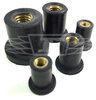
Rivnuts

Joined
28 Jul 2009
Messages
11,988
Reaction score
1,631
Location
Kent
Country
United Kingdom
I assume these are a fairly popular device these days. I've seen many of them in use but never seen them being installed.

I need to create some fixing points in in a thin sheet steel (or possibly ali) unit and as there is a reasonable expectation this is going to be opened a few times I'd rather not rely on self tappers.

My question is how much space is required behing the plate and are they installed only from the one side?
 
AIUI they are installed from one side. it's similar to how a pop rivit works, the tool pulls on the back of the rivet to deform it and fix it to the panel..

The difference is with a pop rivet the stem used for pulling breaks off. With a rivnut the tool does the pulling with a threaded bar which is unscrewed from the rivnut after installation.
 
AIUI they are installed from one side. it's similar to how a pop rivit works, the tool pulls on the back of the rivet to deform it and fix it to the panel..

The difference is with a pop rivet the stem used for pulling breaks off. With a rivnut the tool does the pulling with a threaded bar which is unscrewed from the rivnut after installation.
Looking at the pics of the tool bits I wondered if that'''s the case, how much space is required as the plate I'm working on has only about 10-12mm before the back. Think of it as a square tube.

I'm looking at M5 or could be M4 or M3 if it makes a difference.
 
When I fitted side steps to my Land Rover, they came with Rivnuts. I just used a 6mm bolt with a 6mm nut on it. Insert rivnut, wind nut fully on to bolt, screw bolt into rivnut, hold head of bolt with spanner, tighten nut towards rivnut until it will tighten no more. Job done.
 
these rubber things are also described as Rivnuts or rubnuts. Used in hollow aluminium sections exposed to wet, dirt and salt. Might be intended to avoid the galvanic corrosion when steel and aluminium meet.

Rubnuts.jpg

I have considered using them in a garden wall to hold a gate bar, with the idea that the rubber will absorb vibration.
 
these rubber things are also described as Rivnuts or rubnuts. Used in hollow aluminium sections exposed to wet, dirt and salt. Might be intended to avoid the galvanic corrosion when steel and aluminium meet.

I have considered using them in a garden wall to hold a gate bar, with the idea that the rubber will absorb vibration.

If those are what I think they are, they perform like a toggle fitting. You drill a hole to suit the smaller diameter of the 'nut' to make friction fit, push them in as far as the rubber shoulder, then tighten. The brass insert, as the bolt is tightened, causes the rubber the bulge out behind the panel, preventing the nut being pulled out. They only really work where the panel is an hollow one, with space at the back. The work much less well in a blind hole and the brass insert can sometimes become detached from the rubber.
 
possibly, but I've never needed to. The rubber should stop them falling out under their own weight. I had a couple missing which I will guess means they vibrated free when no screw in them. If they were under load it should make the rubber bulge and wedge into place.

They were to hold a long engine/gearbox undershield, and undone at every service/oilchange.
 
I haven't used them myself, but i'd imagine the depth required behind the panel is the length of the unsquished rivnut minus the thickness of the panel.

It looks like a M3 rivnut is about 10mm long.

A basic rivnut kit only seems to be about £30 from CPC https://cpc.farnell.com/laser/979/nut-riveter-40-nut-rivets/dp/TL16996
Yes thanks, I have seen that but being a skin flint I found a cheaper and whaT looks like a very inferior version on Ebay: https://www.ebay.co.uk/itm/14390864...tKQC6P9XQ8bUPckhsWV8|ampid:PL_CLK|clp:2047675
Potentially I'm looking at doing 16 inserts for this particular project and having never 'needed' them before I'm a bit reluctant to spend too much.
 
I use these a lot, i love them there great I think you need a bit more than the length of the rivet though, as the rivet screws on the tools thread and that thread protrudes through the end I think
Rs sell the rivets and the tool or you can buy a kit
Search AVK on Rs site, 4mm 5mm 6mm and 8mm plus for large holes you get a big flange or tight holes a small flange.
Plus ones for different thickness of sheet.
Bit dear though, if you need more info ask
https://uk.rs-online.com/web/p/thre...Qhn-tOCA_rdWMzNeyZRoC5aIQAvD_BwE&gclsrc=aw.ds

https://uk.rs-online.com/web/p/insert-kits/194310/
 
I'm a bit reluctant to spend too much.
For something a bit more cheap and cheerful, and a lot more forgiving on hole size and panel thickness, take a look at jack nuts.

featured-product-pop-jack-nut-placing-sequence.jpg


Same principle, just a lot less faff.
 
Bare in mind if you use them a flat sheet will not fit flat as the heads will make it stand off a fraction of a millimeter, if thats an issue
 

If you need to find a tradesperson to get your job done, please try our local search below, or if you are doing it yourself you can find suppliers local to you.

Select the supplier or trade you require, enter your location to begin your search.


Are you a trade or supplier? You can create your listing free at DIYnot Local

 
Back
Top