Why is it that American electrical items always look dangerous? Their socket outlets tend to have the terminal on the side and exposed unlike our stuff that has tunnels for the cables and enclosed screws!
Yes.
North American socket-outlets and switches, "approved" by the various "testing laboratories" (which is a requirement there, if one has any vague hope of collecting insurance if a device fails) MUST be tested and approved by such organisations.
This costs the "manufacturer" or supplier a significant number of dollars - for each device so "approved".
Of course, these "laboratories" (such as "UL") keep on approving devices with exposed side terminals, which (probably) would not be
allowed to be installed in any (other) OECD country if electrical devices were to be invented "today".
"our stuff that has tunnels for the cables and enclosed screws" and
is much safer and has less potential for "loose connections" than does the "flat underside" screws used in the USA to connect the "solid" wires required", because with "Tunnel Type" connectors one can bare down in the wire(s) concerned.
(I am biased, because all cables actually used in Australia - above 1 mm² - use "stranded" conductors.)
Between 10 and 20 years ago, the US regulators realised that they had a problem with "loose connections" and introduced a
requirement that electricians and others must use a "Torque Screwdriver", so that the screws concerned could be tightened to the "required" torque (which, although it is "officially" set in Newton.metres is usually referred to in Inch.Pounds - rather than N.m)
(Many sections of the US Government "public service" ARE trying to transit to SI, although many US politicians are still truing to "sabotage" any such efforts.)
A
requirement to use "Arc Fault Circuit Interrupters" (AFCIs) at the "Panel" for "protection" on certain circuits was also introduced, ostensibly because of "electric blanket" problems.
However, it was then realised that these AFCI devices were picking up many other faults, due to "loose connections".
So, the US regulators added more requirements for devices to trip/disconnect when faults were detected by these devices but did nothing to restrict/eliminate the devices which may have been causing the problems.
Meanwhile, because only ONE solid wire may be placed under these "side terminals" of the socket- outlets and switches, it is there necessary to use
other connectors, with "pig tails", if one needs to connect two or more conductors to the one terminal.
These other connectors are usually "screw on connectors" (commonalty called "wire nuts"), which are not allowed in Australia and I doubt that they are allowed in the EU (or the UK). (Please advise.)
These "wire nuts" are tightened by hand without the use of any tool and the adequacy (or otherwise) of any resulting connection cannot be determined !
Contrast this with
https://commons.wikimedia.org/wiki/File:Australian_Set_Screw_Connectors.jpg which (now) use transparent plastic and the quality of the connection can thus easily be determined.
However, Wago 221 and 222 connectors are available in the USA and are slowly gaining ground.
North America now goes on with increasing the use of AFCI devices, but with still allowing "Wire Nuts", and mandating the use of Ground Fault Circuit Interrupters (GFCI) (which are RCDs) in certain situations.
However, there it is still
allowed to place the GFCI at the first Socket-Outlet on the Radial concerned and it is NOT
required to place it at the Panel/CU, leaving the cable from the Panel/CU to the first Socket-Outlet "unprotected" for Residual Current faults.
(Yes, I do know that such "protection" is for the user/builder/uneducated operative and others but not related to "overload" of any "protection device" concerned.)
(Haven forbid that any one in the USA might need to go to the Panel/CU to reset any Breaker !)
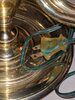
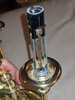
Whether it fits isn't the problem - those USA lampholders will be rated for 120V and therefore not suitable for use at 230V.
Maybe and maybe not.
Most US "lamp holders" and other such devices since WWII are usually rated above 120 V and (generally) in the 400 V to 600 V range.
This is because most of these devices
now come from China (which persons in the USA do not like to admit), where such devices are made for "world wide" distribution and making a sub-set of only 120 V rated devices is
not an economic option.



 PXL_20220408_191918383.jpg236.4 KB · Views: 257
 PXL_20220408_191846118.jpg385.9 KB · Views: 250
 PXL_20220408_191742946.jpg298.3 KB · Views: 236
 PXL_20220408_191735905.jpg224.4 KB · Views: 240
 PXL_20220408_191642287.jpg286.3 KB · Views: 224
 PXL_20220408_191609014.jpg210.6 KB · Views: 214
 PXL_20220408_191559602.jpg294.9 KB · Views: 232
 PXL_20220408_191545811.jpg215.2 KB · Views: 193
 PXL_20220408_190648151.jpg306.5 KB · Views: 231
 PXL_20220408_191531624.jpg156.8 KB · Views: 203


