EICR Failed, does the house need a rewire or issues can be rectified

Joined
1 Jun 2024
Messages
2
Reaction score
0
Country
United Kingdom
Hi
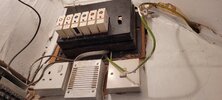
Recently done a EICR Test and a full rewire was recommend, the house is semi detached constructed in 1930 and the whole side of the house has been extended in 1970, therefore some of the wiring could be new and some old, not 100% sure but the consumer unit is located in the newer extension. I have attached some images of the report and there are many C1's:
- 1.1.2 Earthing arrangement
- 3.1 Presence and condition of distributor’s earthing arrangements (542.1.2.1: 542.1.2.2)
- no main earth in property
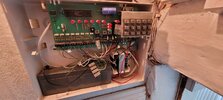
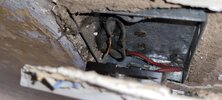
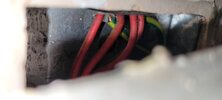
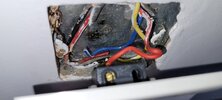
- live cables dangling in boiler room

C2's:
- 3.3 Provision of earthing/bonding labels at all appropriate locations (514.13.1)
- 3.6 Confirmation of main protective bonding conductor sizes (544.1)-The cross-sectional area for the main protective bonding conductor does not meetthe minimum requirements
- no RCD protection to all circuits
- bathroom light fitting not IP rated in zone 2
- 1 ring main for entire property
- no gas bonding present

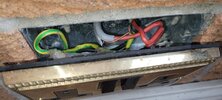
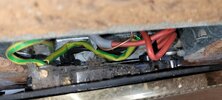
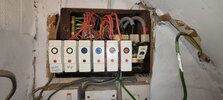
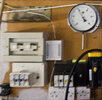
Does the house require a rewire or is it possible to get the issues rectified and a new consumer unit. Also really confused why there is a C1 for no earth to property, when I see a green and yellow earth cable coming into the consumer unit (Attached some images). Most of the plug sockets have earthing but some of the lights don't have the earthing cable.

1717278047577.png

1717278260376.png
 

Attachments

  • 20240601_134856.jpg
    20240601_134856.jpg
    181 KB · Views: 167
  • 20240601_163644.jpg
    20240601_163644.jpg
    206.5 KB · Views: 155
  • 20240601_163648.jpg
    20240601_163648.jpg
    171 KB · Views: 144
  • 20240601_165258.jpg
    20240601_165258.jpg
    184.2 KB · Views: 163
  • 20240601_165312.jpg
    20240601_165312.jpg
    221.3 KB · Views: 165
  • 20240601_170054.jpg
    20240601_170054.jpg
    196.6 KB · Views: 159
  • 20240601_170312.jpg
    20240601_170312.jpg
    98.1 KB · Views: 144
  • 20240601_170525.jpg
    20240601_170525.jpg
    151.3 KB · Views: 154
For starters 1 ring main for whole property is NOT a C2 and I’m not sure I agree with the C2 for the undersized bonding cable unless it has obvious heat damage

But it does sound in need of a lot of work

Your own property or rental you own?
 
For starters 1 ring main for whole property is NOT a C2 and I’m not sure I agree with the C2 for the undersized bonding cable unless it has obvious heat damage

But it does sound in need of a lot of work

Your own property or rental you own?
My own property
 
The large green/yellow wire is probably not a main earth but a bonding conductor (makes sure pipes don’t become live in case of a fault in the electrical system).

At the very least you need an earth rod somewhere and the cables in the boiler room need to be taken care of. From the certificate alone it doesn’t sound like a full rewire is your only choice but depending on how happy you are with the number and placement of sockets it might be the most feasible.
 
The IET who write the regulations have produced a document on EICR myths
RCD protection is required for all socket outlets, a C3 classification code is recommended in BPG 4 where the socket-outlet is unlikely to be used for portable equipment outdoors.
BPG 4 stands for best practice guide 4.

The best practice guide 4 issue 7 is here which is considered to be a reasonable way to code faults.

Main point is
1717292611722.png
they should not be live now. He clearly could not leave the property leaving them live, he would have needed to isolate the live wires before leaving.
The
1717292699674.png
seems to be repeated, and I can see this is a problem as only way to make safe is to turn off supply, which is rather drastic, I had it with my parents house, I know there was an earth, as when I was a boy I ruptured the fuse when I put a line to earth in error repairing a spool to spool tape recorder, but some 30+ years later, I could find no sign of any earth other then the one for the GPO party line phone. The DNO should be able to tell you what earthing system you have, when I phoned them they did not know, it was missing from their records, so some one was sent to inspect to see what earth we should have, I pointed out next door had a TN system so I should have the same, and he agreed and provided me with an earth terminal.
I can not see how any electrician can walk away if there is really no earth, I would think my parents did use the water pipe as an earth, and when the pipe in the street was changed to plastic it was lost at that point, however although no earth, everything was bonded, so it was a quick job once the DNO had been to connect the earth.

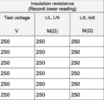
An EICR is one mans option as to the state of the electrics, this house also had a Wylex fuse board when I moved in, still with fuses, not MCB's like yours, and I decided it needed changing, and although there may be nothing to force you to change the distribution unit, it would be prudent to change it to a all RCBO unit, this 1717294273587.png seems odd, I would not expect all to show the same reading, and would have expected 500 volt to be used not 250 volt, but it should mean that the circuits have been tested for borrowed neutrals and the like, and any earth leakage, so there seems to be not reason why the fusebox can't be changed for a modern consumer unit.
 
Last edited:
My own property
I thought EICR's were only needed by landlords - our friend has a couple of flats she lets out and she's just had them done. Out of interest, as a householder, why did you have the EICR carried out and what happens if you don’t get the faults rectified?
 
My own property

So firstly you are under no obligation to act on the EICR , that said you do need to get the earthing clarified / fixed. It could be a TT system with a poor earth rod which could be the reason for the very similar Zs readings. Could you post a photo of the incoming service head?

No R1 + R2 readings either

No cpc in some of the lighting isn’t great either

If I was you visiting spark I would recommend

1. Get main Earth clarified/ fixed

2. Seriously consider a new CU with RCBOs

3. Get a partial or full rewire
 
The IET recommendation is to do a domestic installation with an EICR every 10 years. Other properties have shorter times. With commercial they need doing to comply with the electricity at work act, unless one has a resident electrician in which case it is considered it is a continuous process.

There has always been some argument as to codes, it was 1 to 4, and the IET felt that the code 4 (does not comply with current edition of BS7671) was unhelpful, so the new codes identified as being the new system by the C do not compare to BS7671 we have C1, C2, and C3 plus some others like LIM, but the main 3 dangerous, potentially dangerous and improvement recommended are designed to guide the person commissioning the inspection as to how bad the faults are.

It has been made clear, danger refers to danger to people not and machine, and BS 7671 each edition has a date after which designs must follow the new regulations, so there is no requirement to update. However some items in BS 7671 have been clarified rather than changed, and some changes like bonding in bathrooms require RCD protection if not bonded.

The RCD protection of sockets likely to be used outside has for some time been considered as a code C2 although items being used outside of the equal potential zone should be class II if using a PME supply, so not so sure outside needs the RCD, more items likely to get wet needing a RCD.

But as far back as I can remember there have been arguments as to what code should be given for each fault, and since there is no requirement to correct faults until the landlord law came out, as long as
IET said:
The EICR must be compiled in such a way that the person ordering the report can understand it. The condition of the installation should be accurately described to allow the person ordering the report to make an informed decision on the repairs to be carried out, based on the risk to the users of the installation.
then it really does not matter what code, unless for a rented property.

So the question is what has happened to the earth? Two options one bang in an earth rod and fit RCD's, or two get the DNO to provide and earth. Without a RCD the earth loop impedance (called resistance with DC) must be below 1.38 ohm for a 32 amp MCB type B which is near impossible, so the main thing is you need RCD protection, I did add it with my own house Wilex-board-with-RCD.jpg but this was before we could buy consumer units with the RCD built in, and it did from time to time cause problems, so it likely will need a new consumer unit with RCBO's (RCD and MCB combined) and likely SPD as well which is more to stop spikes damaging electronic equipment in home rather than people.

Since the main fuse will likely be pulled when the DNO provide the earth, better to get CU done first in some ways. Then DNO will fit new seals.
 
- 1.1.2 Earthing arrangement
- 3.1 Presence and condition of distributor’s earthing arrangements (542.1.2.1: 542.1.2.2)
- no main earth in property
C2.
- live cables dangling in boiler room
Sketchy C1
C2's:
- 3.3 Provision of earthing/bonding labels at all appropriate locations (514.13.1)
C3
- 3.6 Confirmation of main protective bonding conductor sizes (544.1)-The cross-sectional area for the main protective bonding conductor does not meetthe minimum requirements
- no RCD protection to all circuits
Depends on the circuits.
- bathroom light fitting not IP rated in zone 2
C3
- 1 ring main for entire property
C3
- no gas bonding present
C2
Does the house require a rewire or is it possible to get the issues rectified and a new consumer unit.
I'd advise you to get a new consumer unit while having the issues rectified. It'll only take less than an hour to get the electrician to fix those C2's and C1's.
 
54-yo wiring is not "new". Realistically the entire electrical installation belongs in the bin. Start again. It's life expired.
 
54-yo wiring is not "new". Realistically the entire electrical installation belongs in the bin. Start again. It's life expired.
Around 1966 we had major changes with wiring, before that date lighting circuits often had no earth, and rubber cable was used, so my parents house built 1954 did require a re-wire, the change from imperial to smaller metric cables combined with spurs off spurs many of the metric cables showed signs of overheating, and reading with the insulation tester showed poor reading, however I used 500 volt, I can see with smart sockets, filtered sockets, RCD sockets and the like why 250 volt used, but would not have used the lower voltage throughout.

However with a powered up system one test I would have made is earth leakage. A guy swapped my parents consumer unit without testing, and then found he could not keep the RCD powered up due to leakage, leakage can be due to failing insulation and the insulation tester at 500 volt will find this, but also it can be due to capacitive or inductive linking, which will only happen with AC, and the insulation tester uses DC, so before fitting a new consumer unit one needs to know if the new 30 mA RCD's will hold in, and we are allowed 30% leakage so nothing over 9 mA is allowed, socket circuits seem to remember 3.5 mA is the limit.

I took a chance, the consumer unit was fitted, all RCBO then I looked for any problems, two lamps using wrong neutral, soon swapped the neutrals over, but the whole idea of an EICR is to find these faults before one starts, and the easy way is a clamp on ammeter with 1 mA resolution or better, around the lives (line and neutral) of each circuit, and putting a load on the circuit, the typical up/down stairs errors are easy shown, OK may miss some obscure faults, but most will be found.

I feel the standard forms should have a box for earth leakage, far more important than which number in BS 7671 the fault brakes, yes as electricians we may know what 701.411.3.3 Additional protection by RCDs covers, but the EICR should be in a language the client understands, so if I as an electrical engineer commission an EICR then OK quote 701.411.3.3 but for an ordinary person (that is a BS 7671 definition) it should says bonding in bathroom is missing so either bonding needs doing or a RCD installed, I recommend the latter. Is that so hard to use everyday language?

I would say there is no EICR unless done by myself where I feel the codes are correct and the information given is how I would like it, so although I agree with @jurassic sparkk with most of what he says, EICR are the personal consideration of the inspector, there is no right and wrong code, it is the inspectors option, which is why he needs to explain why he has awarded that code.
 
The IET who write the regulations have produced a document on EICR myths
RCD protection is required for all socket outlets, a C3 classification code is recommended in BPG 4 where the socket-outlet is unlikely to be used for portable equipment outdoors.
BPG 4 stands for best practice guide 4.
And that same best practice guide reccomends a C2 code for sockets that *are* reasonablly expected to power equipment outdoors.

I posit that in a regular house (flats may be another matter) some sockets WILL be used to supply equipment outdoors.
 
And that same best practice guide reccomends a C2 code for sockets that *are* reasonablly expected to power equipment outdoors.
Usually C3 for no RCD protected circuits but if it's a first floor separate ring then that can automatically be a C2. Some kitchens/extensions are part of the "outside area" so that also would be considered as a C2.
 
I seem to remember around 2004 we got sockets outside need to be RCD protected, but house wise 20 years is not much, often the finance deal has not even been paid off in 20 years.

So we should look at what has changed to make sockets outside more dangerous, in the main that is the move from TN-S and TT to TN-C-S and the RCD does not help. An ELCB-v would, but we banned them, we just hope any out side equipment is class II, so really we are saying class II equipment is more dangerous to class I equipment. Or is my logic flawed?
 
Usually C3 for no RCD protected circuits but if it's a first floor separate ring then that can automatically be a C2. Some kitchens/extensions are part of the "outside area" so that also would be considered as a C2.
So - things/parts magically became "potentially dangerous" when RCDs were introduced when they weren't before and that all electricity is potentially dangerous is of course neither here nor there.

Do you ever get the idea that things aren't meant to be clear and decisive?
Lets charge the customer for altering what we said he had to have done last time.
 

If you need to find a tradesperson to get your job done, please try our local search below, or if you are doing it yourself you can find suppliers local to you.

Select the supplier or trade you require, enter your location to begin your search.


Are you a trade or supplier? You can create your listing free at DIYnot Local

 
Back
Top