
• Looking for a smarter way to manage your heating this winter? We’ve been testing the new Aqara Radiator Thermostat W600 to see how quiet, accurate and easy it is to use around the home. Click here read our review.

Gas bonding - is my incoming gas pipe PE?

Joined
19 Dec 2017
Messages
46
Reaction score
5
Country
United Kingdom
Hi all

Had my boiler serviced this morning and it was pointed out that I don't have any electrical bonding on the gas meter

House is a new build (completed 2022) so initially I just assumed it was something that hadn't been checked/missed and needed to get resolved

However, after reading up on this, there is a PDF from the NHBC that states that PEB isn't required if the incoming gas pipe is plastic (PE) so that's maybe why it hasn't been connected:

https://www.nhbc.co.uk/binaries/con...f-gas-installation-pipework-new-june-2020.pdf

So is it actually required?

Here is a photo of the supply pipe entering the meter box
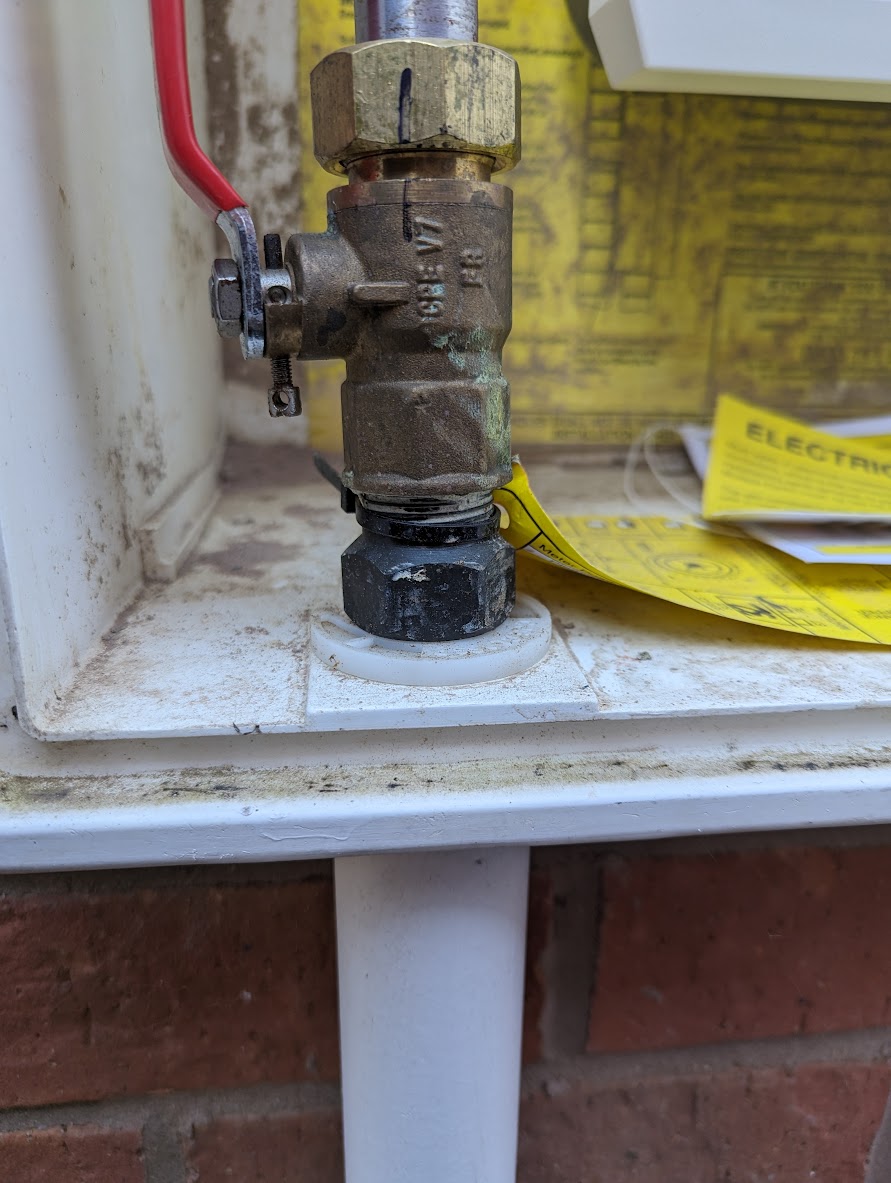
PXL_20240418_075351352.jpg


Advice appreciated
 
It appears to be plastic so it looks like it won't need bonding... but without testing we cannot be for certain so it'll be better to get it tested whether it will need to be bonded or not.
It's probably a cover for the pipe that appears to be white so have a look somewhere else.
 
Last edited:
That plastic pipe is not the gas pipe... just a cover/conduit/hockey stick in which the gas pipe travels. We can't see the actual pipe incoming. You'll find the electric box has a similar one with the DNO cable inside it.
{It's probably plastic. They don't use metal pipes any more afaik. IIRC, my gas pipe in one house was replaced with plastic inside the old metal pipe in the 90s when they replaced all the gas mains with yellow plastic pipework?}

Note that, from the document you reference, the preferred PEB is on the gas pipe just inside the building NOT inside the meter box... so have a search for where the gas pipe enters and runs to see if there is one anywhere else?
 
IIRC, my gas pipe in one house was replaced with plastic inside the old metal pipe in the 90s when they replaced all the gas mains with yellow plastic pipework?}
As I am aware, in my area most of the pipes were replaced to MDPE (yellow) pipe in 2019.
 
We have just had the metal main and supply pipework replaced (by JDT Utilities Ltd) with PE and the meter moved from internal to an external box. A new Bond was not installed.
Additionally SGN replaced the old (min 50 year+) meter the following day.

SGN engineers left a card in the box stating that 'the installation pipework fitted at your property may not have Bonding correctly fitted' with a sketch showing the 'traditional' bonding arrangement with the bond a maximum 600mm from the meter.
Naturally, I took this up with JDT and an engineer who happened to be across the street inspected the original meter position and bond, now 6.6 metres away and across 2 Tee's in the pipework which, I understand is not ideal, declaring 'it's fine'.

I queried this with the JDT office and they sent a subcontracted engineer on their behalf who inspected the work. He told me that SGN have not accepted the idea that a PE supply pipe negates the need for a bond and therefore continue to leave the card with the replacement meter 'but it doesn't need a bond'.
I asked the engineer for an email confirmation in which he refused to install a new Bond on the grounds that the original internal Bond had a Tee joint between it and the original meter "and was not installed to current standards so we are not required to relocate it and bring it up to standards".... no mention of the PE supply pipe.
So, according to JDT, when new works are carried out they can ignore current standards because an engineer, decades ago, wasn't able to do an 'ideal' job.

Okay.. here are photos.
IMG_0255.jpg
IMG_0256.jpg

UPDATE: I had queried the Engineers 'kiss off' email with SGN office. They have come back to me to say JDT have been contracted and paid to install the new bond wherever they had need to move the gas meter to the outside of the property and the bond should be sited inside the meter box and then running to connect inside the property. Apparently, the author of the email has been instructed to come to site today and install the bond. The SGN guy was concerned that this was the first he had heard of JDT failing to fulfil their contract and wondered if any of my neighbours were in the same position.
Coincidentally, my next door neighbour who had been away during the works asked me what had been happening. Her meter had also been moved outside and was in a locked box to which she hadn't been given a key. I had a key so we took a look... to find her key was taped to the inside of the box door!? No bond on her meter either, needless to say.
 
Last edited:
It is not "the meter" which requires bonding; it is the metal pipe which emerges from the ground and enters your premises.

It is not possible to bond plastic pipe; it does not conduct electricity.
 
SGN engineers left a card in the box stating that 'the installation pipework fitted at your property may not have Bonding correctly fitted' with a sketch showing the 'traditional' bonding arrangement with the bond a maximum 600mm from the meter.
Can we have a picture of the sketch please? Just interested.

The 600mm only applies to internal meters and is actually not electrically correct.

Naturally, I took this up with JDT and an engineer who happened to be across the street inspected the original meter position and bond, now 6.6 metres away and across 2 Tee's in the pipework which, I understand is not ideal, declaring 'it's fine'.
It is irrelevant. If bonding is required it should be connected at the point of entry into the premises.

I queried this with the JDT office and they sent a subcontracted engineer on their behalf who inspected the work. He told me that SGN have not accepted the idea that a PE supply pipe negates the need for a bond and therefore continue to leave the card with the replacement meter 'but it doesn't need a bond'.
Ok. That is sort of correct.
By not accepting the idea do they think that PE does conduct electricity?

I asked the engineer for an email confirmation in which he refused to install a new Bond on the grounds that the original internal Bond had a Tee joint between it and the original meter "and was not installed to current standards so we are not required to relocate it and bring it up to standards".... no mention of the PE supply pipe.
So, according to JDT, when new works are carried out they can ignore current standards because an engineer, decades ago, wasn't able to do an 'ideal' job.
It is best not to have 'gasmen' do the electrical stuff.

At least they advised you.
 
He told me that SGN have not accepted the idea that a PE supply pipe negates the need for a bond
It's not that they don't accept it, they are not the "experts" on electrics. They are required, by law, to notify you that it should be checked by a competent person if it might be necessary.
 
I must admit to being confused by cross bonding, seems they don't bond stainless sinks now and although my service is plastic the sparks in fact bonded to my gas meter outlet.
It seems sensible to me to have all services cross bonded as well as things like a sink so everything is connected. Then if a stray wire or faulty insulation on an appliance causes your gas fire, stopcock or kitchen sink to become live the fuse/breaker will operate rather than waiting till you touch it.
Not a sparks as you will guess, just an ex "gasman" ;) :LOL:
 
I must admit to being confused by cross bonding, seems they don't bond stainless sinks ...
'Cross-bonding' is no longer required.
now and although my service is plastic the sparks in fact bonded to my gas meter outlet.
If the gas supply pipe is metal and the (required to be) metal gas pipe entering your house does not come into contact with ground/soil anywhere, then bonding is not required - but, partially aided by badly/.incorrectly worded regulations,many electricians seem to not understand this.
It seems sensible to me to have all services cross bonded as well as things like a sink so everything is connected. Then if a stray wire or faulty insulation on an appliance causes your gas fire, stopcock or kitchen sink to become live the fuse/breaker will operate rather than waiting till you touch it.
Not a sparks as you will guess, just an ex "gasman" ;) :LOL:
Bonding is a two-edged sword. If one touches, say, a damaged cable of, say, a kettle and simultaneously touches, say, an earthed (bonded) metal sink, one will receive a (potentially fatal) shock, but if the sink is not connected to earth, one will not.

Having said that, if the water supply to the house is metal (hence bonded) and the plumbing within the house is copper, then things like metal sinks and stopcocks will inevitably be earthed (hence the hazard I mention) even if they are not explicitly bonded.

Kind Regards, John
 
I must admit to being confused by cross bonding,
No such thing.

The "cross-bonding" below boilers that plumbers love has never been needed.

seems they don't bond stainless sinks now
No need.

Metal parts are safer if not connected to earth in any way - e.g spoon.
If metal parts are connected to earth by some means - an appliance earthing or the actual earth - then that is why they might require bonding; i.e. joining electrically.

and although my service is plastic the sparks in fact bonded to my gas meter outlet.
No need.

It is the inlet pipe which, if metal, might be an extraneous-conductive-part.

That is what I meant by my comment above:
1723725320620.png


It seems sensible to me to have all services cross bonded as well as things like a sink so everything is connected. Then if a stray wire or faulty insulation on an appliance causes your gas fire, stopcock or kitchen sink to become live the fuse/breaker will operate rather than waiting till you touch it.
NO. As I said it would be better if not earthed which is what you are doing by wrongly bonding things.

It is worse if you should touch a live wire with one hand while touching an earthed part with the other. If it were not earthed(bonded wrongly) it would not be as dangerous.
Think bird on transmission lines.

Not a sparks as you will guess, just an ex "gasman" ;) :LOL:
:)
 
No, you misunderstand as well. If a part is not earthed in any way, then you cannot bond it.

The process would be earthing - then you could bond it.
 

If you need to find a tradesperson to get your job done, please try our local search below, or if you are doing it yourself you can find suppliers local to you.

Select the supplier or trade you require, enter your location to begin your search.


Are you a trade or supplier? You can create your listing free at DIYnot Local

 
Back
Top