Very basic help needed plumbing washing machine

Joined
13 Oct 2024
Messages
13
Reaction score
1
Country
United Kingdom
I live in a flat with a tiny kitchen too small to install a washing machine, and no doubt has never had one. I plan to install it just outside the kitchen, pipes that came with it seem just long enough, although in-time I might get slightly longer ones to make routing easier.

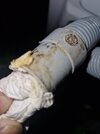
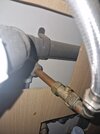
Under the sink there seems to a free doobrie to take a washing machine outlet, see red circle in picture 3. I'm guessing this is fairly straightforward; remove/unscrew plastic cap, pop on pipe (looks about the right size, see pic2). secure with a jubilee clip for safety. Although I'm slightly concerned about siphonage.

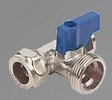
Of greater concern to an inexperienced fool like myself is the inlet, where mistakes get really messy, really quickly ;) My guess is, water off turning screw 90 degrees that's just behind the junction in pic1. Check it's off and remove pressure/some water by operating tap. Then I'm a tad hazy... I'm assuming I can't directly attach a T junction connector like pic4 directly, I'll need a very small bit of copper pipe? Would I be better off using plastic fittings?
.
Any advice very welcome as I've gotta do this soon, I'm outta clean undies.
 

Attachments

  • washing3.jpg
    washing3.jpg
    102 KB · Views: 80
  • washing2.jpg
    washing2.jpg
    61.4 KB · Views: 72
  • washing1.jpg
    washing1.jpg
    145.1 KB · Views: 68
  • washing4.jpg
    washing4.jpg
    4.5 KB · Views: 70
Under the sink there seems to a free doobrie to take a washing machine outlet, see red circle in picture 3. I'm guessing this is fairly straightforward; remove/unscrew plastic cap, pop on pipe (looks about the right size, see pic2). secure with a jubilee clip for safety. Although I'm slightly concerned about siphonage.

Basically, yes, but to prevent siphonage and back flow, the drain pip from the washer, would need to rise up on its route, to a higher level than the highest water level you might ever see in the sink.

Of greater concern to an inexperienced fool like myself is the inlet, where mistakes get really messy, really quickly ;) My guess is, water off turning screw 90 degrees that's just behind the junction in pic1. Check it's off and remove pressure/some water by operating tap. Then I'm a tad hazy... I'm assuming I can't directly attach a T junction connector like pic4 directly, I'll need a very small bit of copper pipe? Would I be better off using plastic fittings?

Yep, turn screw 90, turn the tap on, and ensure the flow has stopped. Then undo the joint between the silver flexible, and the copper pipe. Have a bowl and rags to hand, to catch what leaks out. You should then be able to insert the item in your fourth photo, in place of the silver pipe, Add a short piece of copper in the upper end of that, then reattach your silver pipe.
 
Harry, thank you so much.

So I need a short piece of copper pipe between the copper outlet and the item in the 4th pic? (which is a pain as I can think of a way buying 50cm of pipe (time for skip diving, perhaps!)
 
It's about £8 for a 2m length of 15mm copper pipe so probably not worth investing too much time or effort in finding an alternative source of a small piece, you'd then have a decent bit left over for any other future alterations.
 
So I need a short piece of copper pipe between the copper outlet and the item in the 4th pic? (which is a pain as I can think of a way buying 50cm of pipe (time for skip diving, perhaps!)

Unless you can find an alternative location, where you can cut the pipe, avoiding the need to buy any 15mm?
 
Thanks so much everyone for the advice and tips.

I've decided to increase the length of the inlet/outlet to make things easier & to be sure I can achieve the height of outlet hose you gents have advised. Inlet straightforward, outlet less so as it has no rear connection outlet, as such. See attached pics.

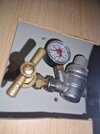
Should I be using PTFE tape on the high pressure unions before assembly? (On that point, re the last advice, Harry. I've always installed using the fitting that cuts into the existing pipe, but this property isn't owned by me, so feel I should use a way that I can remove; additionally I'm unsure where he stop cock is! So cutting in is impossible - there is a stopcock, but I'm unconvinced it's water - see pic')

Any wisdom very welcome ;)
 

Attachments

  • wm1.jpg
    wm1.jpg
    106.7 KB · Views: 45
  • wm2.jpg
    wm2.jpg
    112.8 KB · Views: 42
  • wm3.jpg
    wm3.jpg
    176.9 KB · Views: 40
  • wm4.jpg
    wm4.jpg
    239.2 KB · Views: 45
I've always installed using the fitting that cuts into the existing pipe, but this property isn't owned by me, so feel I should use a way that I can remove; additionally I'm unsure where he stop cock is!

I wouldn't worry too much about adding one of those self-cutting units, I would not anticipate any landlord complaining about that. Your final photo, appears to be your stop tap. Try turning it off, and running water from a tap, which is connected to the same pipe.

The item to the right of the stop-tap, with the dial, is a water pressure regulator.
 
there is a stopcock, but I'm unconvinced it's water
As suggested, turn the mains stop tap off and see if it stops the cold water. That silver valve after it is a pressure reducing valve and usually found on the mains water. That being said, it isn't doing much reducing, that should really be set @ ~ 3 bar.

Never, never and thrice never use a self cutting tap - they are just a leak waiting to happen. That and they can restrict the water in the main pipe as the leave a small tag of pipe internally in the middle of the water flow. Doing it once and do it right.
 
You guys are SO helpful, thank you so much. I'll update once I get the bits I require and begin the job. I may well have mire questions! Best Regards, Roger
 
Never, never and thrice never use a self cutting tap - they are just a leak waiting to happen. That and they can restrict the water in the main pipe as the leave a small tag of pipe internally in the middle of the water flow. Doing it once and do it right.

I've never heard of one leaking, but the beauty of them, is that they make it an incredibly simple operation, for a DIY'er to add an outlet, with the minimum of skill and tools needed.
 
Never, never and thrice never use a self cutting tap - they are just a leak waiting to happen. That and they can restrict the water in the main pipe as the leave a small tag of pipe internally in the middle of the water flow. Doing it once and do it right.
I used one of those in my first house 40 years ago. About a year after I had trouble with the valve in the toilet - either not filling or not stopping - I can’t quite remember now but when I took it apart, I found a little circular disc of copper that the self cutting tap had cut out and it had travelled all the way from my kitchen to my bathroom!
 
I've never heard of one leaking, but the beauty of them, is that they make it an incredibly simple operation, for a DIY'er to add an outlet, with the minimum of skill and tools needed.
I've replaced more leaky self cutters than I would like to remember, they're terrible things IMO, that and they never flow very well anyway.
 
A washing machine, doesn't need much flow, often, a restriction needs to be fitted, to limit the flow.
What restriction needs to be fitted? There may sometimes be a pressure limiter but not a flow limiter.

Fill hoses are relatively free flowing and WM's and DW's will cold fill as much as the mains will deliver and can flow through the bore of the solenoid.
 
Fill hoses are relatively free flowing and WM's and DW's will cold fill as much as the mains will deliver and can flow through the bore of the solenoid.

I normally agree with your comments, but not this time...

Too much flow, into a washing machine, causes the water to spray out of the soap drawer. There have been such issues, reported in this forum. The fix is to add a flow restrictor, to the pipe connection. They are hard plastic, like a washer.
 

If you need to find a tradesperson to get your job done, please try our local search below, or if you are doing it yourself you can find suppliers local to you.

Select the supplier or trade you require, enter your location to begin your search.


Are you a trade or supplier? You can create your listing free at DIYnot Local

 
Back
Top