• Looking for a smarter way to manage your heating this winter? We’ve been testing the new Aqara Radiator Thermostat W600 to see how quiet, accurate and easy it is to use around the home. Click here read our review.

Electrical Safety Group/My electrical safety

Joined
23 Sep 2024
Messages
7
Reaction score
0
Country
United Kingdom
Has anyone heard of this company?

They called me and offered to give a free electrical check. They came round and said that the house needs a full rewiring and the wiring is dangerous. The cost will be about £5000.

Has anyone heard of this company or have any experience of them?

I don't think the house wiring has been replaced since the house was built in 1939.

Any advice would be appreciated!
 
No idea who or what they are, but it's the usual scam pattern of a free check lasting a few minutes which inevitably leads to the entire installation being condemned as dangerous, and unsurprisingly they can fix it all for a massive price.

I don't think the house wiring has been replaced since the house was built in 1939.
Very unlikely, and if that really is true it should all have been replaced decades ago.

Add a few pictures of the fusebox / consumer unit / meter area for further info.
 
They called me and offered to give a free electrical check. They came round and said that the house needs a full rewiring and the wiring is dangerous. The cost will be about £5000. ...Has anyone heard of this company or have any experience of them?
As has been said, what you describe sounds, at first sight, to be very suspect. However, for what it's worth The Electrical Safety Group Ltd has been in business for nearly 26 years and has had 'stable', albeit modest, accounts for most of that period.

However, despite the impression given by the very professional-appearing website, it seems to be essentially a "one woman company" (just one director), although one obviously doesn't know how many 'workers' there may be.

So, I would say that there is nothing 'obviously wrong' with the company but, as has been said, you certainly should get at least one more 'opinion' (ideally by paying for an Electrical Installation Condition Report) before coming to any conclusions about what work may need to be done.
I don't think the house wiring has been replaced since the house was built in 1939.
As has also been said, if that were even remotely true, re-wiring would have really been required a very long time ago. In fact, the same is probably true if the wiring dates from before the 1970s or 80s,with any wiring older than that indeed being potentially 'dangerous'.

Kind Regards, John
 
Thank you to everyone for their kind advice.

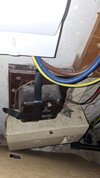
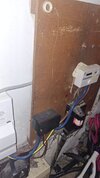
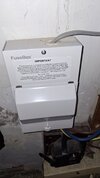
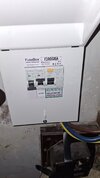
I've attached what is under the stairs. The white box was installed when an electric shower was installed last year.
 

Attachments

  • IMG-20250411-WA0008.jpg
    IMG-20250411-WA0008.jpg
    212 KB · Views: 98
  • IMG-20250411-WA0007.jpg
    IMG-20250411-WA0007.jpg
    203 KB · Views: 96
  • IMG-20250411-WA0006.jpg
    IMG-20250411-WA0006.jpg
    178.1 KB · Views: 97
  • IMG-20250411-WA0005.jpg
    IMG-20250411-WA0005.jpg
    134.6 KB · Views: 101
The brown bakelite thing and the cream MEM box are a lot older. But not 1939.
 
What did the electrician who fitted the shower last year say about the state of the other electrics? I.e. did they suggest that it should be upgraded, and with what urgency? They will have had a better understanding than we can get from a few photos.

An important question is whether your wiring is using ancient rubber-insulated cables, rather than modern PVC (which was introduced in the 1960s I think). If the wiring was replaced, e.g. some time late last century, then maybe you don’t need to rip out and replace everything. If you still have ancient wires then you should certainly plan to rewire everything reasonably soon. You will need to find someone who is competent at neatly installing new cables to every socket, switch and lamp; you don’t want to have to redecorate every room after they’ve finished.
 
Your extra new CU should really have an SPD in it

Were you advised to get the property inspected properly then?

That old MEM board is a bit of a warning sign
 
Your extra new CU should really have an SPD in it
As you will be aware, I'm pretty sceptical about any SPD at the best of times.

However, what aspect of a shower do you think could conceivably benefit from SOPD protection?
[any protection afforded to other circuits fed from other CUs in the installation would presumably be appreciably diminished by the length/CSA of its connections to the origin of the installation).
 
As you will be aware, I'm pretty sceptical about any SPD at the best of times.

However, what aspect of a shower do you think could conceivably benefit from SOPD protection?
[any protection afforded to other circuits fed from other CUs in the installation would presumably be appreciably diminished by the length/CSA of its connections to the origin of the installation).

I tend to agree with your thoughts BUT the cost of including a SPD with a new CU is hardly much so a sensible step.

The next edition of the regs will probably make them mandatory
 
I tend to agree with your thoughts BUT the cost of including a SPD with a new CU is hardly much so a sensible step.
Opinions will undoubtedly differ, but "sensible" is not a word that comes to mind for me. SPDs have virtually nothing to do with 'safety' in the normal sense, and exist primarily to (perhaps) give some protection to 'sensitive electyropnic equipment' - and I don't think you'll find such equipment in a shower.
The next edition of the regs will probably make them mandatory
I fear you may well be right (well, 'required' by BS 7671,, not 'mandatory' in any legal sense), but I would personally regard that as a bad thing, and a movement onto a slippery slope which could get out of hand. Until recently, The Wiring Regs / BS 7671 were all about personal safety (including fire prevention) - but sliding onto the 'protection' of inanimate objects seems to me to be an undesirable change of direction.

People should, of course, be made aware of such devices and what they may possibly achieve, but I strongly believe that householders should then be left with a free choice as to whether or not they want one.

I agree that, per your comment above, the cost of including one SPD in one CU is not all that great, but the cost of installing one SPD in each and every domestic electrical installation in the UK would probably add up to £1billion or so - money which I think could probably be spent more usefully in other ('life-saving' or 'life-improving') ways.
 
We could use it to offset the tax bills of US online businesses, so we can get our tongue further up Trump's ****
 
Bearing in mind that some of us (including me ) rewired many homes years ago and RCDs were uncommon back then, sound new circuits and rewireable fuses were the norm in a consumer unit.
There was a choice to offer some extra protection by adding an Earth Leakage Circuit Breaker , the two variants offered were Voltage Operated or Current Operated, the Voltage Operated were eventually disbanded because they were to easy to defeat either accidentally or deliberately then the Current Operated became known as the Residual Current Device and was a more precise wording of its function.
It was for quite a while seen as a good improvement but voluntary only as far as our Regs were concerned.
Personally I used to recommend them as an optional extra and tried to encourage people to have one by using a phrase like “ if you have a pet dog and it saves your dogs life you would consider it a worthwhile extra cost, well it could save a human life!”.
My ploy usually worked but for a long while I could not include it as my standard rewired price because it would outprice me against many others who did not fit them.
As more people had a “Powerbreaker” to protected them whilst mowing the lawn or using a power tool outside my recommendation became a little easier and RCDs became cheaper and more common.
Eventually becoming more common as an RCD main switch on a consumer unit covering all circuits , then split loads then dual RCDs then so called “High Integrity” and perhaps the addition of a few RCBOs too (which again were very expensive) today all of these are quite cheap and considered normal so the preference of a consumer unit with RCBOs for each circuit gives some peace of mind.

Quite a transition of the mindset in the minds of both the electrician and the general public.

OPDs I perceive as “could be useful in some circumstances so if the costs are low let’s usually fit them in a consumer unit because it might help”.

Obviously I am talking about TN systems where a reliable Earth is provided by the energy supplier, TT systems have for a long time nearly always required some kind of RCD or ELCB.

I advise having the installation inspected and tested via an EICR preferably with a contractor who will gain from the outcome then you might have a reasonable idea if a complete rewired is required
 
I advise having the installation inspected and tested via an EICR preferably with a contractor who will gain from the outcome then you might have a reasonable idea if a complete rewired is required
... who will not gain from the outcome ... ?
 
It was for quite a while seen as a good improvement but voluntary only as far as our Regs were concerned.
Personally I used to recommend them as an optional extra and tried to encourage people to have one by using a phrase like “ if you have a pet dog and it saves your dogs life you would consider it a worthwhile extra cost, well it could save a human life!”.
My ploy usually worked but for a long while I could not include it as my standard rewired price because it would outprice me against many others who did not fit them.
I think that was a perfectly reasonable view,and also that it was perfectly reasonable that the situation has evolved such that residual current protection is now required (at least by BS 7671, although not 'mandatory') for almost everything within domestic electrical installations.

We can (and do) have debates about how many injuries/deaths have been prevented by such devices, and also about the 'cost-effectiveness' of widespread deployment of these devices at national/global level. However, there is presumably no doubt that such devices must have prevented at least some injuries/deaths, not the least by clearing faults before anyone got a shock [determining whether (or 'how many') deaths/injuries have been prevented by limitation of duration of a shock is essentially impossible].

So, as above, I agree that there is a sound basis for your view and the current views of BS 7671, leaving only the question of whether the money spent on these things might have prevented more injuries/deaths if spent on something else. However ....
OPDs I perceive as “could be useful in some circumstances so if the costs are low let’s usually fit them in a consumer unit because it might help”.
Do I take it that you mean "SPDs"?

If so, then, as I've said, this seems to be a totally different ballpark, and a movement of BS 7671 in a direction with which I'm not very comfortable. To-all-intents-and-purposes, SPDs do not (cannot) prevent, or even mitigate, injuries or deaths to human beings or animals. If they achieve anything in a domestic setting, it's a reduction in damage/destruction to some electronic equipment - and I'm personally very doubtful that it is 'appropriate' for 'The Wiring Regulations' to 'require' people to have such 'protection' in their homes.

One of the problems is obviously that it is essentially impossible (and probably always will be) to ascertain whether or not damage to, or destruction of, electronic equipment was due to 'surges', hence whether or not an SPD could (or has) prevented such damage/destruction. [ I have my suspicions about the answers, but will probably never know :-)]. However, I imagine that a good few cases of such damage/destruction (maybe more than those possibly due to 'surges') are due to other sorts of 'accidental damage' - e.g. "poured a cup of coffee over it", "fell off shelf", "trodden on", "chewed by dog" etc. - or even destroyed in a house fire - but I don't think anyone would suggest that it should be 'required' (let alone 'mandatory') that people 'protect' themselves against such eventualities by having appropriate insurance, would they?

It's perfectly reasonable, and probably desirable, that householders be made aware of what SPDs may possibly achieve but (as with a decision as to whether or not they have "Accidental Damage Insurance" for their house contents) it should be for them to decide whether or not they want SPDs

Kind Regards, John

 

If you need to find a tradesperson to get your job done, please try our local search below, or if you are doing it yourself you can find suppliers local to you.

Select the supplier or trade you require, enter your location to begin your search.


Are you a trade or supplier? You can create your listing free at DIYnot Local

 
Back
Top