• Looking for a smarter way to manage your heating this winter? We’ve been testing the new Aqara Radiator Thermostat W600 to see how quiet, accurate and easy it is to use around the home. Click here read our review.

Extension Leads in the Kitchen

Joined
28 Jun 2021
Messages
522
Reaction score
15
Country
United Kingdom
Hi
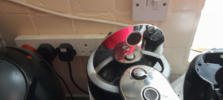
I rent a flat, had a call from tenants for loud noise and MCB trip in the kitchen. It is a small kitchen with 2 double sockets and 2 switched fused spurs. I checked the fuses in the spur, all good, wall sockets are working fine. However, there is an extension lead in the kitchen powering 3 devices; toaster, kettle and microwave, see photo. I told them this is wrong, shouldn't have extension leads in the kitchen for high current devices. Ts are stubborn, said to protect their appliances from current surges.
Is extension lead legal/allowed in UK?
Is it the cause of the MCB trip?
Thank
 

Attachments

  • kitchen.jpg
    kitchen.jpg
    98 KB · Views: 76
Do I take t that they don't know where the 'loud noise' came from?
What is the present situation - has it been possible to reset the MCB and, if so, is everything working normally?
What is the current rating of the MCB ?

Extension leads are not specifically 'disallowed', in kitchens or anywhere else, but overloading circuit (whether via an extension lead and/or multiple sockets) can obviously cause an MCB to trip. Having said that, the 13A fuse in the plug of an extension lead will limit how many loads can be powered by the extension.

Kind Regards, John
 
protect their appliances from current surges.

What, they’ve plugged the kettle and toaster into an extension despite there being enough sockets and the sockets being close enough, because “current surges”? Idiots.
Is extension lead legal/allowed in UK?

Not illegal as far as I am aware.

Is it the cause of the MCB trip?

I can’t think of an immediate mechanism by which that could happen. Any sign of e.g. burn marks on plugs or sockets anywhere?
 
Do I take t that they don't know where the 'loud noise' came from?
What is the present situation - has it been possible to reset the MCB and, if so, is everything working normally?
What is the current rating of the MCB ?

Extension leads are not specifically 'disallowed', in kitchens or anywhere else, but overloading circuit (whether via an extension lead and/or multiple sockets) can obviously cause an MCB to trip. Having said that, the 13A fuse in the plug of an extension lead will limit how many loads can be powered by the extension.

Kind Regards, John
Don't know where noise from but guess from the MCB, all sockets are working. No black marks on sockets or on spurs.
Yes all reset and working.
MCB are 32A
 
Do I take t that they don't know where the 'loud noise' came from?
What is the present situation - has it been possible to reset the MCB and, if so, is everything working normally?
What is the current rating of the MCB ?

Extension leads are not specifically 'disallowed', in kitchens or anywhere else, but overloading circuit (whether via an extension lead and/or multiple sockets) can obviously cause an MCB to trip. Having said that, the 13A fuse in the plug of an extension lead will limit how many loads can be powered by the extension.

Kind Regards, John
Don't know where noise from but guess from the MCB, all sockets are working. No black marks on sockets or spurs.
Yes all reset and working
MCB are 32A
 
What, they’ve plugged the kettle and toaster into an extension despite there being enough sockets and the sockets being close enough, because “current surges”? Idiots.


Not illegal as far as I am aware.


I can’t think of an immediate mechanism by which that could happen. Any sign of e.g. burn marks on plugs or sockets anywhere?
No sign of burns on sockets or spurs or anywhere.
I think it's got to be the extension lead tripping the MCB.
They have 3 appliances and 2 sockets.
 
I think it's got to be the extension lead tripping the MCB.
Unless there is a fault within the extension lead (in which case it would probably not have been possible to reset the MCB), I don't think the extension lead can be to blame, no matter what was plugged into it (an excessive load should blow the 13A fuse in the extension's plug before a 32A MCB tripped).
 
Unless there is a fault within the extension lead (in which case it would probably not have been possible to reset the MCB), I don't think the extension lead can be to blame, no matter what was plugged into it (an excessive load should blow the 13A fuse in the extension's plug before a 32A MCB tripped).
But is it safe extension lead in the kitchen for toaster, kettle and microwave?
 
When is the next PAT test due? Maybe schedule it sooner rather than later. Ideally, their stupid “surge protector” would fail. (Or does that not get tested because it’s not the landlord’s property?)

You could consider replacing the double socket with a triple. I have that in my kitchen for kettle, toaster and coffee machine.
 
1744823417347.png I can hardly tell someone else they should not use an extension lead when this is my own kitchen. That's a coffee machine, and two one cup kettles all plugged into the same socket using that extension, and we often in TV adverts switch on both one cup boilers on together. So 6000 watts around 26 amps, and the 13 amp fuse has blown once or twice when used a second time, but most of the time there has been no problem. The time taken to boil is so short.

However, I note an MK surge protection double socket is only rated 13 amps for the pair. Non surge protected 20 amps, the pair, but it could well be the surge protection bit is overloaded.

I have two SPD at the consumer units, but not elsewhere. I also have all RCBO's as the owner-occupier I have the option of installing what protective devices I see fit, a tenant has to work with what the landlord has provided, I have solar panels and a 5 kW inverter with 6.4 kWh of batteries so my freezers and central heating still run in a power cut, a tenant has not got that option.

So I can see why a tenant wants to add surge protection, although I can't see why required for items like a kettle and toaster.
 
.... I note an MK surge protection double socket is only rated 13 amps for the pair. Non surge protected 20 amps, the pair, but it could well be the surge protection bit is overloaded.
Other than during the very brief period of 'a surge', no current flows through the "surge protection bit", no matter how heavily loaded the socket is.
So I can see why a tenant wants to add surge protection ....
The same reason that anyone else 'wants it', I suppose, whether they actually understand about it or not!
 
The chances of overload from that extension lead tripping the MCB before the fuse in the plug is rare. However, you should encourage the tenants to avoid plugging in multiple high amperage devices in one extension lead.

The cause of the MCB tripping can be due to one of the appliances at fault, it could be a washing machine, laptop/phone charger or even a dishwasher. Ask your tenants if anything was plugged in when the "noise" occurred.

Next time you're there, see what fuse has been installed in the plug. Last week, I encountered a shoved 20A fake fuse inserted in the plug. Check the continuity of the fuse and report back too.
 
The same reason that anyone else 'wants it', I suppose, whether they actually understand about it or not!
John, you'd be surprised of how many these cheapo "surge protection extension" leads fail due to an actual surge. A cheap design consisting of just a MOV and a fuse prevents the extension lead from working again. This leads to people chucking it in the bin and causing more waste.
 
John, you'd be surprised of how many these cheapo "surge protection extension" leads fail due to an actual surge.
I'm not at all surprised :)
A cheap design consisting of just a MOV and a fuse prevents the extension lead from working again.
Indeed. I must say that when 'surge protection' first showed its face, a good few moons ago, I though that was how they were 'meant' to work (i.e. as a 'sacrificial' device) - and, even then, I wondered how much 'surge protection' they actually did before the fuse blew! Those were the days when many people, including some of those who are now 'champions of SPDs' regarded any form of 'surge protection' as being 'snake oil' ;)

As you will be aware, I personally still very much 'wonder'. I doubt that we will ever really 'know', since I imagine its always going to be impossible to know whether an electronic failure (in the absence of an SPD) was due to a 'surge' and/or whether the presence of an SPD had stopped something being damaged by a 'surge'. ... so, really the worst of both worlds - we'll probably never know whether there is a significant 'problem' for which they may possibly be a 'solution', nor whether they are an effective solution even if there is a significant problem! At least for the time being, I will therefore personally continue to try to live without SPDs for as long as I possibly can :)
 

If you need to find a tradesperson to get your job done, please try our local search below, or if you are doing it yourself you can find suppliers local to you.

Select the supplier or trade you require, enter your location to begin your search.


Are you a trade or supplier? You can create your listing free at DIYnot Local

 
Back
Top