• Looking for a smarter way to manage your heating this winter? We’ve been testing the new Aqara Radiator Thermostat W600 to see how quiet, accurate and easy it is to use around the home. Click here read our review.

Main Bonding

Joined
17 May 2025
Messages
21
Reaction score
1
Country
United Kingdom
Hi
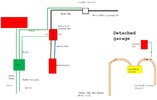
I have 10mm main bonding to the water main from the MET in the house, and to the gas pipe at the boiler , the gas meter is in a detached garage next to the house, the garage electrics are fed to the garage from a Volex shower unit fed from 16mm tails via 4mm swa cable.

Plus there is a 10mm earth cable going to the 4mm swa junction box in the loft ( swa is also earthed each end !

Now the question has I have bonding to the gas pipe in the house, do I still need main bonding to the gas meter in the detached garage, the gas meter has suplimentary bonding to it from the garage cu !.

Has per drawing.
 

Attachments
  • 10mm earth Bonding to garage copy to 4mm T&E +10 to loft junction box.jpg
    10mm earth Bonding to garage copy to 4mm T&E +10 to loft junction box.jpg
    103.1 KB · Views: 54
Last edited:
The gas should have an isolation block of some kind. It is important to bond after that isolation, so if there were a loss of PEN high currents would not go through the gas pipe. Clearly if the incoming gas is in plastic no problem.
 
The gas should have an isolation block of some kind. It is important to bond after that isolation, so if there were a loss of PEN high currents would not go through the gas pipe. Clearly if the incoming gas is in plastic no problem.
Hi
Not sure what you mean " isolation block" it has a valve on the main gas riser pipe into the garage before the meter !
 
The gas should have an isolation block of some kind. It is important to bond after that isolation, so if there were a loss of PEN high currents would not go through the gas pipe.
This is where the regs are confusing (now slightly better than there used to be). If there is an (electrical) 'isolation block' in the gas point, then there is obviously no point in main bonding the pipe on the house side of that 'block', even though the regs can be taken to imply that one should.

If course, if any of the incoming gas pipe prior to the 'isolation block' is touchable, then it would e dangerous not to bond it, despite your concerns about "loss of PEN".
 
It would appear that the armour (plus earth conductor if there is one) of the SWA could be fulfilling the requirement of the main bond from gas pipe to MET - assuming of course it is required.
 
Hi
Not sure what you mean " isolation block" it has a valve on the main gas riser pipe into the garage before the meter !
He means an electrically isolating section/fitting in the incoming gas pipe, but I don't think (although I may be wrong!) that many domestic gas installations actually have them.
 
Both the gas pipes in the garage are extraneous conductive parts and therefore will need to be bonded - both are metal pipes which are buried underground.
If applying 544.1.2 fully then it's just the consumers side after the meter to be bonded, however with the prevalence of plastic gas meters, flexible stainless connectors and no guarantee that a proper metal bracket has been used, both sides should be bonded. This also partially mitigates large current flow through the gas meter and connecting flexible pipes in the event of some fault.

Assuming 4mm² SWA 3 core with one core used as a CPC, that's 4mm² plus the armour.
3 core 4mm² SWA has an armour size of about 23mm² steel, or equivalent conductivity of ~3mm² copper. Note that this is conductivity only, not the calculation for use as a CPC which is entirely different.
Combined total of about 7mm².

If this really is a TN-S supply, then minimum bonding size 6mm² copper, however there are no real TN-S supplies any more, even if they may appear that way.
For TN-C-S, or more specifically where PME conditions apply, the minimum size is 10mm² copper.

The most obvious solution is the extend the 10mm² bonding from the loft junction box to the garage, terminate at an earthing terminal there, add bonding to both gas pipes, and a further 10mm² to the consumer unit in the garage.
Existing SWA armour & core left connected.

Had this been a new installation, then 3 core 10mm² SWA to the garage should have been used. Replacing the 4mm² SWA and T&E back to the origin could still be an option for added capacity such as adding electric vehicle charging in the garage.;
 
Have used the swa earthing each end, there will not be a car charging point from the garage, the 4mm swa is 3 core !
 
Both the gas pipes in the garage are extraneous conductive parts and therefore will need to be bonded - both are metal pipes which are buried underground.
If applying 544.1.2 fully then it's just the consumers side after the meter to be bonded, however with the prevalence of plastic gas meters, flexible stainless connectors and no guarantee that a proper metal bracket has been used, both sides should be bonded. This also partially mitigates large current flow through the gas meter and connecting flexible pipes in the event of some fault.

Assuming 4mm² SWA 3 core with one core used as a CPC, that's 4mm² plus the armour.
3 core 4mm² SWA has an armour size of about 23mm² steel, or equivalent conductivity of ~3mm² copper. Note that this is conductivity only, not the calculation for use as a CPC which is entirely different.
Combined total of about 7mm².

If this really is a TN-S supply, then minimum bonding size 6mm² copper, however there are no real TN-S supplies any more, even if they may appear that way.
For TN-C-S, or more specifically where PME conditions apply, the minimum size is 10mm² copper.

The most obvious solution is the extend the 10mm² bonding from the loft junction box to the garage, terminate at an earthing terminal there, add bonding to both gas pipes, and a further 10mm² to the consumer unit in the garage.
Existing SWA armour & core left connected.

Had this been a new installation, then 3 core 10mm² SWA to the garage should have been used. Replacing the 4mm² SWA and T&E back to the origin could still be an option for added capacity such as adding electric vehicle charging in the garage.;
Have used the swa for earthing each end, there will not be a car charging point from the garage
 

Attachments

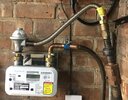
  • IMG-5525 cropped.jpg
    IMG-5525 cropped.jpg
    209.5 KB · Views: 63
Additional 10mm² required from the house.

Incoming gas pipe requires improvement, should not be hanging off the wall like that and the flexible is stretched too far.
 
Additional 10mm² required from the house.

Incoming gas pipe requires improvement, should not be hanging off the wall like that and the flexible is stretched too far.
Yes I told them that at the time they where doing it, I had to put a piece of wood behind the the riser to bring it forward a bit, it is lined with plastic onl metal for about 6 meters into the road !
 
It would appear that the armour (plus earth conductor if there is one) of the SWA could be fulfilling the requirement of the main bond from gas pipe to MET - assuming of course it is required.
That is what I am thinking, yes there is a 4mm cpc to the garage cu
 
I couldn't have a plastic gas supply pipe in my garage due to the risk of it melting in a fire, but you appear to have a plastic gas meter. I have no idea what would prevent a plastic gas meter from melting in the event of a fire in the garage.
 

If you need to find a tradesperson to get your job done, please try our local search below, or if you are doing it yourself you can find suppliers local to you.

Select the supplier or trade you require, enter your location to begin your search.


Are you a trade or supplier? You can create your listing free at DIYnot Local

 
Back
Top