• Looking for a smarter way to manage your heating this winter? We’ve been testing the new Aqara Radiator Thermostat W600 to see how quiet, accurate and easy it is to use around the home. Click here read our review.

OK to have insulated inner cores within plastic trunking?

Joined
14 Sep 2005
Messages
3,770
Reaction score
1,180
Location
Englandshire
Country
United Kingdom
I'm installing heating zone valves. There's enough space within the plastic trunking for the full cables complete with their outer insulation, but it's looking a bit tight for space as the cables enter the wiring centre.

Is it OK to strip the outer sheathing back so it ends just outside the wiring centre (within the trunking), leaving just the insulated inner cores entering the wiring centre itself?

I'm referring to the installed T&E cables that go to/from the zone controller/stats and power/heat pump. The flex cables for the zone valves themselves will be entering via the separate entry point into the wiring centre, with the outer going in and clamped by a strain relief.

All is plastic. There will be a complete covering over all these inner cables once all completed.

Many thanks.
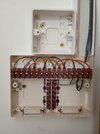
 
E.g. as shown. Just an illustration using an offcut of cable that I'd previously stolen the CPC/earth from.
 

Attachments

  • IMG_20250522_130436694.jpg
    IMG_20250522_130436694.jpg
    202.2 KB · Views: 126
Can they be accessed without a tool or not? I guess you could possibly argue that your trunkings cover could be removed without a tool using just ones own fingers.

I know it's common to get single insulated cables within commercial trunking applications, however in those applications the cables could not (or should not) be able to be accessed without a tool and would also meet the IPXXD or IP4X requirement of Reg 521.10.1

Regulation 521.10.1 of BS 7671 requires that non-sheathed "single" cables for fixed wiring can only be installed in cable trunking if the trunking provides at least the degree of protection IPXXD or IP4X and if the cover can only be removed by means of a tool or a deliberate action. (See the regulation for the precise wording.)
 
I'd say it is poor practice not to have the sheath entering the box.
Also, I'd be inclined to leave the cores long enough to reach the furthest connector terminal - in case you make a mistake when connecting.
WHERE'S THE EARTH WIRE?
 
Thanks, that all makes sense. Not the answer I was hoping for, personally I'd be happy with it but I see the point entirely. I want a new consumer unit installing at some point, by an electrician, which will involve a complete inspection. So I can't do anything that would be condemned.

I'll bring in a second trunking on the left and carve another access route into the top left, to double the width of the access to the wiring centre.

Thanks for the really useful feedback about my pants. Yes they are pants.
 
I would have left the sheath on and cut it where it goes behind the connector strip
Thank you, a very good point - the narrow point is below the connector strip.

I'm adding a second trunking now to give more space, but may still need to do this. The wiring centre does have screws, so it ticks the box if the sheath ends anywhere within it.

There are a lot of wires. 4 zones. Think I'm finding the limits for a standard wiring centre! It'll be fine though.
 
Just watch out for people who are so daft that they'll tell you things which aren't true.
 
My understanding is that you *can* have exposed single cores in trunking, but if you do then you need to install that trunking a lot more carefully than if you are putting sheathed cables in there.

BS7671 requires a "tool or deliberate action" to open trunking containing singles. I don't think I've ever seen plastic trunking that requires a tool. So the question is does trunking require a "deliberate action" to open, I would argue in general yes it does, but you should make sure you avoid leaving edges that could result in the lid getting caught and ripped off.

BS7671 also requires the system to meet IPx4 or IPxxD. That basically means you can't have any holes bigger than 1mm. Also apparently BS EN 50085 says "According to protection against ingress of solid foreign objects, IP4X or any higher degree of protection shall not be declared when it relies on butt joint or the accuracy of cutting of ducting lengths or trunking lengths or access covers without providing relevant fittings or assembly means or additional factory prefabricated sealing means"

It's not clear to me if following BS EN 50085 is mandatory, but it shows what is IMO a fundamental difficulty. You may be able to close up but joints to an accuracy of better than 1mm when the installation is new, but it's hard to keep them that way if there is no overlap or mechanical coupling between the trunking system and the enclosures that it serves..
 
My understanding is that you *can* have exposed single cores in trunking, but if you do then you need to install that trunking a lot more carefully than if you are putting sheathed cables in there.

BS7671 requires a "tool or deliberate action" to open trunking containing singles. I don't think I've ever seen plastic trunking that requires a tool. So the question is does trunking require a "deliberate action" to open, I would argue in general yes it does, but you should make sure you avoid leaving edges that could result in the lid getting caught and ripped off.

BS7671 also requires the system to meet IPx4 or IPxxD. That basically means you can't have any holes bigger than 1mm. Also apparently BS EN 50085 says "According to protection against ingress of solid foreign objects, IP4X or any higher degree of protection shall not be declared when it relies on butt joint or the accuracy of cutting of ducting lengths or trunking lengths or access covers without providing relevant fittings or assembly means or additional factory prefabricated sealing means"

It's not clear to me if following BS EN 50085 is mandatory, but it shows what is IMO a fundamental difficulty. You may be able to close up but joints to an accuracy of better than 1mm when the installation is new, but it's hard to keep them that way if there is no overlap or mechanical coupling between the trunking system and the enclosures that it serves..
IPXXD is far less stringent than IP4X.
 

If you need to find a tradesperson to get your job done, please try our local search below, or if you are doing it yourself you can find suppliers local to you.

Select the supplier or trade you require, enter your location to begin your search.


Are you a trade or supplier? You can create your listing free at DIYnot Local

 
Back
Top