The backs are hollow ground, so it occurs to me that after a few sharpenings, there is no flat edge left to form the bevel.
Is there something I'm missing?
Yes, there may be. I did try a small set of Japanese chisels back in the early 1980s when Roger's were the only people importing them (remember them, pre-Sarjents of Reading and Axminster?). Amazingly sharp (when properly sharpened - but it requires the right stones), but liable to chip far too easily on hardwoods such as oak and maple IMHO.
To maintain them you are supposed to flatten the back every time you sharpen them, in which case the hollows will retreat up the back, thus (image found on the 'net):
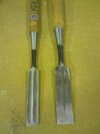
That hollow is called Ura or Urasaki (I've just had to look that up as I just couldn't remember the exact word) and is created by hammer forging. From a couple of books I read on the subject at the time, I recall that if you do grind the back flat you should either get an anvil and a hammer and reforge the Ura or send the chisels back to the maker to have them reforged - supposedly every 5 to 10 years in Japan... (like that was ever going to happen with mine)
I found I couldn't live with them at the time because:
- you need a set of 4 or 5 waterstones or more (including a flattening stone, and plus a nagura stone) to maintain the edges. Having to soak my waterstones for 20 minutes before use and then keep them wet in a bucket of water was hell on a cold winter morning and forever flattening the waterstones (because they get hollow very, very quickly against western oil stones) was a PIA. I can honestly say that the modern glass-backed Shapton water stones are far quicker and easier to use, just splash on some water and you are ready to go, however, they still go hollow and need flattening periodically. Against that diamond plates have made sharpening a lot faster for western chisels
- the chisels I bought needed the hoops fitting
because I use hammers. Apparently this is the norm on reasonable quality chisels
- the edge chipping, When they are sharp and used on mild timbers they are superb, but on hardwoods like oak and hard maple they were less than ideal - that 25 degree (approx) single bevel (never a double bevel - although David Charlesworth used to recommend just that

) is too thin and brittle I found. My problem is I don't often have the luxury of knot-free mild timbers, but saying that on knot-free pine, poplar, etc they were exceptional
- I found them a bit more rust prone than western chisels (even using the right oil). Not brilliant if they live in the van or a damp shed for stretches of time (my western chisels are bad enough in that environment)
- the short backs make the standard chisels less than useful for mortising - you can get Japanese mortise chisels, but I can mortise with a standard set of western bevel edge firmer chisels without the need to carry a second chisel roll with me
- I find most Japanese chisels are just too thick to pare out dovetails, etc
- those hollow backs (Uri) can make them difficult to steer along the length of narrow materials
- I'm not a fan of the handle offset, either. Western chisels are designed so that the handle is in line with blade. The Japanese chisels I had had handles offset a few degrees from the blade which I find uncomfortable. I have tried a couple or three other peoples' chisels and it seems to be a fairly consistent thing with them in my limited experience
How do you find them in use? Do yours hold an edge for long enough? They didn't work for me, but what's your take?
Against all that I do like the Japanese pull saws (and I have quite a few), although again they have limited appeal to me as site tools



 . I picked up various blades in sales and what-have-you initially (like I used to do with traditional Jack saws), not realising that the blades last an unbelievably long time - they seem to stay sharp forever.


