
I've never heard one say that
But then I don't do domestic work.
But then I don't do domestic work.


Simple question for everyone:
If an electricity distributor says to you
"You may NOT use OUR fuse to protect YOUR cables", what do you do?
Two immediate possibilities come to mind:If an electricity distributor says to you .... "You may NOT use OUR fuse to protect YOUR cables", what do you do?
 .
.As I said, I've fitted 80A fuses not far from 'right next' to their 60A onesSuppose I'd have to fit another 80 amp fuse right next to the other one probably
I wonder what they would say about that, given that my 80A fuses are fine for protecting my cables, yet it's quite possible that their 60A ones would blow first? 

Suppose I'd have to fit another 80 amp fuse right next to the other one probably
Provide your own fuse!
1. Yes, one could do that. And they could either change their rules after such a challenge, or they could say "Do you want to connect to our network or not?".Two immediate possibilities come to mind:
1.... Maybe suggest that they go away and learn some Physics? They really ought to understand that if one installed an additional fuse (of credible/practical rating) it would be impossible to guarantee that it would NOT be THEIR fuse which operated first (hence "protecting ONE'S cables") in the event of excessive current flowing in ONE'S cable - so that if they really wanted to be sure that a fuse of theirs would never find itself protecting one's cables, they would need to replace it with a very fat nail
2... Tell them that what they say is fine - since you do not wish your cables to have any such 'protection'.
They could - but I'm far from convinced that, in practice, they would.1. Yes, one could do that. And they could either change their rules after such a challenge, or they could say "Do you want to connect to our network or not?".
I presume you're talking about an EICR? If so, why would it be 'coded' at all? If one's meter tails were adequately protected by a fuse (which happened to be the DNO's fuse), would that not be fine as far as an EICR was concerned, regardless of any silly statement from the DNO that their fuse 'could not be used' for that purpose (when it was actually doing just that)?2. Yes - there are probably all sorts of ways in which one could contravene the regulations if one didn't like what they said. Would that one be a C1, C2, or C3?
Who knows what they would in practice do. I take issue (great issue) with all those who flatly refuse to accept that they are entitled to insist on a fuse or that such an insistence is laughably unjustifiable and can therefore be completely ignored.They could - but I'm far from convinced that, in practice, they would.
It seems pretty clear from what UKPN say that the regulations require their agreement for their fuse to be used.I presume you're talking about an EICR? If so, why would it be 'coded' at all? If one's meter tails were adequately protected by a fuse (which happened to be the DNO's fuse), would that not be fine as far as an EICR was concerned, regardless of any silly statement from the DNO that their fuse 'could not be used' for that purpose (when it was actually doing just that)?
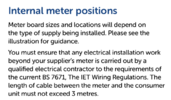
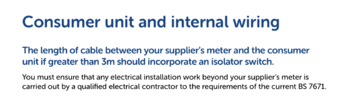
That surely makes no sense? An upstream fuse of appropriate rating to provide adequate protection against overcurrent for a cable of a given CSA (and installation method) provides that protection regardless of its length. Hence, if the DNO fuse is adequate to protect a cable (of given CSA and installation method) which is less than 3m in length, it's surely adequate to protect that cable if it is longer than 3m, isn't it?.... If the distance between the cut-out and the consumer unit is greater than 3 metres an additional point of overcurrent protection (e.g. switch fuse etc.) shall be installed to ensure adequate protection of the meter tails is afforded².
Yes, it does say that but, as above, why on earth would (should) a DNO not agree that that their fuse provides adequate fault protection IF their (upstream) fuse is of an appropriate rating to provide adequate protection for the cable concerned?² BS 7671 (regulation 434.3) states that a device for protection against fault current may be omitted if the DNO agrees that the protection at the origin of the installation (cut-out fuse) affords protection up to the main distribution point ...
It does, indeed, also say that but, again, it makes no real sense to me. The whole point of having a protective device is in case, despite attempts to minimise the risk (which, hopefully one does in any situation), a fault does occur? One could surely say that any cable should be installed "such as to reduce the risk of a fault to a minimum" (and, in no other context would one suggest that an upstream protective device only provided protection for a short length of cable).... and that the wiring between the origin and main distribution point is carried out in such way as to reduce the risk of a fault to a minimum.
That seems to be an 'abuse' of 434.2.1 - which says that 'downstream' fault protection is acceptable under certain circumstances if the protective device is no more than 3m from the origin of the cable (or point at which CSA reduces). We are talking about a DNO fuse which is upstream of the entire length of the tails concerned.As per BS 7671 (regulation 434.2.1), UK Power Networks considers a distance not exceeding 3m (between the cut-out and main distribution board) sufficient to minimise the risk of a fault or damage occurring.
NICEIC have views about all sorts of things, but not necessarily views with which everyone agrees. They have no 'authority', except, in some senses, over their members.It seems pretty clear from what NICEIC say that the regulations require the distributors agreement for their fuse to be used.
An EICR is surely not required to consider compliance (or otherwise) with DNO conditions/statements, is it? If an EICR inspector is satisfied that there is an upstream fuse providing adequate overcurrent protection to the meter tails (per Physics, electrical principles and BS 7671 general requirements for overcurrent protection), is that not 'satisfactory'.So an electrician encountering a contravention of the regulations has a choice: C1/C2/C3 or taking the view that the DNO are being very silly indeed and he's just going to ignore what they say and pretend that the contravention isn't happening.
See above.Which would you suggest he does, given that he is a professional and being paid to produce a professional report on the condition of the installation wrt its compliance with the the regulations?


I am sorry you do not seem to understand the situation.Don't be silly.
It just makes you look like a petulant child who keeps on asking "Why?" "Why?" "Why?" "Why?" over and over again.
How do you prevent it doing so?"You may NOT use OUR fuse to protect YOUR cables",
Of course. Eureka!Simple question for everyone:
If an electricity distributor says to you
"You may NOT use OUR fuse to protect YOUR cables", what do you do?
That doesn't matter if the DNO don't give permission to use their fuse, and the wiring regulations say you must have it.That surely makes no sense? An upstream fuse of appropriate rating to provide adequate protection against overcurrent for a cable of a given CSA (and installation method) provides that protection regardless of its length. Hence, if the DNO fuse is adequate to protect a cable (of given CSA and installation method) which is less than 3m in length, it's surely adequate to protect that cable if it is longer than 3m, isn't it?
It doesn't matter why they would not agree, except in the context of lobbying them to change their rules.Yes, it does say that but, as above, why on earth would (should) a DNO not agree that that their fuse provides adequate fault protection IF their (upstream) fuse is of an appropriate rating to provide adequate protection for the cable concerned?
That doesn't matter in the context of whether you have the authority to disregard DNO rules and wiring regulations.It does, indeed, also say that but, again, it makes no real sense to me.
I'd not be surprised if that was a general requirement.One could surely say that any cable should be installed "such as to reduce the risk of a fault to a minimum"
So nowhere else in the regulations is there a relationship between cable length and the type of protective device? OK.(and, in no other context would one suggest that an upstream protective device only provided protection for a short length of cable).
Who is abusing any regulation by quoting it if it explicitly says that DNO agreement is required?That seems to be an 'abuse' of 434.2.1
That's the whole point. The cables are more than 3m long AND THE FUSE IS NOT THE PROPERTY OF THE OWNER OF THE ELECTRICAL INSTALLATION AND THEREFORE HE MAY NOT USE IT HOWEVER HE CHOOSES JUST LIKE HE MAY NOT CHANGE IT TO A DIFFERENT VALUE.- which says that 'downstream' fault protection is acceptable under certain circumstances if the protective device is no more than 3m from the origin of the cable (or point at which CSA reduces). We are talking about a DNO fuse which is upstream of the entire length of the tails concerned.
If you have a copy of the regulations please scan and upload the regulation in question to show that NICEIC have misquoted it. Same for the quote that UKPN gave.NICEIC have views about all sorts of things, but not necessarily views with which everyone agrees. They have no 'authority', except, in some senses, over their members.
No, but unless UKPN and NICIEC have falsified quotes it is an actual wiring regulation which states that the DNO have to agree for their fuse to be used.An EICR is surely not required to consider compliance (or otherwise) with DNO conditions/statements, is it?
It seems I need to remind you that, unless the quotes are falsified, there is an explicit requirement for DNO agreement in the regulations.If an EICR inspector is satisfied that there is an upstream fuse providing adequate overcurrent protection to the meter tails (per Physics, electrical principles and BS 7671 general requirements for overcurrent protection), is that not 'satisfactory'.
It would seem to me that unless those regulation quotes have been falsified there is no alternative to saying that if the owner of the fuse denies you the right to use it then you have no fuse at all from a regulatory compliance POV.It would seem (at least to me) rather bizarre to suggest that, say, 25mm tails protected by an 80A or 100A fuse was "potentially dangerous, requiring urgent remedial action"! Even (to my mind) "Improvement recommended" would be stretching things!
I don't believe you, but I haven't got time to respond to your 'sentence-by-sentence' responses to what I wrote at the moment. I'll try to find time to respond a bit more later.Good grief - you really have jumped onto EFLImpudences hands-over-the-eyes, fingers-in-the-ears, can't-see-or-hear-anything-I-don't-want-to bandwagon, haven't you.

If you need to find a tradesperson to get your job done, please try our local search below, or if you are doing it yourself you can find suppliers local to you.
Select the supplier or trade you require, enter your location to begin your search.
Are you a trade or supplier? You can create your listing free at DIYnot Local