
• Looking for a smarter way to manage your heating this winter? We’ve been testing the new Aqara Radiator Thermostat W600 to see how quiet, accurate and easy it is to use around the home. Click here read our review.

Filling voids under suspended timber framework floor

Joined
20 Jan 2016
Messages
114
Reaction score
13
Country
United Kingdom
Hi
I'm just building a frame to make a floor level - because the original house floors drop away quite significantly.

I've laser mapped the floor and cut the fillets to measure, the end nearest the door skims down to a few mm and then on to latex, whereas the far end has raised about 7" (it's all now perfectly level!). On top will be fitted 25mm hardwood ply, and then LVT final floor. (The ply already down on the latex section will have 1200g DPM under - I've just tried it up to fit first).

Just some questions if anyone can help me please....

I'd like to put some insulation in to help both the heat retention and to deaden the hollow sound - especially in the highest parts. Buildings regs aren't keen on this, maybe because the insulation cannot fill the entire floor? Would anyone know if I can insulate this or do something to avoid the hollow sounds? Possibly just chuck in all the offcuts of insulation to reduce the air volume or is that a bit mad??

I don't want to stagger the boards as I wanted two complete length boards across the frequently used door entrance section, would anyone think that staggering boards should really be necessary given the 25mm size ply I'm using?

Anything else to comment before I start glueing and screwing this lot down please?

Thanks,
Dave
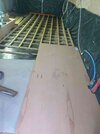
 

Attachments

  • floor - wall.jpg
    floor - wall.jpg
    224 KB · Views: 54
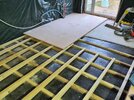
  • floor - door.jpg
    floor - door.jpg
    478.4 KB · Views: 53
Hi
I'm just building a frame to make a floor level - because the original house floors drop away quite significantly.

I've laser mapped the floor and cut the fillets to measure, the end nearest the door skims down to a few mm and then on to latex, whereas the far end has raised about 7" (it's all now perfectly level!). On top will be fitted 25mm hardwood ply, and then LVT final floor. (The ply already down on the latex section will have 1200g DPM under - I've just tried it up to fit first).

Just some questions if anyone can help me please....

I'd like to put some insulation in to help both the heat retention and to deaden the hollow sound - especially in the highest parts. Buildings regs aren't keen on this, maybe because the insulation cannot fill the entire floor? Would anyone know if I can insulate this or do something to avoid the hollow sounds? Possibly just chuck in all the offcuts of insulation to reduce the air volume or is that a bit mad??

I don't want to stagger the boards as I wanted two complete length boards across the frequently used door entrance section, would anyone think that staggering boards should really be necessary given the 25mm size ply I'm using?

Anything else to comment before I start glueing and screwing this lot down please?

Thanks,
Dave
What a can of worms you have made there. I think I'd have been inclined to use a floor leveller, or s/c screed leveller (for the deeper bits), polythene, then fitted insulation boards direct to the polythene and floated some T&G glued together flooring on top.
 
Last edited:
It was a can of worms me buying this house in the first place TBH!

According to my understanding the building suffered settlement with the levels partly due to a very large extension being attached which pulled the entire building to one side and because it's all built on peaty soil with part of the river running close-by which has now dried up. Over the recent years I am 99% confident the shifting has settled down.

For the room next to this we dug down and made a concrete floor on top of insulation, this cost about £2500 and that room was about 1/3 of the size of this one, so I'd be looking at maybe £6-7k to do this one the same, hence timber filleting seems the cheaper option although is a little complex when it comes to the issues of insulation/vapour/etc.

Somebody came today to have a look and said the more insulation I can get in there the better. It wouldn't be touching the original floor and so there would be an unvented void underneath of 1" courtesy of the tile battening I fixed down - unless it's a better idea to fill that void entirely with foam?. Could I possibly either ventilate the void by fitting soffit vents under cupboards, or try and stop any moisture entering by using a VCL on top of the insulation and under the ply?
 
OP,
Thats a nice bit of carpentry, well done, but unfortunately its not the best solution.
However, no drama its down so just carry on with finishing the floor.
Where possible, you could fit ventilation grills at the side edges of the floor - google "floor strip venting".
You dont need "25mm hardwood ply" - staggered 18mm OSB would do fine.
Your benchmark is your FFL where it meets the threshold: ie take account of the LVT & its underlay.

FWIW:
As above, screeding & SLC would have been the best solution.
Whats the purpose of the black plastic sheeting on the LH wall?
No big deal but its firrings not "fillets".
 
Hi Ree
Thanks for your compliment :), that's the part I know but unfortunately the rest of what I need to do is a bit of a haze to me! It's 25mm ply that I've already got and have allowed for that to get it to FFL where it blends in to other rooms. I get that screeding/SLC would be good in "normal" houses, but I've got a wedge up to 7" to fill which is a massive amount. The black sheet is tanking (an architect told me to tank 1M up the walls - maybe because we're next to a river) and the original floor is liquid DP'd with BlackJack (since I believe the quarry tiles were actually intended to be the DPC).

With all the concerns about Inter-condensation it sounds far less complicated if I leave the floor voids entirely empty and just have this as a cosmetic ramp? Although I'm sure it would need a VCL included underneath the ply? Would that be fair to say and am I complicating things by wanting it filled?
 
OP,
You weren't to know but 7" is no big deal, its certainly not a massive amount.
For reference: on floor jobs like yours its often best to get a professional in for the day, a morning's work actually but you pay for the day.
A guy who does screeding would glance at the job - order in the materials - prep - mix, or get you to mix.
And then do the screed. It would work out as a very good deal - cheap and quick compared to DIYing it.

Do you intend to erect a stud framing the room side of the plastic sheet?
Whats on the other side of that wall?

Its a risk but given the idea is air movement then leave out all insulation & dont use a VCL.
 
I guess when people like myself are in the position of having done so much work already and purchased all the gear then it's going to be nigh on impossible to change minds! I'm thinking of this as essentially an insulated stud wall on it's side. All the walls will have stud walls (because if the floor is out of true then so are the walls) and the long section of sheeting is against an external wall so PIR boards in studwork will be used on that.
 

If you need to find a tradesperson to get your job done, please try our local search below, or if you are doing it yourself you can find suppliers local to you.

Select the supplier or trade you require, enter your location to begin your search.


Are you a trade or supplier? You can create your listing free at DIYnot Local

 
Back
Top