• Looking for a smarter way to manage your heating this winter? We’ve been testing the new Aqara Radiator Thermostat W600 to see how quiet, accurate and easy it is to use around the home. Click here read our review.

Self charging plug in hybrid, is there such a thing?

Joined
7 Jan 2010
Messages
14,123
Reaction score
4,121
Location
Dystopia, a small island too close to Europe
Country
United Kingdom
Talking today, the discussion got on to hybrids, my friend said they were the best of both worlds, I replied that they were also the worst of both worlds- as I think (correct me if I'm wrong) that neither ice or hybrid will work on their own if there is a fault in either. You have plug in hybrids and self charging hybrids, but is there such a thing as a plug in self charging hybrid, and if not, why not?
 
The plug-ins do self-charge to a certain degree but I think they can only take it to about 30/40% of a full charge. Some hybrid cars run full time on electrical power - but the electricity is produced by running a petrol engine to produce the electrical power! When you stick your toe down, the engine revs its nuts off to produce the electricity for the drive motors. Plug-ins on average can only do 30-40 miles before the engine kicks in. Great if you only do 30 miles a day and plug it in every night. Electricity is not exactly free though and if you have to buy it from a charge station, it can be bloody expensive. Once your battery is depleted, you are then paying for it in mpg because you are carting a heavy battery around. Our next car is going to be a self charging hybrid so I’ll see how it goes before even thinking of going plug-in or fully electric.
 
We bought a self charging (only) hybrid and it’s a good all rounder

Honda HRV, had it nearly a year now
 
Some hybrid cars run full time on electrical power - but the electricity is produced by running a petrol engine to produce the electrical power!
Funnily enough, and I never knew that until we blagged an engine room visit on a cruise we were on, that’s how cruise ships work, so hybrid is nothing new in seafaring vessels. Our one had four massive V8 diesel generators producing electricity. Only one was needed for in port and running all the ships cabin power etc, another one or two were used for the drive motor depending on sea conditions. The other was always a spare or being overhauled. They were overhauling one of them during our visit. 8 new individual 4 valve cylinder heads, the size of a mini, pistons the size of a dustbin. Look at the size of this piston ring!

IMG_0322.jpeg
 
but is there such a thing as a plug in self charging hybrid,
No. One excludes the possibility of the other.

Hybrids or 'self charging hybrids' as Toyota now calls them are cars with a petrol engine, a small battery and an electric motor. The battery is charged from the petrol engine and when braking which uses the motor as a generator.
They can drive short distances on electric only, and can have the electric motor provide assistance to the petrol engine, or drive on the petrol engine only. They have been available for the best part of 30 years, and their peak occurred over a decade ago.

A plug in hybrid is basically the same thing with the addition of a charge port so the battery can be charged using electricity from a power outlet. The rest of the system is the same, so the battery can also be charged from the engine and braking.
A 'plug in self charging hybrid' is just called a plug in hybrid.

Other variants:
the 'mild hybrid' which has an even smaller battery and a feeble electric motor so that the battery is only charged from the engine and braking. The motor cannot move the car on it's own, the engine is used 100% of the time with a tiny bit of assistance from the electric motor some of the time. No plug in option, and they only exist so that manufacturers can continue selling petrol engine vehicles for a bit longer.

The 'e-power' contraptions which Nissan sells where a petrol engine charges a small battery and that is used to power an electric motor. The engine cannot move the vehicle, it's sole purpose is to charge the battery. It's an electric car entirely powered by petrol with no option to charge using electricity. No actual use case for such things exists and it's a mystery why anyone would ever consider such a thing.

Range extended EVs, which are electric vehicles that are usually charged from an electrical outlet, but also have a petrol engine generator in the back to charge the battery and provide extra range. Very few were made and those who bought such items rarely used the extender part. Obsolete now that EVs can do 100s of miles on a charge.

 
Talking today, the discussion got on to hybrids, my friend said they were the best of both worlds, I replied that they were also the worst of both worlds- as I think (correct me if I'm wrong) that neither ice or hybrid will work on their own if there is a fault in either. You have plug in hybrids and self charging hybrids, but is there such a thing as a plug in self charging hybrid, and if not, why not?
The Toyota Prius I think pioneered the use of its variable valve timing to use the Atkinson cycle to give enhanced fuel economy, I think its still used today. I think they also stored hot coolant in a insulated thermos flask to give very fast warm up from a cold start, don't know if this feature has been retained.

The Chevy Volt was an all electric motor drive with a petrol generator to charge the batteries only?
 
The Toyota Prius I think pioneered the use of its variable valve timing to use the Atkinson cycle to give enhanced fuel economy, I think its still used today.
My brother in law has a Kuga plug-in hybrid. That uses a modern version of the Atkinson cycle.
 
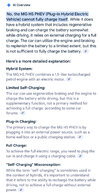
Apparently,the MG HS PHEV can recharge itself once discharged.
 
Apparently,the MG HS PHEV can recharge itself once discharged.
Most PHEV's can recharge themselves to a certain degree but most of them can't fully recharge to a full battery unless they are plugged in to the mains. Those that can self charge themselves fully, cost an absolute fortune in fuel using the ICE to charge the battery, much more than if charging it with cheap rate electricity so pretty pointless really.

IMG_8049.jpeg
 
What is the economy benefit in running a full hybrid like the Prius vs say the same, or equivalent car (non hybrid) with the same Atkinson cycle & thermos flask + Stop/Start etc.
 
Talking today, the discussion got on to hybrids, my friend said they were the best of both worlds, I replied that they were also the worst of both worlds- as I think (correct me if I'm wrong) that neither ice or hybrid will work on their own if there is a fault in either. You have plug in hybrids and self charging hybrids, but is there such a thing as a plug in self charging hybrid, and if not, why not?

It all gets incredibly complicated with hybrids, and the "marketingspeak" doesn't help one bit! Engineers tend to talk about "series hybrids" (where only one powertrain - usually the electric motor, can turn the wheels) and "parallel hybrids", (where either - or both can turn the wheels). As far as I can see, any hybrid could be turned into a "plug-in" hybrid, by adding a charging socket.

I think you're right to regard hybrids as the worst of both worlds. All the weight and complexity of both powertrains, all the servicing needs of an internal combustion engine (which, in many cases, can lead an utterly miserable life - frequent cold starts and short periods of running). They can give absolutely fantastic "official" figures for CO2 emissions and fuel consumption, but only because the official drive cycle in the type approval tests only covers about 15 miles! Once a hybrid's battery is flat, it's just an ICE car lugging an electric motor and battery around everywhere with it. I could chuck my petrol generator in the boot of my EV, and a couple of jerry cans of fuel, if I wanted that!

The EU has wised-up to the way plug-in hybrids are used in real life, compared to the way the official drive cycle tests are carried out, and has just changed the "utility factor" in the calculations. From the start of next year, all new cars sold in the EU will have to use these new factors when quoting PHEV fuel efficiency and CO2 figures - and they will become MUCH worse. I think that will seriously affect the popularity of plug-in hybrids.
 
Not sure i agree with the comment above. We have a self charging hybrid and it’sa good package and economical too - better on local journeys than on motorways.

As most of the mileage is locally that suits us
 
Not sure i agree with the comment above. We have a self charging hybrid and it’sa good package and economical too - better on local journeys than on motorways.

As most of the mileage is locally that suits us

That's fair. If your running is such that you can do a significant proportion of it under electric power, they can be quite good, but as a whole, most of them aren't. We often get plug-in hybrids back as trade-ins, and it's patently obvious that the charging cable is still in its original factory packaging and has never been used. Remember the OP's post was specifically about the plug-in ones.
 
We often get plug-in hybrids back as trade-ins, and it's patently obvious that the charging cable is still in its original factory packaging and has never been used.
Is that just the granny lead though? I'd have thought that most people buying plug ins would be using a proper charge box at their home.
 
What is the economy benefit in running a full hybrid like the Prius vs say the same, or equivalent car (non hybrid) with the same Atkinson cycle & thermos flask + Stop/Start etc.
Do they do a non hybrid Atkinson engine powered vehicle - I’d have thought they would be a bit gutless?

"In essence, while the Atkinson cycle offers efficiency gains, it comes at the cost of reduced power output, requiring careful consideration and often integration with other technologies like electric motors in hybrid systems to mitigate the drawbacks".
 
Back
Top