new boiler cold radiators where does installers liability end

The process is quick, easy and fairly informal.

I would suggest that for many people that couldn't be further from the truth..when did you last apply for a court judgement?
20 years ago when I issued my 1st claim it was far more straightforward but the process is now more time critical and formal.
A recent claim I helped our daugher with had the defendents solicitor harassing her for weeks...that added a whole extra level of trouble. Only at the very last deadline did they buckle under...7 months of agro. Luckily they paid up but many don't leading to months/years of more hassle.
 
I would suggest that for many people that couldn't be further from the truth..when did you last apply for a court judgement?
20 years ago when I issued my 1st claim it was far more straightforward but the process is now more time critical and formal.

Had three, one not mine, won three, last around 15 years ago, all very straight forward. If anyone made a nuisance of themselves, as you suggested the solicitor did, I would have been making a formal complaint.

Any company, will likely have assets which can be targeted, so getting prompt payment should pose much of a problem.
 
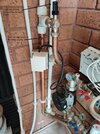
Is the pump running?, if so what are those colours. Grundfos frequently recommend running at full speed, initially, constant curve III below, one green LED followed by two amber, this allegedly gets rid of the air eventually (I have my doubts about this) but it can create havoc with a OV system like yours if it is or has been left running at this speed as it will pump at a head of 6.4M which can cause pump over into the feed & expansion cistern leading to constant air ingress, if it is running in this mode&setting I would suggest changing it to constant curve I, just one solid green LED, which should still give a more than adequate head of 4.2M and far less chance of pump over, just press the setting button briefly to change settings.
This "valve" you show is probably a manual air vent, if there is a square on the top, a rad bleed/vent key should fit it, ensure you vent this often/repeatedly until all air is gone.
THe section of pipe where the cold feed is teed in frequently gets blocked/partially blocked leading to all sorts of problems, carry over etc and sometimes requires cutting out and replaced with a new section of piping, you could also convert it, like my 53 year old system, to a combined vent&cold feed with a almost 100% guarantee of no pump over.

Can you also follow the pipe back from the pump bottom (inlet), you might see a 15mm pipe with a 22mm pipe a bit further back but no more than 150mm/6ins from it, the 15mm pipe will be the cold feed from the feed&expansion cistern and the 22mm will be the vent that should carry on up and over the cistern and then turn back down with its end pointing into the cistern.
If you wish you can initially run the pump on speed III and look or get someone to look into the cistern and watch for any pump over through that vent on pump start up and again on pump shut down, then change to Speed I and look again in the cistern

View attachment 390741
Right.... now I`ve been here before so I`m not going to count my chickens but... I turned the pump down to one and all the whooshing noises have stopped and I`ve been able to turn ALL the rads on, all hot, all quiet (previously I could only open 3 before the noises and vibration set in.) As I say, the morning will be the test but as it stands, what can I say, this seems to have solved it. Again, what, in laymans terms, has happened?
 
THANK YOU TO EVERYONE WHO HAS CONTRIBUTED IDEAS TODAY, I APPRECIATE ALL YOUR TIME AND i WILL CONSIDER ALL YOUR THOUGHTS OVER NEXT COUPLE OF DAYS - ALTHOUGH HOPEFULLY, FINGERS CROSSED, WE HAVE A SOLUTION.
THANKS AGAIN!
STEVE
 
This "valve" you show is probably a manual air vent, if there is a square on the top, a rad bleed/vent key should fit it, ensure you vent this often/repeatedly until all air is gone.
The section of pipe where the cold feed is teed in frequently gets blocked/partially blocked leading to all sorts of problems...

Can you also follow the pipe back from the pump bottom (inlet), you might see a 15mm pipe with a 22mm pipe a bit further back but no more than 150mm/6ins from it, the 15mm pipe will be the cold feed from the feed&expansion cistern and the 22mm will be the vent that should carry on up and over the cistern and then turn back down with its end pointing into the cistern.
Returning, if I may, to the problem of your heating malfunction (as I expect that nursing the good lady back to health has a higher priority than taking on the injustice system).

Johntheo5 has given good advice.
Though not shown on your photos I also suspect you have a fill and vent arrangement as described by Johntheo5. All your pipework rises after the pump, therefore air will need to be vented manually as described by him.

Below the pump (but not shown) there should be two pipes joining into the 22mm 'primary' pipe, one 22mm and the other 15mm size. Each should go directly into the loft, the 15mm pipe connected to the water supply from the f&e tank, the 22mm one venting just above it. It is where the 15mm joins the 22mm primary that the magnet test should be applied - an attracted magnet means a build up of magnetite inside the pipe, which may be the source of your problem.
A blockage in the cold feed will cause air to be sucked down the 22mm vent pipe on pump (system) start-up. You have described the noise of entrained air previously.

A temporary solution would be to reduce the pump speed to 1, then bleed the high points with the system OFF (pump not running) and the heating valve lever locked in its MANual position. Once the air has been vented set the heating valve lever back to AUTO and turn on the HOT WATER only. The pump will start at speed 1 and you may need to bleed more air from the high points before the system goes quieter.
At this point stop the system and wait for the pump to stop.
Set the HW again to ON and verify the system remains quiet. If it does then switch ON the heating too, and bleed again if necessary.
If all seems well then change the pump speed to 2 (II). Again verify a quiet operation before repeating the stop-start of the system.
FYI Speed 2 is the usual speed for an 18kW boiler and eight rads.

You may need expert help to remove hardened magnetite from the cold feed pipe, but let's not get ahead of ourselves...

MM
 
Apologies, whilst writing my last contribution I missed two messages....

If all seems better now, then perhaps a system balance would be in order, followed by addition of flushing chemicals to clear the magnetite (into the new filter)....but that's for another day.
 
Again, what, in laymans terms, has happened?

1. You may have solved, with a little help, what your paid experts seemed unable to resolve.
2. Your pump has stopped over pumping, putting lots of air into the header tank, exacerbating the problem of air getting into your system, and causing airlocks.

If you have definitely solved the problems, the installer owes you a refund for the extra visits, plus he needs to now install the legally required TRV's, and make sure your system has inhibitor solution installed,
 
THANK YOU TO EVERYONE WHO HAS CONTRIBUTED IDEAS TODAY, I APPRECIATE ALL YOUR TIME AND i WILL CONSIDER ALL YOUR THOUGHTS OVER NEXT COUPLE OF DAYS - ALTHOUGH HOPEFULLY, FINGERS CROSSED, WE HAVE A SOLUTION.
THANKS AGAIN!
STEVE
Well done Steve.

There may be air still in the system. Every now and then, go round and bleed the radiators and the air nipples in your airing cupboards.

Do be patient and only open the nipples so that you hear air. Not too much!!!
And make sure the heating is off and the pump isn't running when you do this.
 
This morning, for the first time since June, the heating came on, silently, and all the radiators are hot. It seems the problem IS finally solved! (Sadly it`s so hot I can`t actually revel in my new-found warmth, but the time will come)

Well done Steve.

There may be air still in the system. Every now and then, go round and bleed the radiators and the air nipples in your airing cupboards.

Do be patient and only open the nipples so that you hear air. Not too much!!!
And make sure the heating is off and the pump isn't running when you do this.
Yep, I will do that, but it is virtually silent now. Previously at switch on it sounded like there was a babbling brook flowing through the kitchen radiator:giggle:
I`ve been round the radiators and there`s no trace of air, will keep an eye on everything as you suggest but it all seeems to be running as it used to. (I did get them to add inhibitor after they last flushed it)
Once again, THANK YOU to everyone who offered their advice, esp. johntheo5, I really can`t express what a relief it is to be able to finally put this behind me.
 
Last edited:
Once again, THANK YOU to everyone who offered their advice, esp. johntheo5, I really can`t express what a relief it is to be able to finally put this behind me.

I hope you will be asking them for a refund for those extra visits, plus a little extra for having to struggle to resolve the problems yourself, after they failed miserably?

On my system, I've found it can take upto two months of bleeding, before I finally get all the air out. Mostly, the air seems to collect in the bathroom radiator.
 
I`ll be honest, I want nothing further to do with them. Absolutely nothing. I didn`t pay for 3of the 4 visits, but absurdly they are still after £100 for coming outon the 3rd: I`m just leaving it... if they do continue then I`ll pursue the TRVs, and post my.... not so glowing review on Trustpilot etc. Otherwise, I`m sure you can understand, I`m just SO happy it`s all working and I can focus on getting Deb back on her feet.
 
I`ll be honest, I want nothing further to do with them. Absolutely nothing. I didn`t pay for 3of the 4 visits, but absurdly they are still after £100 for coming outon the 3rd:

Understandable! I would at least suggest you reply to their email demanding that payment, explaining that despite you not being an heating engineer, that you did eventually manage to get the system back into working order, without their further 'skilled' help, and that you fully anticipate they will cancel that claim for £100. It will forestall them pestering you further, or them perhaps seeking a claim in court, against you.

Up to you really, whether you explain to them how you solved it - maybe explain the cause, if they ask.

Do make sure they send you the completed documents that were mentioned earlier.
 
This morning, for the first time since June, the heating came on, silently, and all the radiators are hot. It seems the problem IS finally solved! (Sadly it`s so hot I can`t actually revel in my new-found warmth, but the time will come)


Yep, I will do that, but it is virtually silent now. Previously at switch on it sounded like there was a babbling brook flowing through the kitchen radiator:giggle:
I`ve been round the radiators and there`s no trace of air, will keep an eye on everything as you suggest but it all seeems to be running as it used to. (I did get them to add inhibitor after they last flushed it)
Once again, THANK YOU to everyone who offered their advice, esp. johntheo5, I really can`t express what a relief it is to be able to finally put this behind me.


Glad you're sorted more or less now, there's another item that you might have a look at.
All gas boilers have a ABV(automatic bypass valve), its internal if the boilere is a system one but external if, like yours, a heat only boiler with a externally mounted pump, its purpose is to circulate water around the boiler and through the heat exchanger for a few minutes to cool/prevent it from overheating after the zone valve(s) close and the burner shuts down. It should look something like the one at the top of the photo and will have a numbered index which represents the presssure that it opens at, the idea is that it will partially open when the pump pressure rises slightly after the zone valves close, check its setting, if its set to < 0.35/0.4, check the pipework at either side, it should be cool, then with all zone rad valves open and the boiler firing, keep turning the setting knob very slowly clockwise until you just feel the pipe getting hot, stop then and maybe just turn it back antclockwise say a 1/16th of a turn or so.
Ignore the txt in the attachment, I wrote that when assisting someone with a ABV problem

Was the UPS3 a new pump that was installed by these people.? (Edit) I see it was.
 

Attachments

  • ABV+Manifold.jpg
    ABV+Manifold.jpg
    512.4 KB · Views: 27
Last edited:
Glad you're sorted more or less now, there's another item that you might have a look at.
All gas boilers have a ABV (automatic bypass valve), its internal if the boiler is a system one but external if, like yours, a heat only boiler with a externally mounted pump, its purpose is to circulate water around the boiler and through the heat exchanger for a few minutes to cool/prevent it from overheating after the zone valve(s) close and the burner shuts down. It should look something like the one at the top of the photo and will have a numbered index which represents the pressure that it opens at, the idea is that it will partially open when the pump pressure rises slightly after the zone valves close, check its setting, if its set to < 0.35/0.4, check the pipework at either side, it should be cool, then with all rad valves open and the boiler firing, keep turning the setting knob very slowly clockwise until you just feel the pipe getting hot, stop then and maybe just turn it back anticlockwise say a 1/16th of a turn or so.
Ignore the txt in the attachment, I wrote that when assisting someone with a ABV problem

Was the UPS3 a new pump that was installed by these people.?
Glad you're satisfied.
You have an ABV, it is the silver item just behind the pump on your third photo in post number 11. Take @Johntheo5's advice but start with the ABV adjusted fully clockwise and the heating ON (perhaps not today!). Feel the pipe just below the ABV and turn it anti-clockwise until the pipe starts to get hot, then clockwise a quarter turn as he suggests....just a typo from him I suggest.
 

If you need to find a tradesperson to get your job done, please try our local search below, or if you are doing it yourself you can find suppliers local to you.

Select the supplier or trade you require, enter your location to begin your search.


Are you a trade or supplier? You can create your listing free at DIYnot Local
 
Back
Top
