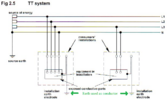
What 'earth' would the inverter "auto-connect neutral to"? If the 'failure' were a 'PEN failure', then there would be no DNO-supplied earth to connect to, so the only alternative would be a local earth electrode, in which case it would become TT, not TN-S.
The system does have an earth electrode, which is always connected. But the connection neutral to earth is within the system, not at some point on a pole with no earth from the pole to local system, and does not cause the fault current to run through the ground, so it is therefore a TN-S system, not TT.
I have tried to work out why we need the earth electrode with a local generator, be it from battery or liquid fuel, it does not matter.
The only reason seems to be when using items outside the bonded area, equipotential zone, when having an earth electrode will allow multiple faults to work a RCD or other safety device. If only one item is used, then an IT supply would be safer, only with multi-items do we need an earth, so I have 4 sockets and one FCU (supply to central heating) so I do have multi-items connected to the supply, so I need an earth.
Where the problem lies if the earth electrode is too good, when using a transmitter we want a good earth for the transmitter, so a friend of mine had 4 earth rods, and bare copper between them on 4 corners of his garden, so with a loss of PEN, the estate he was on tried to stabilise the three phases by passing current through his earth, which only had a 4 mm² earth cable shed (shack) to house, which could not take the load, and melted.
But with an earth electrode of 60 Ω not enough current will flow to melt any earth wire. If, however, we have multiple earth electrodes, as with a PME system it is what the M stands for, and each electrode takes a share of the current, then the voltage swings will be limited. TN-C-S is not always PME.
The problem is detecting we have a fault. +10/-6% = 216.2–253 volts, so with a single phase supply from a 3 phase supply, it may not be apparent when the PEN is lost. Each time I look to see how much battery I have left, I see
so I would see manually any large voltage fluxulations, and I know never seen below 240 volt or above 252 volt so I would be alerted of a possible problem, but even if I did think there is something wrong, what could I do about it, unless outside the permitted range?
I could test current on the earth rod, but since I have no idea as to what is normal, how would that help.
As to if Smart meters report the voltage back to base I don't know, maybe they do? But it would need someone who knows what to expect to be able to flag up a fault.