• Looking for a smarter way to manage your heating this winter? We’ve been testing the new Aqara Radiator Thermostat W600 to see how quiet, accurate and easy it is to use around the home. Click here read our review.

TN-C-S or TN-S

What do you mean by that - i.e. what sort of 'supply failure' are you considering/contemplating?

It certainly would not be "TN-S" if the 'failure' resulted from someone or something chopping right through the cable ;)
Well it would, as the inverter will detect DNO failure, and auto connect neutral to earth, giving a TN-S supply.
 
I read online somewhere that you can export a TN-S supply to a outbuilding such as a shed,
Yes, This does show how to export to an outbuilding but Autumn 2005 is going back a bit, now we regard a building similar to a caravan the same as a caravan. So a wooden shed could have a TN-C-S supply, but not a metal shed.

This has caused problems with some buildings, and one has to use some common sense. The access steps and veranda here
1763818370420.png
mean this is unlikely to be a problem, but this
1763818457464.png
is very different, and see not problem here
1763818547400.png
so to try and make rules is hard, there are so many variations, one like this
1763818697531.png
arrives each gala and I assume the chassis is not earthed, but never tested, just plugged into to handy 16 amp outlet. The fact, the building it comes from is connected to 8 miles of railway track means unlikely, even if the PEN is lost, that the earth pin would be far from true ground polarity.

More of a worry is we have two metal frame buildings with 6 inch air line between them, fed from different step down transformers. So there could be with a PEN failure high current flow between the buildings, and no voltage or loop impedance measurement it likely to show the PEN has failed, only a clamp on ammeter is likely to show failure, and at what current flow should one be worried?
 
Well it would, as the inverter will detect DNO failure, and auto connect neutral to earth, giving a TN-S supply.
What 'earth' would the inverter "auto-connect neutral to"? If the 'failure' were a 'PEN failure', then there would be no DNO-supplied earth to connect to, so the only alternative would be a local earth electrode, in which case it would become TT, not TN-S.
 
That contains some elements of truth but like many things that can be 'read online somewhere' it's also full of fails.
Indeed - a risk of which everyone should always be aware. As far as a 'third party' is concerned, it does, of course, apply just as much to what you and I 'write online somewhere' as to what anyone else writes - so people might want to take the rest of what you went on to write, and everything I'm writing in this post "with a pinch of salt", no matter what we might both think about the correctness of what we write :-)
If a TN-C-S supply is used for some outbuilding, AND that outbuilding also has extraneous conductive parts such as a metal water pipe, then those parts require bonding to the installation earth terminal, and that bonding will need to be at least 10mm². .... The more sensible answer is to not have extraneous conductive parts in the outbuilding, such as using a plastic pipe for water supplies. No bonding required and the cable is sized for the load.
That is, indeed, a more sensible option, when possible, but in the real world, many greenhouses and a good few sheds etc. have 'bare' floors (e.g. soil, soaking wet timber etc.) and/or 'structural metalwork - such that extraneous-c-ps are essentially unavoidable.
The more useless and often impossible option is to make the outbuilding TT, and not have any connection to the TN-C-S installation earth terminal.
That involves earth electrode(s) at the outbuilding, absolutely no connection to any items connected to the TN-C-S supply, which also means all water and other services must be in plastic, and the outbuilding must be located far away (and in reality that means 10 metres or more) from anything connected to the TN-C-S installation or any other TN-C-S installation such as neighbouring properties. Generally far more expensive and time consuming. In many urban areas impossible to achieve.
Is proximity to something connected to a TN-C-S installation actually a significant issue? I can't see how that prevents everything inside the outbuilding from being constituted as an equipotential zone - and, as for those 'part in and part out' of the outbuilding, then (a) if the TT electrode is close to the outbuilding (and everything within the building connected/bonded to it), would than not preclude any dangerous PDs, and (b) it doesn't sound any worse than a (not electrically isolated) 'outside tap', or a Class I item used outdoors, in relation to a TN-C-S installation, does it?
 
TNS, I would guess - because if it was TNC-S, I would expect the earth strands to go higher in the neutral block, and then a piece of 16mm2 earth cable coming out of the terminal on the top right.
 
What 'earth' would the inverter "auto-connect neutral to"? If the 'failure' were a 'PEN failure', then there would be no DNO-supplied earth to connect to, so the only alternative would be a local earth electrode, in which case it would become TT, not TN-S.
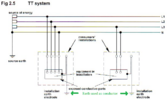
The system does have an earth electrode, which is always connected. But the connection neutral to earth is within the system, not at some point on a pole with no earth from the pole to local system, and does not cause the fault current to run through the ground, so it is therefore a TN-S system, not TT.

I have tried to work out why we need the earth electrode with a local generator, be it from battery or liquid fuel, it does not matter.

The only reason seems to be when using items outside the bonded area, equipotential zone, when having an earth electrode will allow multiple faults to work a RCD or other safety device. If only one item is used, then an IT supply would be safer, only with multi-items do we need an earth, so I have 4 sockets and one FCU (supply to central heating) so I do have multi-items connected to the supply, so I need an earth.

Where the problem lies if the earth electrode is too good, when using a transmitter we want a good earth for the transmitter, so a friend of mine had 4 earth rods, and bare copper between them on 4 corners of his garden, so with a loss of PEN, the estate he was on tried to stabilise the three phases by passing current through his earth, which only had a 4 mm² earth cable shed (shack) to house, which could not take the load, and melted.

But with an earth electrode of 60 Ω not enough current will flow to melt any earth wire. If, however, we have multiple earth electrodes, as with a PME system it is what the M stands for, and each electrode takes a share of the current, then the voltage swings will be limited. TN-C-S is not always PME.

The problem is detecting we have a fault. +10/-6% = 216.2–253 volts, so with a single phase supply from a 3 phase supply, it may not be apparent when the PEN is lost. Each time I look to see how much battery I have left, I see
1763827520260.png
so I would see manually any large voltage fluxulations, and I know never seen below 240 volt or above 252 volt so I would be alerted of a possible problem, but even if I did think there is something wrong, what could I do about it, unless outside the permitted range?

I could test current on the earth rod, but since I have no idea as to what is normal, how would that help.

As to if Smart meters report the voltage back to base I don't know, maybe they do? But it would need someone who knows what to expect to be able to flag up a fault.

 
Thanks everyone. And yes, there would be no extraneous parts or any plumbing in my future shed. It's a small brick building with a flat roof what is about 4 meters away from the back of the house.

I also vaguely recall on whether your allowed to export the CPC on a TN-C-S supply, also sometimes depend on your local DNO and if they allow it or not, again got no evidence for this claim, just a de ja vue feeling of something I think I also saw long ago.
 
I also vaguely recall on whether your allowed to export the CPC on a TN-C-S supply, also sometimes depend on your local DNO and if they allow it or not, again got no evidence for this claim, just a de ja vue feeling of something I think I also saw long ago.
I've never heard of that one but, even if it's theoretically true, the DNO are never going to know what people have done with the supplies to their outbuildings (unless, for some bizarre reason, one goes out of one's way to tell them :-) )
 
The system does have an earth electrode, which is always connected. But the connection neutral to earth is within the system, not at some point on a pole with no earth from the pole to local system, and does not cause the fault current to run through the ground, so it is therefore a TN-S system, not TT.
I don't really understand that - could you perhaps clarify?

It almost sounds as if you are saying that any TT installation is actually TN-S, because the N and E are 'separate'!
 
The loop, in through the line wire, which goes to an overload device, and to the device being used, which has an earth fault, so goes to the earth wire back to the supply transformer, and trips the overload, where does the ground come into that loop.

Or

The loop, in through the line wire, which goes to an overload device, and to the device being used, which has an earth fault, so goes to the earth wire back to the earth, through the earth back to supply transformer, and trips the overload, clearly the earth is used in this case.
 
The loop, in through the line wire, which goes to an overload device, and to the device being used, which has an earth fault, so goes to the earth wire back to the supply transformer, and trips the overload, where does the ground come into that loop.
What "earth wire back to the supply transformer"? As I said, if there is a 'CNE failure' there is no route back to the transformer other than (if there is a TT electrode, or other connection to earth) 'through the ground'. I can'gt see how that could be called 'TN'.
 
I've never heard of that one but, even if it's theoretically true, the DNO are never going to know what people have done with the supplies to their outbuildings (unless, for some bizarre reason, one goes out of one's way to tell them :) )
I think it was more difference is guidance from different DNO's than anything set in stone.
 
What 'earth' would the inverter "auto-connect neutral to"? If the 'failure' were a 'PEN failure', then there would be no DNO-supplied earth to connect to, so the only alternative would be a local earth electrode, in which case it would become TT, not TN-S.

Wouldn't TN-S vs TT depend on whether there is a cable from where the N connects to a local earth rod to the installation, or whether the installation has an earth electrode separate from the one N is connected to?


1763860567642.png

1763860916789.png
 

If you need to find a tradesperson to get your job done, please try our local search below, or if you are doing it yourself you can find suppliers local to you.

Select the supplier or trade you require, enter your location to begin your search.


Are you a trade or supplier? You can create your listing free at DIYnot Local

 
Back
Top