Car leakage battery ?

Do you know my wife? That's her all over, come and get these, and I have not a clue what these are.

My meter
1767528914219.png
will test DC current down to 1 mA, but to test DC it needs to be zero'ed, and that is only any good if the meter is not moved after being zero'ed, so not that accurate. These
1767529077287.png
also work with DC amps, 30 - 0 - 30 hard to read even one amp.

So a typical 40 AH (amp/hour) battery, as the name implies, can deliver 1 amp for 40 hours, assuming fully charged, so to last two nights, looking at 0.5 amp (500 mA) or less, the first meter could read that, likely could read 20 mA with reasonable accuracy, but the problem is to fully charge a lead acid battery to start with.

A lead acid flooded battery (flooded means you can top it up) will take at least 8 hours to recharge, it does not matter how much the charger can give, it is how much the battery can absorb. A VRLA or AGM (valve regulated lead acid or absorbed glass mat) needs longer, and the longer it has been left discharged, the longer it takes to recharge, so can take up to two weeks to recharge.

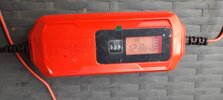
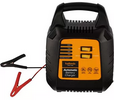
The special chargers Charger 5A.jpg will start at 5 amp, but will quickly drop to 3 amps, then 0.8 amps, and then 0.1 amps, and they tend to show charge complete when not really complete, when the battery has been discharged for some time.

Plugging one of those charges into an energy meter, it seems it uses plusses of charge, it will charge until 14.4 volts, then stop until 12.8 volts, then start again, and a fully charged good battery connected to a Jaguar XE when Colvid was with us, would switch on once a day at around midday, I assume it would send info to base at that time? So, fully charged will switch on around once an hour with a reasonable battery. It would need a day or two on charge to be sure fully charged.

Both Lidi and Aldi do cheap chargers for AGM batteries, CTEK chargers lowest output around £50, yes good, but expensive, RING also do a cheaper charger to CTEK, with Lidi and Aldi have to wait until on offer.

The standard battery charger 1767530553188.png found in Halfords etc, may say "Fully Automatic Charger" but reading further down the advert it says
1767530660761.png
so can't be used with VRLA or AGM batteries.
1767530763889.png
That to put it simple is a lie, it does not prevent overcharging, any way what are
These?
 
is this a new car battery just fitted - if so take it back - or is the battery over 5 years old , as mine was
t may not be leakage but the inability for a cell to hold charge
 
Test charge rate not so easy today, old days 13.8 to 14.8 volts, depending on type of vehicle, showed charging OK, but with stop/start technology not that simple. But in other ways easier, if the car engine is stopping at junctions, then clearly the engine management thinks it's charging OK.

Battery should show more than 12.6 volts, I think? Good alternator and turning on lights should hardly make any change in voltage with engine running.
 
yep, thats the exact results i had - in fact i only just deleted all the votage measurement - take the car out for 10mile run and it was back up , then a few days later - low voltage warning
garage, aid they did a full battery test and alternator test & said the battery was fine , and did not need replacing this was 2024 in about oct and then still happening , so i asked them to just change - its an stop/start - which i switch off and needed the bttery coded to the car - and has been fine every since
i may have posted here - but more likely on an audi forum
 
Can these be clamped to check leakage ,it's losing charge over a couple of nights

The most reliable method, is using an amp meter, in series with one of the battery leads, and set on a suitable range. You should expect a discharge of around 10 to 40mA, 0.010amps to 0.040mA.

Much more than this, then you may have a phantom discharge problem, which needs to be traced. There is another similar, current thread, where this is being explored at the moment.
 
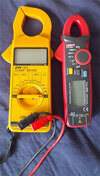
I have two clamp-on meters, Clamp-meter-small.jpg yellow one will not measure DC amps, red/black one will. I used these
1767563511566.png
for years, there was a version to measure start amps as well, but can't find it any more.

The problem with hard-wiring an ammeter, is any capacitor, can result in amps being drawn above the rating of the meter. But the smallest 12 volt bulb in series with battery connection is normally good enough, a 2.2 watt bulb uses around 0.2 amps, so lit at a dull glow (6 volt) would mean the battery should last nearly 2 weeks (assuming 60 Ah).

In the main, failed battery is due to either not charging, or something left on, like a boot light. And the problem is the vehicle in not used enough to recharge the battery. So with a use of say 1 hour a day, and a discharge of 0.2 amps, day one, the 60 A/H is down to 55 A/H and the run only puts back 2.5 A/H so each day it gets lower and lower.

By the time the battery is down to 30 A/H it starts getting hard to start, years ago we would disconnect the battery to test, but some engine management systems do not like being disconnected. So I prefer to use a low amp charger overnight.
 
The problem with hard-wiring an ammeter, is any capacitor, can result in amps being drawn above the rating of the meter.

The obvious trick, is to have the meter set on the correct range, and initialise the test with the meter connected - but across a removable shorting link. The link must be very easily removable, without disturbing the meter connections. My car, very conveniently, already includes such a link. As Eric suggests, a 12v lamp in series, might be all that is needed to identify a 4amp discharge.
 
Seems a bit risky no sticking bulbs in series with the battery ,no?

What's the verdict on checking leakage , series ammeter or clamp ?
 

If you need to find a tradesperson to get your job done, please try our local search below, or if you are doing it yourself you can find suppliers local to you.

Select the supplier or trade you require, enter your location to begin your search.


Are you a trade or supplier? You can create your listing free at DIYnot Local

 
Back
Top