Increase rcd rating?

Joined
15 Apr 2008
Messages
117
Reaction score
3
Location
Derbyshire
Country
United Kingdom
I have a secondary distribution board which enables me to provide emergency power to essential services including a water pump and heating from a small generator if needed. It is protected by a 30mA rated rcd. Recently it tripped for no apparent reason. The only change in the system is an updated heating control system which includes relays. Is it possible that back emf from an opening relay would cause this? The other possibility is the phase capacitor on the water pump starting to degrade.
Either way, would upping the trip rating to 100mA or even 300mA be likely to solve the problem?
None of the mcbs tripped.
Thanks.
 
Thanks. The problem is it only happens occasionally...last one was three weeks ago, one before that about 3 months ago, in the middle of night. So fault finding not easy. I may try switching water pump to main board...I think it is the most likely candidate. I suspect the rcd is just too sensitive, or perhaps needs an A curve rather than AC due to inductive loads?
 
The problem is it only happens occasionally...last one was three weeks ago, one before that about 3 months ago, in the middle of night. So fault finding not easy.
Intermittent faults are very difficult to find.

I may try switching water pump to main board...I think it is the most likely candidate.
Ok? Are there not RCDs there?

I suspect the rcd is just too sensitive,
They can be tested.

or perhaps needs an A curve rather than AC due to inductive loads?
Isn't that likely to find more faults?
 
We have types AC, A, F, C, S etc, also some are single direction, and some dual direction, and we also have stand alone RCD's and RCD's built into the MCB (RCBO) and changing the design and using type A RCBO's may help.

I got RCBO clearly marked type C on the packet, but after they were fitted, realised they were type AC, as far as I know, you can't get single module width type F or C RCBO's, I did look at the mA DC difference between type AC, A, and C, and I question unless you have some device to auto disconnect if DC is detected what is the point? A failed rectifier is likely to produce far more than 6 mA, so only where half-wave rectifiers used in the first place, would you know how much DC is being produced, and the three port central heating valve was being produced well before we used all RCD protected homes, so we have always had some DC, it is not down to modern equipment.

So in the home, looking at near enough engineering, we could not fit all type F or C even if we wanted, using a standard consumer unit. We need either single width RCBO's or just two RCD's when using a standard consumer unit, as far as I am aware, one can't get a consumer unit over 125 amps or 3 phase, and we are told when in the control of an ordinary person we should use the consumer unit type of distribution unit. Although not found the rule saying that?

We can no longer use these Auto RCD.jpg in the home, and to rewire the home in Ali-tube and use RCD sockets is far too expensive, so in real terms we have to use RCBO's, there are RCD's with a residual current monitor (RCM) built in, the moeller xpole but then we are faced with the consumer unit being changed to moeller to comply with type testing rules. So the RCBO seems the only option for domestic.
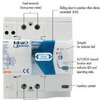

 
Ok? Are there not RCDs there?
Yes, but if it then trips that board, I know where the fault is. I have had to replace the phase capacitor before, but cannot remember if it started tripping the rcd last time.

The fact it happened at night suggests it was the new heating system, or the water pump that fired up when the dishwasher came on. I cannot see how a wago relay would result in an earth fault, but could result in a residual.

My logic behind the switch to an A curve is they are more tolerant of residuals caused by inductive loads (or so I believe). MK do an A curve 100mA that may solve the problem.
 
Yes, but if it then trips that board, I know where the fault is. I have had to replace the phase capacitor before, but cannot remember if it started tripping the rcd last time.

The fact it happened at night suggests it was the new heating system, or the water pump that fired up when the dishwasher came on. I cannot see how a wago relay would result in an earth fault, but could result in a residual.

My logic behind the switch to an A curve is they are more tolerant of residuals caused by inductive loads (or so I believe). MK do an A curve 100mA that may solve the problem.
Is your dishwasher on this consumer unit?
 
No. Completely seperate board. As are the ovens, hob, washing machine and other likely candidates. This board enables my generator to provide essential services in a power cut, and has heating and water pump, one lighting circuit, and ring main for low power itms such as routers and hubs (to support TAPO heating system)
 
We have some odd names for consumer units, it seems high integrity means it has three neutral bars, and you can have two RCD's and some RCBO's but depends on what type of consumer unit has been fitted.

There is nothing to stop swapping the RCD for an isolator and fitting RCBO to just one side of the consumer unit.
 
This one is pretty standard. MK rcd with 6 mcbs. Single live and neutral, no option to split board. So would be easy to switch out, but not sure if casing size and cut out is rcbo compatible...they look much bigger
 
You have to have 30mA for protection of persons.
Good job you cant see the main board! It is an old split board...one half rcd protected, one half not! However, we no longer use the unptotected side! My logic was that the heating and water pump are stand alone, no user access unless under maintenance
 

If you need to find a tradesperson to get your job done, please try our local search below, or if you are doing it yourself you can find suppliers local to you.

Select the supplier or trade you require, enter your location to begin your search.


Are you a trade or supplier? You can create your listing free at DIYnot Local

 
Back
Top