
- Joined
- 18 Apr 2022
- Messages
- 7,233
- Reaction score
- 1,095
- Country

If every rad could call for heat independantly... why would there be a wall stat?
For the occupants to use to specify the temperature they wanted in the room.

If every rad could call for heat independantly... why would there be a wall stat?
That's basically what TRVs doI agree, but ....
... if I understand correctly there are now some 'regulations' (I don't know their 'status') calling for 'zoning' of heating, and that that is usually achieved with wall stats in each zone. Is that not the case? (not that I personally care - I'm happy with what I have, regs or no regs)
Which is what the TRV doesFor the occupants to use to specify the temperature they wanted in the room.
It is - but (speaking from relative ignorance) the impression I get is that 'the requirement' is not satisfied by TRVs alone. Hopefully someone knows something about this, and can tell us.That's basically what TRVs do
It all depends on the TRVs, mine most certainly not but some are fully programmable using the app form the other side of the world.It is - but (speaking from relative ignorance) the impression I get is that 'the requirement' is not satisfied by TRVs alone. Hopefully someone knows something about this, and can tell us.
Which is what the TRV does
I was talking about 'dumb' TRVs (like you and I have), not new-fangled ones.It all depends on the TRVs, mine most certainly not but some are fully programmable using the app form the other side of the world.
That's fine if you have a wall stat it every room (but then you wouldn't need TRVs, anyway!).The room I am in now has 3 radiators. .... So you think that if I want to change the temperature it is not better to only have to adjust one wall stat than it is 3 TRVs.

My understanding, from a Heating Engineer is that with TRVs a Room Stat is still required and is used as a "High Limit Stat".No need for there to be one without a TRV.
If every rad could call for heat independantly... why would there be a wall stat?

What one needs to remember is a TRV is a thermostat, it depends on where one reads as to if it needs a timing element, but the electronic TRV does have a timing element, so there is no need for any wall thermostats or programmers, the electronic TRV head can do the lot, which is what the Honeywell EvoHome did and still does all those years ago.... if I understand correctly there are now some 'regulations' (I don't know their 'status') calling for 'zoning' of heating, and that that is usually achieved with wall stats in each zone. Is that not the case? (not that I personally care - I'm happy with what I have, regs or no regs
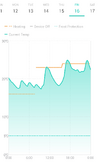 must help when trying to work out failings. The Wiser version records from the internet outside temperature as well
 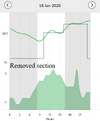 I have removed a section to make picture smaller, it shows thermostat setting, room temperature, and outside temperature but it does not help with an install where one has no idea of the pipe run, which is all micro bore, so there is around a 20 minute delay from boiler turning on to radiators getting warm.
Even the cheap eQ-3 TRV heads can be paired, so all radiators work together. In 2019 when I fitted them cost me £15 each for the heads.The room I am in now has 3 radiators.
No my Wiser TRV head can do the lot, it all depends on what head is put on the TRV as to what it can do,My understanding, from a Heating Engineer is that with TRVs a Room Stat is still required and is used as a "High Limit Stat".

Obviously not essential (a much much simpler system would 'work'!), but for those who like the new-fangled (and have appropriately deep pockets), perhaps better than a situation in which all but one of the TRVs are (with heating 'turned on') unable to switch on the boiler if the wall thermostat is 'forbidding' that
It is - but (speaking from relative ignorance) the impression I get is that 'the requirement' is not satisfied by TRVs alone. Hopefully someone knows something about this, and can tell us.
That's roughly what I was trying to describe.My understanding, from a Heating Engineer is that with TRVs a Room Stat is still required and is used as a "High Limit Stat".

If you need to find a tradesperson to get your job done, please try our local search below, or if you are doing it yourself you can find suppliers local to you.
Select the supplier or trade you require, enter your location to begin your search.
Are you a trade or supplier? You can create your listing free at DIYnot Local
