Is this article a Red Haddock ???

I don't understand butter :-)
Oh, I remember delivering butter in the 70s, most we could throw the boxes off the wagon, but one make, I can't remember which, had to be handled with kid gloves, if thrown, the box would collapse on catching covering one with butter. The other time was late 90s Chard Junction, watching the butter being put into boxes, did not realise churning butter was a continuous process.
Why not? If all the TRVs turned off, the boiler would presumably follow suit, wouldn't it?
Once the hot water returns, the boiler will switch off, but it would keep switching back on again as it cooled to test if required. Only 1 of my 14 TRV heads will turn the boiler on. Rest need the boiler to have been activated by another device.
 
Once the hot water returns, the boiler will switch off, but it would keep switching back on again as it cooled to test if required. Only 1 of my 14 TRV heads will turn the boiler on. Rest need the boiler to have been activated by another device.
Is that not rather an odd arrangement - is it perhaps a consequence of a 'new-fangled' control system? Why should not any of the TRVs be able to turn the boiler on?
 
Is that not rather an odd arrangement - is it perhaps a consequence of a 'new-fangled' control system? Why should not any of the TRVs be able to turn the boiler on?
My trv's are purely mechanical to restrict water flow.
 
Why should not any of the TRVs be able to turn the boiler on?
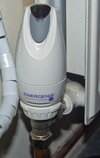
Because I have not paid for TRV heads which link to a hub. I got 5 of these, EQ-3 Bluetooth Smart Radiator Thermostat.jpgand had 4 of these IMGP8035.jpg taken from my late mothers house, the latter claimed to work with Nest, however one they worked the wrong way around, the wall thermostat told the TRV head the temperature to set them to, and although changing Nest Gen 3 with the app would also change the TRV head at the same time, set schedules failed to change the TRV setting, so had to use them in isolation.
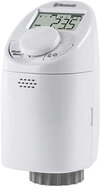
The Wiser head
1769179263291.png
and Kasa head
1769179303956.png
can connect to a hub or wall thermostat, but the Kasa wall thermostat is hard-wired, so I did not have wiring where it would need fitting, so only the Wiser head connects to a hub, and so can turn on the boiler (and of course also allow it to stop) and since two far away from hub, it needs a socket adaptor to relay the signal, so will not link to boiler if there is a power cut.

Both the Wiser and Kasa can have remote sensors, with Wiser putting a wall thermostat and TRV in the same room, the wall thermostat takes control, with Kasa there is a sensor available so it can sense away from the radiator, so if radiator on an outside wall, it does not open too soon.

This I suppose is a problem, each TRV head has different features, the eQ-3 head will detect a rapid drop in temperature, which would happen if the window or door opened, and turn off for a time you the user has set, handy when unloading shopping from the car. Tried the geo-fencing with both the Energenie TRV and Nest Gen 3 wall thermostat, it was a failure, Energenie had anti hysteresis software which was OTT, and Nest turned the heating back on basically just before you came through the door, so heating running when one gets home, but home still cold. Not tried with Wiser, know it uses IFTTT same as Energenie, but never tried.

There is an article on DIYnot on the aqara-radiator-thermostat-w600 but it does not compare it with any other make, so little more than an advert.

I wish there was a comparative site, Which have one and Another one here the early guides said how Nest could work with Energenie which it will not, so how much can you trust the guides?

If I need any more, I will use Drayton Wiser, as it does seem the best of the bunch, but I learnt the hard way, I trusted Nest, and they must be around the worst smart thermostat you can buy in the UK, USA version very different.

 
Is that not rather an odd arrangement - is it perhaps a consequence of a 'new-fangled' control system? Why should not any of the TRVs be able to turn the boiler on?

Perhaps Eric has the 'one' TRV, where the room temperature needs to be closely maintained at the correct temperature, rather than temperature limited, as is normal with basic TRV's?

His advantages seem to be, one of being able to remotely program his rooms as zones, for both time and temperature, via the TRV's, but apart from the one TRV, they lack the ability to close the loop, and demand heat from the boiler.
 
Well put @Harry Bloomfield I did look at cheaper mechanical TRV heads. The ones I removed, when tested, had about 3°C between fully closed and fully open, so they did not have °C on the scale but just *123456 on them, it seems around 2.5 = 20°C, but it depends on size of radiator and size of room, and of course losses, so first the lock shield valve needs setting, to give the head enough time to close, before the radiator gets stinking hot, and we start a hysteresis.

So the way I set the lock shield valve is with the TRV report, if it says the current is over the target, then lock shield open too much, so when I replaced the electronic valves with mechanical ones before leaving mother house, as buyer did not want the electronic type, the lock shield already set spot on, and the mechanical valves worked well.

But without fitting the electronic first, one would not know if lock shield valve or the TRV needs adjusting, so near impossible to set, without a differential thermometer which yes I do have one, but lost the sensors.

Mother house, wall thermometer set to 17°C and the TRV set to 2¼ and the TRV would open wide when front door opened, heating the radiator, but before the wall thermostat turned off the boiler it had throttled back, so radiator only just warm, allowing other rooms in the house to heat up. But living room, dinning room and kitchen were small, so were the three bedrooms, and modulating boiler, so all worked reasonably well.

In this house, two kitchens, five bedrooms, two living rooms, two bathrooms plus a shower room, and a dinning room, to heat all rooms 24/7 would cost a fortune, and the boiler is on/off only, one wall thermostat is not enough, so I have 4 devices able to turn the boiler on/off. The living room is twice the size of mother's old house, 4 easy chairs 2 couches, dinning table and 6 chairs, two x 2 kW radiators and a wood burning fire, although the latter never used, being able to have 15 people seated in the living room gives on an idea of its size. And all heated with a 20 kW boiler which is really too big, it always cycles on/off, never heard it run for over 2 hours.
 
Below, is a typical days consumption of gas. None at all during the night, because the stat is programmed to maintain 14C, then at 10a, it changes to 18C, at which time there is a surge, as it raises back up to 18C. On and off then, until around 20:30, by which time, it looks as if the living room gas fire had been lit, on it's minimum setting of 500w. The stat, is located in the hall, just beyond the door, so the heat from the living room, inhibited the CH boiler, for the rest of the evening, then at 22:00 the stat went to set back at 24C, until next morning. Obviously, that day, we did no or little cooking, because the heat from that, can also cause the stat to shut the CH down.

The second surge in consumption, was at 15:00, when it is programmed to heat the HW cylinder.

1769201206043.png
 
Looks to me like there might be some truth in this article then the remainder of it ??
I wonder.

what do you think.

Without reading any other replies in this topic.

Without reading anything beyond

One of history’s greatest scientists tried to fix this flaw over a century ago — but his ideas were suppressed ...
.
If the pipe is smooth, the water flows cleanly. But if the pipe has bends, kinks, and turbulence, the water sprays, sputters, and loses pressure.

That’s what AC power does inside your walls.

It fluctuates, spikes, and forces your appliances to gulp more electricity than they actually need.

what I think is that you should go and buy one. Or if you have more than one socket circuit, buy 2 or 3 or whatever. Put sockets on your lighting circuits so that you can end up with loads of them. That will be the fastest, and most efficient way to find out if
there might be some truth in this article
Go on - you deserve the truth.
 
But is it an essential, for a comfortable home? I would suggest not..
Obviously not essential (a much much simpler system would 'work'!), but for those who like the new-fangled (and have appropriately deep pockets), perhaps better than a situation in which all but one of the TRVs are (with heating 'turned on') unable to switch on the boiler if the wall thermostat is 'forbidding' that :-)
 
Obviously not essential (a much much simpler system would 'work'!), but for those who like the new-fangled (and have appropriately deep pockets), perhaps better than a situation in which all but one of the TRVs are (with heating 'turned on') unable to switch on the boiler if the wall thermostat is 'forbidding' that :-)
No need for there to be one without a TRV.

If every rad could call for heat independantly... why would there be a wall stat?
 
No need for there to be one without a TRV.
I agree, but ....
If every rad could call for heat independantly... why would there be a wall stat?
... if I understand correctly there are now some 'regulations' (I don't know their 'status') calling for 'zoning' of heating, and that that is usually achieved with wall stats in each zone. Is that not the case? (not that I personally care - I'm happy with what I have, regs or no regs :-) )
 

If you need to find a tradesperson to get your job done, please try our local search below, or if you are doing it yourself you can find suppliers local to you.

Select the supplier or trade you require, enter your location to begin your search.


Are you a trade or supplier? You can create your listing free at DIYnot Local

 
Back
Top