Controlling multiple electric heaters centrally

You did not say Infrared, that changes things. The infrared heater does not heat the air, it heats objects in front of it, so any thermostat which measures air temperature is not going to work, it is instant heat, so a PIR to turn it on as you enter the room would work, they are used where there are a lot of air changes, common with listed buildings where you can't fit double glazing etc. Also garages, churches, use them a lot.

So now back to start, why are they fitted? It may be because rooms not used for long, like with the church, or massive drafts like with the garage, or wrongly specified to start with. One thing need to be careful of is where aimed, as Infrared will go out of even double-glazed windows, so must not be aimed at windows, also of course nothing in line of sight between room occupants and the heaters.

They are the same as open fires, which also give out infrared, so are fitted at the focal point of the room. Or fitted high up, these
1770798413614.png
typically used in bathrooms, it seems there is far and near infrared and I don't really know the difference, but we are looking at how the flat is used.

Back in the 90s we all had infrared heaters, they were called light bulbs, and I, for one, set the central heating to a background heat, which was supplemented in the evening by turning on the lights. When I changed to compact fluorescent lamps, I also had to change the thermostat to a programmable one, so evening heating was higher, and as a result in winter in real terms, the tungsten bulb was saving energy, as having the air cooler, resulted in less losses with air changes, we had 6 x 60 watt bulbs so 360 watts, and the heater you link to is 350 watts, so you need to look at the building first, and its use. My late sister would leave for work at 7 am and visit our parents on return, so only got home at 8:30 pm and by 10 pm was going to bed, so for her that heating would have worked well.

For me, retired, and at home all day, same when small children are at home, we want 24/7 heating, so infrared is not really going to work. My daughter had this problem when they decided she could work from home, her home was never designed to be an office.

So using existing heaters, looking at occupancy controls, I have same with my lights, I have a switch by the door, so I can turn them on/off as I enter/leave the room.
 
@ericmark it's just a normal 2 bed apartment in Birmingham city centre. It's a converted 1800s industrial building with about 50 apartments in it.

My partner works during the day and when she's not at mine is there in the evening and at weekends. Pretty standard residential use.

She installed these panel heaters when she moved in as all that was there was a couple of small electric convectors not up to the task. She has two in the main open plan living area hanging from the ceiling pointing down at the living space. One in the hallway, hanging from the ceiling, same in bathroom, and one wall mounted in the bedroom.

They do seem to heat up the apartment ok when they are on. But no controls, no programmers and on 3 pin plugs so not classed as fixed heating for the EPC assessment.

The hot water megaflo cylinder, as I've said is just directly attached to 2 fused spurs in the cupboard.

I should add the ceilings are very high as she has the top floor apartment which is into the roof so the apex of the room is like 6m high.
 
Last edited:
Well I think you have had some very good takes on here judging by all of the comments.

My first thought is how to live in it as is or do you want to rent it out?
It could be a one or the other rather than an and/or decision as overlaps are likely to be rare as best in both instances.

If renting out you have the Energy Performance Rating uppermost and what is on the inspectors list and what is not.
If system A/ is recognised as rated being between 30% to 100% acceptable compared to the best on the market then any inspector would only list as 30%, not an "average" and not a maximum possible.
You have to live with acceptable to them figures even if you know you can get a higher value by careful use.

If you "design" your own system for your own use and it is not on the inspectors list then you will get nowt I`m afraid.

Of course, if it is only for your own or your partners use you might end up with a system that is pretty good and/or beating or equaling the rest.

For your own usage some simple (or not too complicated) ideas such as smart switches thermostats and timers built into the programming or as add ons might be simple, pretty good and very cheap for now - and you might aim for an idea that will allow you to get a reasonable cost if you decide to change just before rental starts.
 
When was it converted? Surely some sort of heating was installed during the conversion - it's a buildings regs requirement, isn't it?
Between 2005-2009 sometime. I don't know what requirements were in place at the time, or why they didn't install very good heating or why they didn't install gas, that's all way out of my control. I personally think what was done was inadequate but we have to work with what we have.


My first thought is how to live in it as is or do you want to rent it out?
It could be a one or the other rather than an and/or decision as overlaps are likely to be rare as best in both instances.

If renting out you have the Energy Performance Rating uppermost and what is on the inspectors list and what is not.
If system A/ is recognised as rated being between 30% to 100% acceptable compared to the best on the market then any inspector would only list as 30%, not an "average" and not a maximum possible.
You have to live with acceptable to them figures even if you know you can get a higher value by careful use.
She has lived with what she's got for 15 years plus now, and now she wants to rent it out so what is there is clearly inadequate, not just from an EPC perspective but also thinking about making the flat have an acceptable level of heating for the future tenant.

But even though the EPC might recommend storage heaters because they have to, clearly in the real world we know that they will cost probably £10k to install, and that's even if the freeholder agrees to running new off peak supply/control cables from the communal meter room to this specific apartment, and that in the real world storage heaters don't even save much money these days and aren't very user friendly.

So what is the point trying to go down that route when we know it's not a good solution for anyone. Answer, there isn't.

The EPC process is clearly nonsense, not only on this topic of heating, but also generally. Some of the EPC certs in the same building list the wall construction as cavity insulated and some as solid uninsulated. It's the same building, I can guarantee you that the walls of this old 1800s factory don't switch to cavity insulated walls at any point.

We need to do enough to help future tenant have a good quality controllable heating system, without wasting money on solutions that are clearly not beneficial these days.
 
Between 2005-2009 sometime.

It's odd that it doesn't have better heating. Did she buy it from the developer, or was there a previous owner? It almost feels as if a previous owner must have removed something!

Do find out what the neighbours do. I honestly think they will have better ideas of what's realistic in the building than we "random strangers on the internet".
 
Do find out what the neighbours do. I honestly think they will have better ideas of what's realistic in the building than we "random strangers on the internet
Based on the large number of EPC for the building, no-one has storage heaters, all have panel heaters limited controls scoring poorly on EPC. Not sure what else there is to say.

Whilst I appreciate that you are random strangers on the internet, you're also collectively electricians and heating installers and competent DIYers etc. there isn't a great deal of choice in electric only heating when no gas or no E7 is available. I'm not sure what else information there is to give you to help get some advice that I haven't already?


Did she buy it from the developer, or was there a previous owner? It almost feels as if a previous owner must have removed something!
There were 3 wall mounted small convector heaters with a built in dial thermostat installed. She bought it from the developer, not another person, in 2010. The heaters were inadequate to heat the place according to her.
 
It does not require new cables to have an off-peak supply. Some smart meters do have a fifth wire, to auto switch on items wanting the off-peak supply, but it turns over the whole supply to off-peak tariff, all you need is the heaters to be on a timer. There is a whole range of off-peak tariffs, if the supplier can switch items on/off then cheaper than if you need to switch them, and the longer the off-peak, the worse the rate is.

Energy can be stored as heat or chemical, but the chemical (batteries) is expensive, but it leaks less. AI says "An Energy Performance Certificate (EPC) rates a home's efficiency from A (most efficient) to G (least efficient)." most must be a heat pump, least an open fire, but electric heating can't be below 100% efficient. It does not allow any heat to escape, so could not be anything else.

But it continues "Fuel Source: Electricity is generally considered a high-cost fuel in the EPC calculation model (SAP), which can result in lower ratings for electric heating, even if the system is efficient. Controls: Modern, smart, or programmable thermostats can increase the score by managing heat usage better." so basically not looking at efficiency, it is looking at cost, which is not the same.

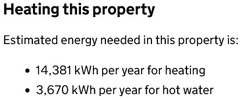
So my main house is 58, and it says I could improve it to get 70, it does not give any advice as to how to improve the rating by changing heating method, it says what I have is average, and 1770818097417.pngso at 55p per litre and 10 kWh per litre, it should cost £992.80 a year, so that means if I am to live another 15 years, making me 90, then to spend £3000 to improve it, then need a 20% reduction in my yearly cost, or £200 a year. That is not going to happen.

So to rent this house, need C or better, so need an extra 10 points. I have added solar and fitted low energy lighting, so I would just scrape in. So you need to look at the EPC for your flat and others in the block, and see what is needed to hit C.

Step 1: Floor insulation (solid floor) Typical installation cost £4,000 - £6,000 Typical yearly saving £48 Potential rating after completing step 1 60 D that's 2 points if I spend £5k, but next step cost £56 and saves 1 point, it is so ridiculous, no one in their right mind is going to follow the suggestions.

It is so clear with all the restrictions placed on landlords that the government do not want people to become landlords. It is as simple as that.
 
It does not require new cables to have an off-peak supply. Some smart meters do have a fifth wire, to auto switch on items wanting the off-peak supply, but it turns over the whole supply to off-peak tariff, all you need is the heaters to be on a timer. There is a whole range of off-peak tariffs, if the supplier can switch items on/off then cheaper than if you need to switch them, and the longer the off-peak, the worse the rate is.
I have been researching this since I posted the thread and I don't believe it's fully correct.

You are right that smart meters these days can record multiple peak/off peak periods so don't technically need dedicated off peak circuitry.

However, it still appears to be the case that for off peak storage heater systems to be installed according to manufacturer requirements, and be recognised as such by EPC, you still need a dedicated off peak consumer unit and dual supply cabling in the property that is switched via the meter on a hardwired method. You cannot, to comply with EPC and building standards, rely on switching timers and 'soft' smart meter off peak recording only.

I think fundamentally the building standards have not kept up with modern technology.
 
Here's what chatgpt has to say on the topic:

1. What is required to install a full HHR storage heater system:

* Establish a dual rate tariff via energy supplier.
* Configure the smart meter to provide an off peak switched supply or 2nd set of tails depending on meter type.
* Install new tails or a switched load output from the meter to feed a dedicated off peak distribution board.
* Install a second consumer unit dedicated to storage heating.
* Run new dedicated radials to each storage heater location.


2. Is there any allowed wireless/remote solution to switch an off peak CU?

* No. There is no permitted wireless, radio, zigbee, wi-fi or other remote signalling method that can substitute for a meter controlled switched load output, and dedicated off peak consumer unit.
* EPC methodology only recognised storage heaters if they are wired to a dedicated off peak supply with appropriate load control. Timer only systems are classed as direct acting electric heaters, losing all EPC benefits.


3. What about using a remote contactor triggered by a smart meter tariff?

* No, the only allowed method is a switched load output or 2nd set of tails provided by the meter.
* If your meter does not provide an ALC output, or you cannot run additional cables from the meter to your flat, then you cannot create compliant off-peak heating installation.
* In your building, it appears HHR storage heaters are 100% impossible. You cannot: run new tails; install an off peak CU; get a switched off peak feed; place a contactor by the meter; use remote switching; use timers instead.
* You likely qualify for an EPC grade C exemption on the basis of technical infeasibility, building service constraints, lack of freeholder consent, costs exceeding the £10k cap.
 
I have been researching this since I posted the thread and I don't believe it's fully correct. ... You are right that smart meters these days can record multiple peak/off peak periods so don't technically need dedicated off peak circuitry.
Indeed. In fact, even a 'dumb' dual-tariff meter can record usage during the two periods relevant to tariffs like E7. However, that's only about metering - nothing to do with the switching on/off of supply to the storage heaters.
However, it still appears to be the case that for off peak storage heater systems to be installed according to manufacturer requirements, and be recognised as such by EPC, you still need a dedicated off peak consumer unit and dual supply cabling in the property that is switched via the meter on a hardwired method. You cannot, to comply with EPC and building standards, rely on switching timers and 'soft' smart meter off peak recording only.
That may well be true. A '5-terminal' ('smart' or 'dumb') meter could control the switching of the storage heater (with a dedicated 'off-peak CU') if that's what they wanted, but that would inevitably requiring some sort of cabling between meter and the heaters (and 'dedicated CU' if installed) - either a 'signalling cable' or an actual switched supply. If, as you have said, the meter is remote and distant from the flat, and that that installation of additional cabling would not be allowed, then there clearly is a problem.
I think fundamentally the building standards have not kept up with modern technology.
Nor, it sounds, with common sense! These days, people switch suppliers and tariffs 'every five minutes'. Hence, even if it was all as you have described (with dedicated off-peak meter etc.) on the day the EPC inspector was there, the consumer could change to a different tariff, which maybe had no 'cheap off-peak period' (or, at least, a different one) 'the next day' couldn't they?
 
no-one has storage heaters, all have panel heaters

I bet they aren't these "infra-red" ceiling-mounted panels though. More likely panel-shaped wall-mounted convectors, like the ones she removed. But do check.


Here's what chatgpt has to say on the topic:

It sounds convincing, but you can't actually believe any of it.

 
I bet they aren't these "infra-red" ceiling-mounted panels though. More likely panel-shaped wall-mounted convectors, like the ones she removed. But do check.
You're probably right, but what she has installed does a better job than the original heaters according to her. When I've been there, it's felt warm enough. There's just no timer/stat control with them, hence the reason for my original question on what to do. We can't leave these as the only heating source because they will completely fail the EPC as it stands, it wouldn't reach the current band E requirements needed for rental.


It sounds convincing, but you can't actually believe any of it.
Yep agreed. Where can I go to to get an official answer though?
 
I’ve just had a similar issue. My apartment does have night storage heaters in it and each heater has 2 hard wired 13a connections. They’re so uneconomical as you have to guess the weather and even then, they never provide sufficient heat. So I’ve taken them out and replaced them with electric radiators from bestheating.com and got the Milano Ecoso Aruba radiators with wifi controlled thermostats on each one. So I no longer have an economy 7 set up apart from on my hot water cylinder but the radiators come on whenever I want them to and heat the place up really quickly and have already started reducing my electricity bill.
They’re controlled through a smart wifi app which costs £40 for the year and is fully programmable. It might be possible to set them up in Alexa but I’ve not looked in to that.
 
What I was looking for was a smarter way to control the existing panel heaters and hot water cylinder by adding thermostats and central programmer.

Well, take a look at what Alexa, and smart plugs can do. It's a cheap, simple, very versatile option.

Buy one smart plug, one temperature sensor, and install Alexa on a tablet, or phone. You can set individual plugs/heaters to turn on, and off, at set times, turn on and off with temperature. What more do you want?
 

If you need to find a tradesperson to get your job done, please try our local search below, or if you are doing it yourself you can find suppliers local to you.

Select the supplier or trade you require, enter your location to begin your search.


Are you a trade or supplier? You can create your listing free at DIYnot Local

 
Back
Top