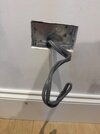
How do I wire this a socket?

Joined
4 Jun 2011
Messages
98
Reaction score
2
Location
London
Country
United Kingdom
How do I wire this to a socket?
Electrician installed a new point but wire is a loop.
Said he would come back to put the socket on but I want to do it now.

I’m confident with wiring plugs, switches etc, just not seen a loop like this and need some confirmation what to do.

Thanks
 

Attachments

  • IMG_5710.jpeg
    IMG_5710.jpeg
    473.4 KB · Views: 52
Turn the power off and make sure it is off.
Strip back the cable so you can see the internal coloured sleeving.
Get the earth sleeving that you will need.
Leave yourself enough length of the blue brown and Earth wires.
Two blue to neutral. Two brown to live. Sleeve the two earth wires with the sleeving.
Put the two earth wires in the earth terminal.

A proper electrician will then do a continuity test of the ring final at the consumer unit before reconnecting the power.
 
You have an electrician who has carried out the first fix (fitting the back box and running the cable). When he comes back he carries out the second fix (attaching the faceplate) and then tests to ensure it safe for you to use. Wait until he finishes the job.
Obviously impatient. Maybe one of these who drives at speed to get places?
 
Turn the power off and make sure it is off.
Strip back the cable so you can see the internal coloured sleeving.
Get the earth sleeving that you will need.
Leave yourself enough length of the blue brown and Earth wires.
Two blue to neutral. Two brown to live. Sleeve the two earth wires with the sleeving.
Put the two earth wires in the earth terminal.

A proper electrician will then do a continuity test of the ring final at the consumer unit before reconnecting the power.
Should perhaps also be mentioned that an earth core should run to the metal back box and, if the chosen socket faceplate is metal and it has a separate/dedicated earth connection for the face, that should be linked up to earth too

Other detail I think would help:

Make sure the power is off. If it’s not, attempting fitting this socket could be the last thing you ever do

Prior to doing any work, use a multimeter at the fuusebox end to prove good continuity on all cores - pull the browns out of their MCB, put the meter in resistance mode (ohms, omega symbol, 200 probably) and check you get a low reading. Repeats for blues and earths. If the meter remains showing 1. or OL, you have a wiring fault that should be resolved before continuing

Cut the wire at the bend

Cut down the wire a short way with your cutters, so it ends up splayed like a Y

Grab the earth (the gold one) with your pliers and pull it gently in one direction while pulling the grey sheath in the other direction. The core will pull through the side of the grey

Keep going til you get to about 1cm away from where the wire comes into the box

Separate all the cores from the grey sheath and clip the sheath off and bin it

Repeat with the other

Offer the socket up to the hole and touch the bottom of it to the wall, and flip it down so you can see the back. Note where the holes are for L, N and E and measure how much wire you’ll need to comfortably reach them while giving some slack to allow you to bend wires around and out of each others’ way, but not so long you’re trying to cram a foot of wire into the back box.
Cut all wires to length, bearing in mind you need about a 1cm to put into the holes on the back of the socket

Fit the Earth sleeve to the two gold cores measure such that you have about 1cm of core sticking out when the Earth sleeve is in place. Turn the end of the core over and back on itself like an umbrella handle/fish hook and squash it flatter(don’t obliterate it) with pliers

When you skin and fit the blue and brown you should not have any copper core showing out the back of the socket hole. The inner core should be snipped to length to allow the sheath to go a couple mm past the hole entrance

Ensure that the screw is clamping copper, not the sheath (don’t cut the copper stick-out too short)

Pull hard on the wires. If they fall out, do it again, better

You’ll likely have a bit of copper wire hanging around that you can use to connect the back box (little gold terminal in the lower left) to earth

When time comes to fit the socket face, route the wires so they don’t pile up on top of each other and aren’t a crammed in dogs dinner

Particularly ensure that no wire is jammed behind the screw holes for the screws that hold the socket face on. You don’t want to wind the screws in, straight through the love core and create a fault

When you fit the face, get both screws started before tightening them. Hold the face of the socket firmly against the wall and wind the screw up. If it goes tight or feels of check you aren’t hitting a wire or the back box. If the screws are too long you can clip them down with snips, then tickle them with a grinder to resolve damage to the threads that will make it hard to start them

Don’t over tighten the screws; you need just enough pressure to stop the socket face sliding round the wall, without ruining the face or the plasterboard

Do the same check with the multimeter

Wait until he finishes the job.
Maybe, or maybe there is a reason he won’t be back. This isn’t work that must be carried out by a spark; it’s acceptable to DIY

 
Last edited:
Should perhaps also be mentioned that an earth core should run to the metal back box and, if the chosen socket faceplate is metal and it has a separate/dedicated earth connection for the face, that should be linked up to earth too
You wouldn't connect an earth to a plastic socket?
 
You wouldn't connect an earth to a plastic socket?
He didn't say that he wouldn't. He said:

" IF the chosen socket faceplate is metal AND IT HAS A SEPARATE/DEDICATED earth connection for the face, that should be linked up to earth TOO"
i.e. as well as the normal earth connection.

Although all the metal faceplate sockets I've seen link the faceplate to the socket earth by virtue of their construction, not by a separate terminal.
 
He didn't say that he wouldn't. He said:

" IF the chosen socket faceplate is metal AND IT HAS A SEPARATE/DEDICATED earth connection for the face, that should be linked up to earth TOO"

Although all the metal faceplate sockets I've seen link the faceplate to the socket earth by virtue of their construction, not by a separate terminal.
They don't have a separate terminal for the face plate like switches do.
 
You wouldn't connect an earth to a plastic socket?
“If the faceplate is metal and has a separate earth connector for the face, that should be linked up too”

If the socket is plastic it definitely won’t have an earth terminal for the face

If the socket face is metal it may have one and if it does have one, that should also be linked to earth as well as all the other things linked to earth: the socket terminals (every socket should have its earth terminal linked to earth) and the back box (visibly metal; should be earthed)

They don't have a separate terminal for the face plate like switches do.
I didn’t guarantee that it would, I just said “if”. You sometimes only get one shot on a forum to get relevant info across to an OP; can’t really rely on them to return with more questions, so was covering bases. I too think it unlikely the OP will have a socket constructed thus but we just don’t know what they’ve bought
 
Although all the metal faceplate sockets I've seen link the faceplate to the socket earth by virtue of their construction, not by a separate terminal.
There do exist "clean earth" sockets which have the earth connection for the outlet intentionally seperated from that for the backbox/faceplate. There also exist modular sockets which have them seperated as a consequence of the modularity.

But both are unusual,.
 

If you need to find a tradesperson to get your job done, please try our local search below, or if you are doing it yourself you can find suppliers local to you.

Select the supplier or trade you require, enter your location to begin your search.


Are you a trade or supplier? You can create your listing free at DIYnot Local

 
Back
Top