Some Simple / Small Dry-Lining

Joined
15 Feb 2008
Messages
202
Reaction score
6
Country
United Kingdom
Hi forum - grateful some advice please…..

Old house, small and odd shaped rooms - very few plugs, sockets etc.
I’ve a couple of alcoves (one at 600mm wide and one at 800mm widet) that aren’t much use TBH.
I’d like to dry line the end wall only (of both) so that I can run in some new sockets.
In one alcove I’ve had some damp problems (now treated) and the other is in a bathroom.

How far off the existing wall should I space it ?
And should I fill the space with something like a rock-wool or a kingspan ?

Thanks D
 
Insulated plasterboard stuck on with foam.
Then a few TIMCO plastic insulation fixings.
Foam will act as a damp barrier
 
Than you @Wayners - that’s so different to what I had in mind.
So stick it directly to the wall an a dot & dab fashion with an expanding adhesive ?
And what do the TIMCO fasteners do ?

I was thinking I’d need some airflow; some battens / framing.
And maybe even a vent top and bottom.

D
 
Okay - I’ve figured out the TIMCO plastic fasteners.
That’s quite a neat system with the expanding adhesive.

Can I just check something for fear of dropping a clanger.
The wall where I’ve had the damp work was re plastered with Dryzone Hi-Lime Renovation Plaster.
I was advised not to paint it with vinyl based paint to allow it to breath; I’ve used SUPERMATT.
If I use ‘squirty-foam’ adhesive, might that have same affect as non breathable paint?

D
 
I've user insulated plasterboard over solid walls many times with no problems.
Just needs to be dry with no damp problems.
To your specific job I can't say for sure.
You need to research a bit and decide.
 
Thank you @Wayners and @foxhole.
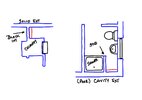
A poorly drawn sketch may help…..

The alcove by the chimney (correct @foxhole) is also adjacent to a solid external wall.
I’ve had the chimney and the alcove wall injected / re plastered with the High-Lime.
And it’s in this area I’ve avoided vinyl paints etc for breathability.
I recall (from the damp work) that the alcove wall is a single course of cinder block.

The alcove in bathroom is probably more straightforward.
It faces onto an external cavity (Northerly).
The cavity is small; maybe 50mm at most.
I can see no evidence of damp problems in this area.
The stud wall forming the shower appears plywood faced.
It’s not too noticeable as it only faces into the alcove.

The dry lining I’m thinking about is shown by the red lines in each alcove.
In both cases, this is to allow power sockets and in the bathroom; an illuminated cabinet.
Any advice much appreciated.

Thanks D
 

Attachments

  • IMG_6473.jpeg
    IMG_6473.jpeg
    202.5 KB · Views: 6

If you need to find a tradesperson to get your job done, please try our local search below, or if you are doing it yourself you can find suppliers local to you.

Select the supplier or trade you require, enter your location to begin your search.


Are you a trade or supplier? You can create your listing free at DIYnot Local

 
Back
Top