
Rcd protectio in bathroom

Joined
5 Feb 2007
Messages
1,164
Reaction score
17
Location
Liverpool
Country
United Kingdom
I got a EICR 5 years ago which passed.

I have a dual board with no rcd protection on lights.

So bathroom light have no rcd. Ladt spark passed it as all plumbing in bathroom is plumbed in plastic so I believe this is reason why no supplementory bonding was required.

This is my understanding.

I got a different spark to do this EICR and he has failed it on c2.

Can anyone advise if this is now a c2 please
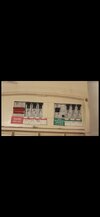
 

Attachments

  • Screenshot_20260501_133913_WhatsApp.jpg
    Screenshot_20260501_133913_WhatsApp.jpg
    62.8 KB · Views: 16
Ultimately it's the Inspector's view which is relevant, and not anyone else's. Not to say that I agree with it if supplementary bonding indeed isn't required.
 
BS7671:2008 said:
Where the location containing a bath or shower is in a building with a protective equipotential bonding system in accordance with Regulation 411.3.1.2, supplementary equipotential bonding may be omitted where all of the following conditions are met:
(i) All final circuits of the location comply with the requirements for automatic disconnection according to Regulation 411.3.2
(ii) All final circuits of the location have additional protection by means of an RCD in accordance with Regulation 701.411.3.3
(iii) All extraneous-conductive-parts of the location are effectively connected to the protective equipotential bonding according to Regulation 411.3.1.2.
So it is either/or, if the bonding is omitted, due to plastic pipes for example, then you need the RCD.

The rules have changed, with what type of RCD is required, but as far as I can make out, if you have a metal tap, it needs equipotential bonding, this would be the same as bonding window frames etc, which at one point was done.

But the EICR does not any more have a code for does not apply with current edition, code 4 was removed, so code C2 is potentially dangerous, and it is down to the inspector to decide if it is potentially dangerous, in fact there is nothing to say the inspector must code anything, and in the landlord law, it does not refer to any codes anyway, only that the inspector says it is fit for continued use. But using the C2 allows one to identify what makes in no longer fit for further use, which means someone else can do the repairs, and their invoice and minor works certificate is enough to show the repairs have been done, and the EICR does not need to be redone.
 
Can someone please explain what this EICR item means?

In the bathroom/shower section, item 6.2 says:

“Where used as a protective measure, requirements for SELV or PELV met”
It has been coded C2.

I am trying to understand what this actually refers to. The bathroom fan appears to be a standard 240V fan connected to the lighting circuit, and I am not aware of any 12V SELV/PELV fan, light, transformer, or other SELV/PELV equipment in the bathroom.

If there is no SELV/PELV equipment present, should this item normally be N/A rather than C2?

I’m not trying to avoid remedial work — I just want to understand what the C2 relates to so I can arrange the correct remedial work.

I have asked the electrician who did EICR if can advise but he has not got back as of yet.

Thanks
 
Can someone please explain what this EICR item means?

In the bathroom/shower section, item 6.2 says:

“Where used as a protective measure, requirements for SELV or PELV met”
It has been coded C2.

I am trying to understand what this actually refers to. The bathroom fan appears to be a standard 240V fan connected to the lighting circuit, and I am not aware of any 12V SELV/PELV fan, light, transformer, or other SELV/PELV equipment in the bathroom.

If there is no SELV/PELV equipment present, should this item normally be N/A rather than C2?

I’m not trying to avoid remedial work — I just want to understand what the C2 relates to so I can arrange the correct remedial work.

I have asked the electrician who did EICR if can advise but he has not got back as of yet.

Thanks

The light you have requires RCD protection

At the end of the day it’s a rental and you have a duty of care for your tenants
 
So bathroom light have no rcd. Ladt spark passed it as all plumbing in bathroom is plumbed in plastic so I believe this is reason why no supplementory bonding was required.
The requirements for circuits in a bathroom to have RCDs protection is separate from whether supplementary bonding is required or not.

All circuits in or passing through a bathroom have required RCD protection since the 17th edition in 2008.

Supplementary bonding can be omitted in certain circumstances, and having RCD protection is one of the requirements for that, but it's not the only one.

In any event, 3 RCBOs for that consumer unit will hardly break the bank.


“Where used as a protective measure, requirements for SELV or PELV met”
It has been coded C2.
Being generous, it's a mistake.
Less generous options are available.

Either way it's highly unlikely a domestic bathroom has any SELV, and it certainly won't have PELV.
SELV was usually 12V halogen downlights wired to a massive isolating transformer the size of a biscuit tin. All obsolete and long gone.
 
The requirements for circuits in a bathroom to have RCDs protection is separate from whether supplementary bonding is required or not.

All circuits in or passing through a bathroom have required RCD protection since the 17th edition in 2008.

Supplementary bonding can be omitted in certain circumstances, and having RCD protection is one of the requirements for that, but it's not the only one.

In any event, 3 RCBOs for that consumer unit will hardly break the bank.


Being generous, it's a mistake.
Less generous options are available.

Either way it's highly unlikely a domestic bathroom has any SELV, and it certainly won't have PELV.
SELV was usually 12V halogen downlights wired to a massive isolating transformer the size of a biscuit tin. All obsolete and long gone.
Thanks, that helps.

So if I understand correctly, the bathroom lighting/fan circuit not having RCD protection is separate from the plastic
pipework/supplementary bonding point, and fitting an RCBO to the relevant lighting circuit would likely remedy that issue.

Which I am happy to do and not alot of money. Easy fix and if brings eicr up to satifavtory Im happy.


The part I am still unclear on is item 6.2 SELV/PELV. The fan appears to be a standard 240V fan and I am not aware of any 12V fan/light or transformer in the bathroom, so it sounds like that item may have been marked C2 in error unless the inspector can identify actual SELV/PELV equipment.

I will ask the inspector to clarify exactly what item 6.2 relates to, and also ask for the exact location/accessory for the other C2 items.
 
.... All circuits in or passing through a bathroom have required RCD protection since the 17th edition in 2008.
To clarify a little for those who don't know ....

All circuits serving a bathroom or passing through Zones 1 and/or 2 of a bathroom (but not serving the bathroom) have required RCD protection since the 17th edition in 2008.
 
None in my zones 1 or 2.
That's probably often the case - which is why I felt that (for the sake of those readers (now or in the future) "who don't know") it was appropriate to give a full explanation of what the regs actually say, rather than the 'simplified/truncated' version that was posted.
 

If you need to find a tradesperson to get your job done, please try our local search below, or if you are doing it yourself you can find suppliers local to you.

Select the supplier or trade you require, enter your location to begin your search.


Are you a trade or supplier? You can create your listing free at DIYnot Local

 
Back
Top