preventing a shed base from rotting, engineering bricks ?

Joined
25 Jul 2008
Messages
9,225
Reaction score
2,736
Location
Bristol
Country
United Kingdom
As per post title. Im relocating a very good quality shed and want to stop the base from rotting. I read placing it on engineering bricks will work well as they don't absorb water. Does anyone agree this is a simple good idea. placing on dpc etc will just trap moisture in my opinion
 
Last edited:
Does anyone agree this is a simple good idea. placing on doc etc will just trap moisture in my opinion

Yep! Raising the floor will allow drying airflow, and help prevent rot. You can use anything which is strong enough, and none absorbent to moisture, to sit it on.
 
A good idea, but they're usually perforated so may cut/sink into the wood over the years.

Slate was always used as a DPC in walls before plastic was invented. It will have some very limited porosity, so won't hold water against the wood as plastic would.
 
Wouldn't 10mm plastic shims work? I would have thought it would be enough to raise the shed up without making the base ideal for for rat nest.
 
If the underside of the shed is accessible, ~ 2mm thick plastic washers fixed with galvanised clout nails at 30cm or so spacing can be effective to create an air gap, so that even if the timber gets wet it can then dry out.
 
Make sure it's level!

For me new shed I put five 4" posts concreted into the ground, one for each corner and one for the middle, then built a level frame about 4" off of the ground and built the shed on top of that (I soaked the posts in solvent based wood preserver).

I have another shed which was in the garden when I moved in which has been built on top of breeze blocks, but whoever did it didn't know what a spirit level was. It's sagging on one side and the roof has gone a bit concave.
 
Quite like the idea of fitting plastic to the bottom. I got some old slabs to sit it on on-top of some type 1. It needs raising so could put some timber across the shed base to raise it. Then pack the timber up with plastic. That will save having to build the sub base up and creating a continuous base. Just need to strategically place and level the slabs. I have plan. Just need to decide on what plastic. Some little blocks or feet will keep it up above any damp
 
my thoughts
fit gutters as splashback always causes premature failure off the bottom few planks and base edge timbers

space preferably at least 12mm and up to a brick height on non-permeable material topped with dpm/roofing felt /whatever off the ground as belt and braces
keep in mind your limited to 2.5 m near the boundary to avoid the need for planning so any packing above ground level will need to be less than would raise the shed above 2,5 m

my thoughts on plastic shims are be careful as you have a small support footprint and iff you use on thin packing material then perhaps may be too high a point loading
for example you may use a say 200mmx200mm tile under a say 35mm wide floor joist so the shim may be 35x 70mm so to spread the load better to aim for perhaps 60 plus percentage off the contact along the joist so 2x70mm within the 200mm tile
working to the packing edge will also reduce the unsupported span from pad centres to pad edges
 
Our shed sits on concrete base which is about 3 inches taller than the surrounding ground. There is air flow right underneath the shed. It’s been there over 12 years and damp isn’t an issue

Sure there is a step up but that’s not an issue
 
Our shed sits on concrete base which is about 3 inches taller than the surrounding ground. There is air flow right underneath the shed. It’s been there over 12 years and damp isn’t an issue

Sure there is a step up but that’s not an issue
Thanks but want to avoid the work and cost of putting a concrete slab down. I have to fund a 2 story extension after moving the shed
 
my thoughts
fit gutters as splashback always causes premature failure off the bottom few planks and base edge timbers

space preferably at least 12mm and up to a brick height on non-permeable material topped with dpm/roofing felt /whatever off the ground as belt and braces
keep in mind your limited to 2.5 m near the boundary to avoid the need for planning so any packing above ground level will need to be less than would raise the shed above 2,5 m

my thoughts on plastic shims are be careful as you have a small support footprint and iff you use on thin packing material then perhaps may be too high a point loading
for example you may use a say 200mmx200mm tile under a say 35mm wide floor joist so the shim may be 35x 70mm so to spread the load better to aim for perhaps 60 plus percentage off the contact along the joist so 2x70mm within the 200mm tile
working to the packing edge will also reduce the unsupported span from pad centres to pad edges
Thanks for your input. The slabs are 400 square. The shed is below 2.5m tall. I’m thinking of 6 timbers to spread at 90degrees across the existing floor timbers. Will then place these 6 on the slabs. Probably 3 slabs to each timber. I see your point on the weight being on the shims in a small area but dividing it by 18 points i think it will be ok. Perhaps it’s all just overkill if I use treated timber. Good shout on adding the guttering. One side will be close up to a neighbour’s fence so be good to keep at least that side dry.
 
Quite like the idea of fitting plastic to the bottom. I got some old slabs to sit it on on-top of some type 1. It needs raising so could put some timber across the shed base to raise it. Then pack the timber up with plastic. That will save having to build the sub base up and creating a continuous base. Just need to strategically place and level the slabs. I have plan. Just need to decide on what plastic. Some little blocks or feet will keep it up above any damp

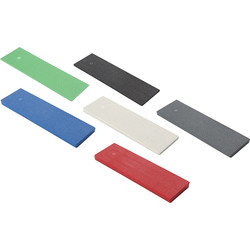
I normally use the following shims.


You may need a crowbar to lift the base slightly to add more (if required). The thickest is 6mm. You can use glue to glue more together- I normally use a hot melt glue gun to fix them together. The glue sets in seconds.

Alternatively, you could use two interlocking shim wedges, such as

https://www.amazon.co.uk/Black-Plastic-Interlocking-Wedges-Furniture/dp/B06XD6186T

You can use two, one on top of the other (inverted) and hammer them together until you get the correct height. You can then use a sacrificial chisel to remove the excess.

Another alternative is glazing shims.


From memory, a mouse can squeeze through a gap between 6-10mm. A rat will need just about 38mm. Sorry, am harking back to the possibility of nests under the shed.
 
So we started saying that a plastic DPC would cause rotting, but now we're looking at various other forms of plastic?

I thought the engineering bricks were a pretty good idea. Slate possibly better IMO. Shims would eventually sink into the wood, they're too small. Anything plastic that's flat and sheet-like will encourage rotting.
 

If you need to find a tradesperson to get your job done, please try our local search below, or if you are doing it yourself you can find suppliers local to you.

Select the supplier or trade you require, enter your location to begin your search.


Are you a trade or supplier? You can create your listing free at DIYnot Local

 
Back
Top