
Where to put subfloor ventilation fans?

Joined
11 Mar 2011
Messages
119
Reaction score
2
Location
London
Country
United Kingdom
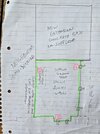
I've got an old semi-detached house with a suspended timber floor across most of ground floor (area in green on drawing), mainly 4x2" timbers across a maze of sleeper walls with about 250-500mm underneath them. I have all the timber floor up so I can replace a few rotted timbers. I will also insulate between the 4x2" with 100mm Celotex, and foam and tape all the gaps to create an airtight seal.

An extension at back with concrete slab means no through ventilation front-back. The airflow into the side airbricks is small as it's down a very sheltered side passage, and our neighbour's subfloor is full of rubble. So probably very little side-side natural airflow too. I have already put a couple of extra air bricks in where I can, but the damp smell in the heart of the house is still strong.

I think subfloor fans are probably the answer. But where should they go? And which direction should they push the air? I have labelled pink 1, 2, 3 as possible places:
- Positions 1 or 3 would be replacing air brick with an externally accessible trickle fan like WMF Mori. Should they push air in or suck it out?
- Position 2 I could create a hatch in the cupboard floor for maintenance and use a traditional inline fan. From there guess you would want to push air back towards the air bricks?
- Other option would be to put an external fan in 1 but duct it through to the heart of the unventilated space. But should it suck or blow?

Or does anyone think I should do something else; my only other ideas are:
- Just rely on the insulation to stop warm damp air from house coming down into the void, and hope this stops rot (once sealed up will be hard to know)
- Treat the timbers with something to prevent dry rot?
- Fill the void in some way? I don't think it would be worth paying for a whole concrete subfloor. But are there any expanding foam treatments that could exclude air from the subfloor permanently?

Thanks - bit stuck with this one. But I know doing something now while I have the subfloor up will be a lot easier than replacing a rotted floor in 10yrs time!
 

Attachments
  • fan positions.jpg
    fan positions.jpg
    413.5 KB · Views: 16
Last edited:
Depending on the depth of the subfloor it may be a lot easier and much more effective to just remove the floor completely and fill the void with insulation and concrete.

We moved from a house with suspended floor to one with solid. It's vastly superior, with absolutely no worries about vents or rot.
 
I would put a fan in position 1 with a duct leading to the 'deadest' spot in the subfloor, which is probably nearest point 2. I would have the fan sucking air out of the subfloor, which would force air to be drawn in through all the openings and create some general air movement under the floor.

We insulated under the suspended floor of our lounge with 100mm of celotex when we replaced the floor due to a 100 year old mixture of wet rot and woodworm. I have been very disappointed with the results. The floor is no warmer underfoot now that it was before the insulation and the room doesn't feel any warmer either.
 
You don’t need sub floor fans .
It probably does if the original through-flow path has been blocked by the extension.

Are you sure there aren't any airbricks in the back of the extension? They're often ducted through the concrete in this sort of situation.

Otherwise, I'd definitely have the fan extracting, so that the air pressure down there is below that of the house. If you blow air into the subfloor then it will blow up into the house and stink worse than ever. You'll need to draught-proof the floor as well as possible, otherwise all the heat will constantly get sucked out of the house.

But concrete would be best, by far.
 
The solid floor should have ducting through it ? Are there external vents to extension? How could warm damp air defy gravity and pass through floor covering?
 
Depending on the depth of the subfloor it may be a lot easier and much more effective to just remove the floor completely and fill the void with insulation and concrete.

We moved from a house with suspended floor to one with solid. It's vastly superior, with absolutely no worries about vents or rot.
I think getting a full concrete slab poured would be too much hassle but I did wonder about foam.

Even if we leave the main void open, is it better to fill in tiny gaps like this between the external wall and the sleeper wall that the beams rest on? I could just use a can of foam for that, but it's not going to ventilate properly.
partial voids.jpg
 
I would put a fan in position 1 with a duct leading to the 'deadest' spot in the subfloor, which is probably nearest point 2. I would have the fan sucking air out of the subfloor, which would force air to be drawn in through all the openings and create some general air movement under the floor.

We insulated under the suspended floor of our lounge with 100mm of celotex when we replaced the floor due to a 100 year old mixture of wet rot and woodworm. I have been very disappointed with the results. The floor is no warmer underfoot now that it was before the insulation and the room doesn't feel any warmer either.
Yes thinking about it over the day I was thinking that would be the best way to mimic natural circulation of air through air bricks.

I am also thinking of sealing in the insulation with aluminium tape to try to stop any air movement between the subfloor and the house - for heat efficiency and containing smell. I think the air from outside is supposed to be drier than that in the house, although hard to imagine that from that dank side passage.
 
It probably does if the original through-flow path has been blocked by the extension.

Are you sure there aren't any airbricks in the back of the extension? They're often ducted through the concrete in this sort of situation.

Otherwise, I'd definitely have the fan extracting, so that the air pressure down there is below that of the house. If you blow air into the subfloor then it will blow up into the house and stink worse than ever. You'll need to draught-proof the floor as well as possible, otherwise all the heat will constantly get sucked out of the house.

But concrete would be best, by far.

No ventilation out through the extension. Building Control did question it, but there were no air bricks in the old outrigger so no obligation to provide more insulation than was already there (probably why the dry rot was advanced even before the extension).

With all the floor up I should be able to seal it pretty well, celotex plus foam round edges, then aluminium tape.
 
I'll go for ducting from near 2 in the deadest part to the air brick at 1. I'll try for 110mm rigid circular but might have to go for the rectangular stuff if there's too many sleeper walls to get through. And direction pushing air from the dead area out of the air brick.

What about the fan? Should I go for:
- Replace airbrick 1 with a Mori fan to pull the air towards outside?
- Inline fan at 2, the other end of the ducting (accessible via a hatch in the cupboard floor) to push the air towards the outside?
I think you'd get more airflow pushing, and those fans are cheaper. But most people seem to recommend the air brick ones. Any ideas?

fan plan.jpg
 

If you need to find a tradesperson to get your job done, please try our local search below, or if you are doing it yourself you can find suppliers local to you.

Select the supplier or trade you require, enter your location to begin your search.


Are you a trade or supplier? You can create your listing free at DIYnot Local

 
Back
Top