
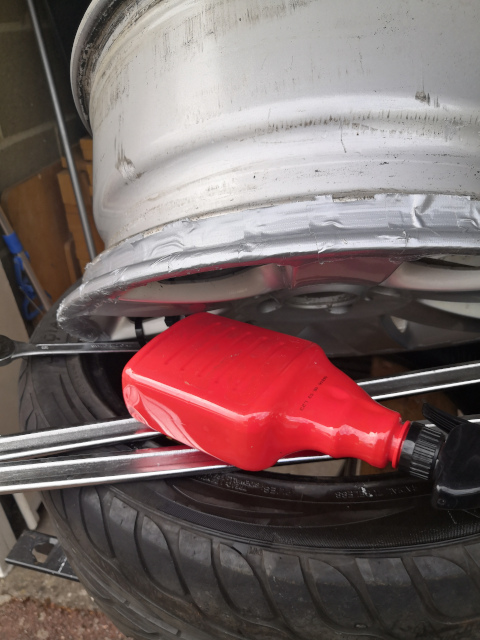
Having gained access to an aluminum alloy rim, I noticed various corrosion bubbles in the tyre bead areas. I am thinking of spot repairing them by sanding flat and painting. Anyone ever used brushable enamel for this kind of repair? Any recommendations for paint? Since the repair areas are hidden, the paint colour doesn't matter very much. Thanks.

You are using an out of date browser. It may not display this or other websites correctly.
You should upgrade or use an alternative browser.
You should upgrade or use an alternative browser.
Enamel for alloy wheel?
- Thread starter DiyNutJob
- Start date


You don’t need to sand or paint. There’s a special product we use just for that. Ask me nicely and I’ll tell you what it’s called if you really want some help and are not just starting another argument thread.
Last edited:
If you really wanted to do it, you'd be best ff bead blasting the rim, filling all the pinholes and crevices with filler, sanding and etch-priming. Then paint whatever you like over the top, but it's much easier to go to a tyre place and ask them to use the stuff that Mottie mentioned.
Yes, I really really want to do it. I like to go for final solutions that's good for lifetime. I have no pin holes, only corrosion bumps. Have you used etch priming that overlaps existing paint? Any bad reactions? I said spot repair. No blasting is needed.If you really wanted to do it
Yes, I really really want to do it. I like to go for final solutions that's good for lifetime. I have no pin holes, only corrosion bumps. Have you used etch priming that overlaps existing paint? Any bad reactions? I said spot repair. No blasting is needed.
Ah... I can see this turning into another "Nutjob" thread...

Step 1 - ask for advice;
Step 2 - receive advice;
Step 3 - disagree with advice and turn the thread into a 10 page slanging match...
The "bumps" that you can see, are because the oxides of aluminium that make up the corrosion, are less dense than the aluminium itself, so they occupy more volume. (The same is true of rust bubbles on ferrous surfaces). You say you are looking for a permanent solution, but sanding will only scrape off the existing corrosion down to the level of the surrounding metal. Just like rust, the corrosion will extend to slightly below the surface of the metal as well, so if you want to get it all out, it will leave small pits in the aluminium below it, once you've got the corrosion out.
Anyway, I'll leave that with you. All depends whether you really want a "good for a lifetime" solution, or whether you actually just want a few more years out of them. Looking at the photos on the other thread, it's been kerbed to death anyway...
No, I haven't had a problem with any of the various etch primers I've used (widely available from car shops) on any of the previously painted aluminium components that I've used it on, but that doesn't mean that somewhere out there, there isn't a combination of the two that won't react. However, you've got the tyre off now, so you have plenty of "inconspicuous area" inside the rim to test it on...
Correct.Ah... I can see this turning into another "Nutjob" thread...
Step 1 - ask for advice;
Step 2 - receive advice;
Step 3 - disagree with advice and turn the thread into a 10 page slanging match...
You're wasting your time. He doesn’t want a solution, he wants an another 10+ page thread only to be locked by the admin.
Step 4 - you will be in thread to join the match.Step 3 - disagree with advice and turn the thread into a 10 page slanging match...
You must factor in the specific gravity of the paint and the application thickness and area, to ensure you don't unbalance the wheel 
You must factor in the specific gravity of the paint and the application thickness and area, to ensure you don't unbalance the wheel
He'll balance his own, on a balancing machine of his own invention, forgetting that balancing wheels is a 3-D problem...

Fork it. I will do painting another time. This is a spare "donut" that I may never actually use. I will sand flat and use bead sealer instead. The sealer will also be needed for my regular wheel when I open it up to replace the leaking valve. Pulling the valve out by hook is a no go because the force needed has a high chance of damaging the hole.
THE END.
You call that asking nicelyYes, I really really want to do it. I like to go for final solutions that's good for lifetime. I have no pin holes, only corrosion bumps. Have you used etch priming that overlaps existing paint? Any bad reactions? I said spot repair. No blasting is needed.
Not quite. But the final solution is at hand. The bead seat that was disrupted by corrosion must be flattened, filled, and repainted. The bead sealant will be suitable, but not not in the way you know. The sealant must be cured before tyre mounting. Relying on the uncured sealant to hit all the right spots during tyre mounting is a shot in the dark that will often lead to failure. Painting and curing the bead seat using conventional paint or bead sealant is the only sure way of getting a good seal. Since the cured sealant is a weak coating, use of lubricant is a must to maximise the chance of the bead slipping over the coating with reduced disruption.THE END.
I must be if people respond positively.You call that asking nicely
Similar threads


- Replies
- 29
- Views
- 4K
- Replies
- 0
- Views
- 843
- Replies
- 1
- Views
- 953
