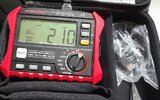
The testers pass at around 1.8Ω to 1.9Ω where the pass for a ring final is 1.38Ω. A 20 amp radial with a type B MCB/RCBO it will trip on the magnetic part at between 3 and 5 times the rating, so 100 amp, plus 5% safety margin so 105 amp for the calculation so 230/105 = 2.19Ω, with 25 amp 1.75Ω before we started adding the 5% 2.3Ω and 1.84Ω and the socket testers likely designed before we added the 5% safety margin. A 32 amp ring final would be 1.37Ω with 5% and 1.44Ω without it.
If over that reading a short circuit would only work the thermal side of the trip, and tripping times would be longer, since this is live to live (line to neutral) as a line to earth would trip the RCD not sure, if is really too much of a problem. As to if the plug in tester measures line to earth or line to neutral I don't know, I suspect line to earth, but my plug in tester has the option to select, and gives a reading rather than 4 LEDs.
But using a plug in tester, rather than using the test button, in my case it gives the milliseconds it took to trip, and can test at ½, 1, and 5 times the rated value, both pos and neg half cycle, and the ½ test shows that one could draw an extra 15 mA over the background leakage, so you're not close to the limit, so likely the background leakage is within the 30% permitted (9 mA with a 30 mA trip) but the cheap ones shown, do not do all that, so in theory not much better to the test button on the RCD.
But in practice, I know we had a 10 mA socket where I worked, (MK metal) and pressing the test button would trip the 10 mA, 30 mA and 100 mA RCDs so it seems it was no set even to test at 5 times rated current to take out the 100 mA trip, so how much to trust the built in test button I don't know, we were told it was to show it hadn't stuck, more than show it will trip at rated current.
All my outside sockets, are either the only device on the RCBO feeding them, or plugged in so I can easy unplug should water get into them.