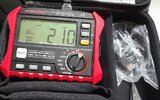
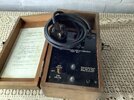
RCD adaptor won't reset...

Try in a different socket, sometimes if the earths poor they wont reset
Edit: I did try the adaptor in a different socket but it still wouldn't reset.

I've plugged the floodlight directly into the socket without the RCD adaptor, and its now protected solely by the fixed RCD in the CU. So I'm happy with the situation as it stands, but thanks anyhow for that advice.
 
As a "rule of thumb" there is no detrement having 2,3,10 RCDs one after the other, they will all give you the same protection (if they are of the same rating) however likley (possibly as much as a 7% failure rate then it might be considered likely to cause that small failure rate to reduce (although getting it down to 7% for each RCD fitted then applyng to the remainder might not realistically get you down as pure maths might sometimes imply).

So no harm and might do some good , however just a caveat or two and if you read Flameport`s comment it might be a consideration.

Most people feel happy with one RCD and I often do myself if it is in addition to protection to good substanstial earthing, if total reliance is on an RCD then I favour having two in series just to mitigate faulty RCDs a little, but that`s me and I am probably a minority.
The main thing is testing to see you have a decent reliable earth in place is the best approach in the first instance.
 
Most people feel happy with one RCD and I often do myself if it is in addition to protection to good substanstial earthing,
Agreed, on a TN installation with "good substantial earthing" one RCD is plenty.

I can see an argument for RCD plugs on long extension leads for two reasons. Firstly "good substantial earthing" may be questionable at the far end. Secondly one end may be indoors while the other is outdoors and RCD protection requirements for indoor sockets are a relatively recent thing.

if total reliance is on an RCD then I favour having two in series just to mitigate faulty RCDs a little, but that`s me and I am probably a minority.
I don't have a reference handy, but I recall hearing that in some countries it is a requirement that the same RCD not be relied on for both "fault protection" and "additional protection". Also, even if technically allowed by regs I also consider it dubious to have no "fault protection" for the busbar/pan assembly inside a metal CU/DB.

So even if not technically required I think a main RCD for "fault protection" with 30mA RCDs for "additional protection" is a sensible choice on TT installations.
 
Agreed, on a TN installation with "good substantial earthing" one RCD is plenty.

I can see an argument for RCD plugs on long extension leads for two reasons. Firstly "good substantial earthing" may be questionable at the far end. Secondly one end may be indoors while the other is outdoors and RCD protection requirements for indoor sockets are a relatively recent thing.


I don't have a reference handy, but I recall hearing that in some countries it is a requirement that the same RCD not be relied on for both "fault protection" and "additional protection". Also, even if technically allowed by regs I also consider it dubious to have no "fault protection" for the busbar/pan assembly inside a metal CU/DB.

So even if not technically required I think a main RCD for "fault protection" with 30mA RCDs for "additional protection" is a sensible choice on TT installations.
Do you mean a main rcd for the entire installation ?

That’s best avoided where possible imo

All 30ma rcbos is the best way imo
 
Last edited:
There has been a video released about using a uni-directional RCBO (RCB and MCB combined) when fitted the wrong way around, and it failing.

But I have only once found a failed RCD, the whole reason it failed was it was fitted in series with an ELCB-v. (ELCB was the name used before RCD) up to now failed RCDs have failed to reset, not failed to trip, but so easy to press test button the chance of one failing and not being found is really slim.
I can see an argument for RCD plugs on long extension leads for two reasons. Firstly "good substantial earthing" may be questionable at the far end. Secondly one end may be indoors while the other is outdoors and RCD protection requirements for indoor sockets are a relatively recent thing.
Since the modern RCD uses imbalance the longer the lead the more capacitive and inductive linking there is likely to be, so the longer it is, the more likely it is to trip.

As to earth being that poor it will not trip, which is exactly why it would not trip when an ELCB-v was in the circuit, it also means any shock line to earth will also be non-lethal. And no RCD would trip so no point having more than one.

The only time we have two RCDs in series in circuit is:-
A) Each one is three times the valve so there is discrimination.
B) Caravan or Boat where regulations require it.
C) It is being used for the non volt trip function.
 
I’ve seen plenty of faulty/failed rcds

Some on new work not tripping within parameters and some on older work not tripping at all
 
Today I do have a tester, RCD tester ramp.jpg but it will only test the current type, I have never had one for ELCB-v Clare ELCB tester3.jpg but really pressing the test button should be good enough to ensure it will work, even if out of parameters.

I know I am lazy, with a RCBO can't really undo the terminals as torquing up has been known to affect the tripping current, so one should use a clamp-on as well to see what the background leakage is, but I have missed this as with the RCD/MCB one could turn the MCB off, yes there could be earth - neutral leakage, but until a couple of years back, my clamp-on would only measure in 0.01 increments where really need 0.001 increments at least.
 
As a "rule of thumb" there is no detrement having 2,3,10 RCDs one after the other, they will all give you the same protection (if they are of the same rating) however likley (possibly as much as a 7% failure rate then it might be considered likely to cause that small failure rate to reduce (although getting it down to 7% for each RCD fitted then applyng to the remainder might not realistically get you down as pure maths might sometimes imply).

So no harm and might do some good , however just a caveat or two and if you read Flameport`s comment it might be a consideration.

Most people feel happy with one RCD and I often do myself if it is in addition to protection to good substanstial earthing, if total reliance is on an RCD then I favour having two in series just to mitigate faulty RCDs a little, but that`s me and I am probably a minority.
The main thing is testing to see you have a decent reliable earth in place is the best approach in the first
As a "rule of thumb" there is no detrement having 2,3,10 RCDs one after the other, they will all give you the same protection (if they are of the same rating) however likley (possibly as much as a 7% failure rate then it might be considered likely to cause that small failure rate to reduce (although getting it down to 7% for each RCD fitted then applyng to the remainder might not realistically get you down as pure maths might sometimes imply).

So no harm and might do some good , however just a caveat or two and if you read Flameport`s comment it might be a consideration.

Most people feel happy with one RCD and I often do myself if it is in addition to protection to good substanstial earthing, if total reliance is on an RCD then I favour having two in series just to mitigate faulty RCDs a little, but that`s me and I am probably a minority.
The main thing is testing to see you have a decent reliable earth in place is the best approach in the first instance.
As a matter of interest, how reliable and useful are the plug in socket testers like the one below?


IMG_3418.jpeg
 
Your typical 3-light socket tester is just three neon bulbs, there isn't a lot to go wrong with it, but it does have some limitations, most notablly.

* It can't tell a bad earth from no earth.
* It can't detect earth/neutral reversal.

I guess perhaps one of the bulbs could fail, perhaps one should periodically test their socket testers with a L/N reversal adapter.

I've seen some more expensive models with a loop test feature but only indicating one of a few broad ranges rather than giving a value as a "proper" loop tester does.

Your tester looks like a standard "3 light" tester with an additional function to test for voltage between the protective earth conductor and the user (similar to a voltstick or neon screwdriver).

Overall I would say socket testers are a lot better than not testing at all, but aren't really a substitute for proper test equipment.
 
Last edited:
1785966277007.png
1785966302231.png
1785966324889.png
There are plug in testers which can test RCDs and do a loop test, but it seems designed for radials not ring finals, so they can pass circuits which should fail.

Some cheap testers
1785967085750.png
still have a RCD test, but no loop test, but the one you show does not seem to have a RCD test.
 
The testers pass at around 1.8Ω to 1.9Ω where the pass for a ring final is 1.38Ω. A 20 amp radial with a type B MCB/RCBO it will trip on the magnetic part at between 3 and 5 times the rating, so 100 amp, plus 5% safety margin so 105 amp for the calculation so 230/105 = 2.19Ω, with 25 amp 1.75Ω before we started adding the 5% 2.3Ω and 1.84Ω and the socket testers likely designed before we added the 5% safety margin. A 32 amp ring final would be 1.37Ω with 5% and 1.44Ω without it.

If over that reading a short circuit would only work the thermal side of the trip, and tripping times would be longer, since this is live to live (line to neutral) as a line to earth would trip the RCD not sure, if is really too much of a problem. As to if the plug in tester measures line to earth or line to neutral I don't know, I suspect line to earth, but my plug in tester has the option to select, and gives a reading rather than 4 LEDs.

But using a plug in tester, rather than using the test button, in my case it gives the milliseconds it took to trip, and can test at ½, 1, and 5 times the rated value, both pos and neg half cycle, and the ½ test shows that one could draw an extra 15 mA over the background leakage, so you're not close to the limit, so likely the background leakage is within the 30% permitted (9 mA with a 30 mA trip) but the cheap ones shown, do not do all that, so in theory not much better to the test button on the RCD.

But in practice, I know we had a 10 mA socket where I worked, (MK metal) and pressing the test button would trip the 10 mA, 30 mA and 100 mA RCDs so it seems it was no set even to test at 5 times rated current to take out the 100 mA trip, so how much to trust the built in test button I don't know, we were told it was to show it hadn't stuck, more than show it will trip at rated current.

All my outside sockets, are either the only device on the RCBO feeding them, or plugged in so I can easy unplug should water get into them.

 

If you need to find a tradesperson to get your job done, please try our local search below, or if you are doing it yourself you can find suppliers local to you.

Select the supplier or trade you require, enter your location to begin your search.


Are you a trade or supplier? You can create your listing free at DIYnot Local

 
Back
Top