Import cost £38.32 and export payment £50.79 for August, so my bill is -£12.47 so yes solar is paying for its self. But that a 6 kW array, not 2 kW which is maximum with plug in, and is using a battery to store it, not permitted with plug in, and with an off-peak tariff, which is unlikely to work out well with plug in. In answer to
@Odds
I have now said many times, clearly plug in solar will reduce the energy bill, but as to how it compares with a stand-alone battery and solar, is more to the point.
So if I was to put two solar panels on my wall, and use a plug in grid tie inverter, how would it compare with same two panels, and a battery pack, and a pair of leads one going clockwise and one anti-clockwise around the room powering cabinet lights, up-lighters, phone chargers, chairs, TV and video in the room?
What plug in solar is doing, is removing the need to distribute the power around a room or house. And how easy it will be to distribute the power does depend on the home.
So easy enough to work out how much power per year from a 2 kW array, I simply look at my 6 kW array and divide by 3. What is a lot harder, is to work out how much of that power can be used. And putting a cap on a 2 kW array of 800 watt which you can actually use, means we have very little data to draw on.
I have paid £21.70 standing charge in August, I only used £16.62 OK does not really help as most of that was off-peak, so
this is likely better, but for plug in it does not really tell us very much, and most the YouTube videos are done by people who already have solar, even the efixx one, he used batteries, so in real terms people are buying blind, they have not a clue what it will save. I have guessed at around £75 a year, but it is a guess, and even after being fitted a year, it will tell very little.
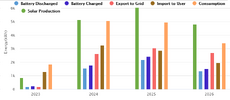
If I look at my own totals, 2025 was far better to 2024, 2023 it only went in this time of year, and 2026 clearly not a full years data, I have a 6 kW array pointing South-West with a 5 kW inverter, and 6.4 kW of battery now, but to begin with only 3.2 kW.
But the stand alone or grid tie, it is all down to not what the solar produces, but what I can use of that production, I look now
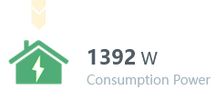
that looks very good, but I know that is down to the iboost+ heating my domestic hot water, which allows around 150 watt of export before it diverts power, watching the graph
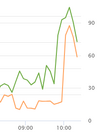
you can see how the use follows solar production, so reasonable sure that is where the power is going. So maths 800 watt, minus 200 watt back-ground, and 150 watt before iboost+ cuts in so max of around 450 watt into the domestic hot water, and the iboost+ costs £300 not really worth it with my solar panels, hardly worth it with plug and play. There do seem to be some cheap versions
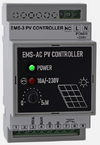
as to how well they work I don't know?
Using something like this
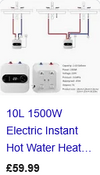
in the kitchen could ensure all solar is self used, but again stand alone battery or grid tie is the main question.



