Plug in solar

I think batteries will come, quite quickly, as part of plug in solar. I could of course be wrong.

I agree, which is why I will wait, as once there is a mass market the price will go down.

Mmm.

I'm not so sure. I imagine the bulk of the cost of a battery will be the lithium cells in it, and given how many of those are being made already, I doubt there's much scope for economies-of-scale reductions.

An increased market might tempt other manufacturers to launch products and shave profit margins. Oh look - a race to the bottom with products containing as much energy as 20 (or more) sticks of dynamite.
 
Depends on usage really, if someone is home most of the day then you could power anything with it. If they are out all day then it will still power things while you are out, like fridge/freezers, but you'd really need to do your sums on potential savings.

Aye, there's the rub - i don't think most folk do not or can not find time to work out an annual usage for energy consumption. I may be wrong, since the advent of better ways to take readings of monthly use, then calculating an annual consumption rate based on a seasonal average. It's fiddly. I did it a few years ago when considering a change with our energy provider, taking readings monthly then working out the cost at the end of the year to make a comparison check with other providers...in the long term i guess a solar panel might make a diff. but where will i put this device? People with smaller homes and flats will have to consider how much room they take up.
 
Do you trust them? Those numbers are useless without saying size of solar array, and batteries. September to date View attachment 421620 Consumption 29.7 kWh and production 40.6 kWh would not matter what battery size, even on rainy days I produce more than I use. October last year the consumption exceeded production View attachment 421625 until March View attachment 421623 so for 4 months I use batteries to move power from off-peak to peak times, but best month this year View attachment 421626 shows if I want to self use the power around 3 kW would be a better size. Maybe smaller, so 2 kW into a battery pack, and it is unlikely one would stop saving solar produced very often because battery was full.

Yeah, that's more like Bloomfield territory (peace be upon him): that kind of micromanagement is way too itty-bitty for me, i'm afraid. If it's cold, i turn on the heating. If i need tea, i turn to the kettle without fussing over how many watts i may use in the process of getting a reviving cup of leaf juice.

Is it cost effective? would be uppermost in my mind should i consider buying one.
 
Aye, there's the rub - i don't think most folk do not or can not find time to work out an annual usage for energy consumption. I may be wrong, since the advent of better ways to take readings of monthly use, then calculating an annual consumption rate based on a seasonal average. It's fiddly. I did it a few years ago when considering a change with our energy provider, taking readings monthly then working out the cost at the end of the year to make a comparison check with other providers...in the long term i guess a solar panel might make a diff. but where will i put this device? People with smaller homes and flats will have to consider how much room they take up.
That's all true, but isn't much different choosing "actual solar", or some other things. None of those seem to have been discussed in the past but now some are up in arms, not because they want it, but because of the poor people who don't know what they are doing.
 
There`s rhe rub.
A salesman will always try to sell you something.
Whther that is "True" or is sometimes true or mostly true or not often true or is pretty true for a few people but not often true for lots of people.

What you got to work out is what is likely true for you then thes costs and implications.

Extremely rare to have a "One size fits all"
 
That's all true, but isn't much different choosing "actual solar", or some other things. None of those seem to have been discussed in the past but now some are up in arms, not because they want it, but because of the poor people who don't know what they are doing.

T'was ever thus. I have a feeling it's going to be the kind of technology to suit affordable homes and terraces rather than detached houses. 'Plug and play' really opened up the computing market and perhaps this will do the same. Off at a slight tangent: i heard of up to 15% of elderly people are unable to access a computer because it's too confusing, ensuring the digital age leaves them out in the cold, unable to book a hospital appointment or arrange to see their GP. The world is becoming sub-divided by technology at a rapidly increasing rate.
 
There`s rhe rub.
A salesman will always try to sell you something.
Whther that is "True" or is sometimes true or mostly true or not often true or is pretty true for a few people but not often true for lots of people.

What you got to work out is what is likely true for you then thes costs and implications.

Extremely rare to have a "One size fits all"
Agree with all of that, what I mean is, let's just not pick on one thing. In a short while we'll just be picking on another new thing though.
 
With solar, it is not what the solar produces, it is how electric is bought and sold which makes it worthwhile or not.

In the early days some countries bought and sold at same price, so no need for a battery. The need for a battery is hinged around the off-peak tariffs, and the difference between selling price and buying price.

So over the years, the advantage/disadvantage of energy storage has changed. When economy 7 first came out, the overnight tariff was so cheap, it did not matter that energy was wasted as it heated the home at the wrong time, there was still a gain monitory wise.

The same with the likes of the iboost+ and using solar to heat water, the unit still works well, but the tariffs mean it no longer makes monitory sense.

I have been surprised when reading the forums, how many people even with professionally fitted solar, are not paid for export. But for 20 months I fought with British Gas to try and get payment for export, and failed, then moved to Octopus and all sorted within 2 weeks.

Basic fact was British Gas were giving me the run around, I needed to apply to the DNO for a second MPAN number, but British Gas were telling me I had filled in their forms in the wrong format. Hindsight, it was due to British Gas delay in fitting a smart meter, if it had been fitted before solar, then the solar company would have done the paperwork, but it was fitted 4 months after the solar, so it was really down to British Gas.

However, the point is, it is tariff dependent, and what is or is not worthwhile, all depends on tariffs. And even then, the tariff advertised as being for solar, for most people as not as good as the tariff advertised as being for an EV.

But with only 800 watt, what tariff will help is a problem. Until I had solar a year I had no idea what tariff would work out best for me, and since a added a second battery, it was two years before I could really work things out as to which tariff was best for me.

And when the tariffs changed, so did how much solar save change. Solar is a leap of faith, as tariffs are likely to change many times during its life.

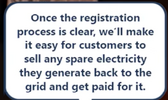
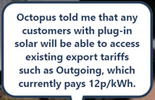
It seems Octopus 1788524441801.png1788524506908.png will be paying for export, so this really changes the question as it if it is all worthwhile.

 
Last edited:
T'was ever thus. I have a feeling it's going to be the kind of technology to suit affordable homes and terraces rather than detached houses. 'Plug and play' really opened up the computing market and perhaps this will do the same. Off at a slight tangent: i heard of up to 15% of elderly people are unable to access a computer because it's too confusingt, ensuring the digital age leaves them out in the cold, unable to book a hospital appointment or arrange to see their GP. The world is becoming sub-divided by technology at a rapidly increasing rate.
Big double ditto for that.
It used to be possible to ring folk if not call in to a surgery/showroom.
When tinternet opened up we all thought "Hah additional possiblities - great.
No such luck, it has narrowed down the scope and made it impossible for many, especially the older ones (not the 12 year olds they can walk it.
It is impossible to actually speak to somebody in services at GP, Dentists, Public Bodies and large retailers and Banks etc etc etc - We have become a third rate third world nation .

Actually you can get hold of someone pretty quick if you owe them money!
 
And even then, the tariff advertised as being for solar, for most people as not as good as the tariff advertised as being for an EV.

What logical reason is there for selling off-peak electricity to people to use for charging their cars for less than you sell it to them for running their domestic appliances?
 
Sadly, a few of the electrical debaters have left us, not them all, but you might not get an answer to this kind of question any more.
 
I did look at tariffs, I can see how if you allow the supplier to decide when you use the power, and also I can understand why the shorter the off-peak is then the cheaper it is as you have no option be use it when there is not a surplus of power.

So if you had a 8p tariff for 5 hours, 10p tariff for 6 hours, 12p for 12 hours etc, that would make sense, but that is not the case.

There are three stage tariffs, with off-peak, standard and peak, which was the tariff suggested for solar, however, the 4 pm to 7 pm peak would need one to monitor battery state and boost it before 4 pm if there was a chance of it running out before 7 pm, the export tariff also was three stage, and this would mean taking a gamble on the weather, when deciding how much the charge the battery.

So for the homeowner, we want to set up and forget, so if we can charge the battery at 8.625p/kWh and get paid 12p/kWh it does not matter if the battery is charged too much to accept the solar, as you're still on the gain, I can set up and forget about it. No daily adjustments, to gain a few pence.

This is where the 800 watt of the plug-in solar comes unstuck, as no one has any data as to what tariffs are likely to help, what will or will not pay. And if the same panels feeding a battery pack so not limited to 800 watt, would work out better.

Octopus has just moved the goal posts again with the 12p per kWh hour offer for export, but my battery ensures I do not import except for off-peak for most of the day, rain or shine, but with no battery it's all guess work.
 

If you need to find a tradesperson to get your job done, please try our local search below, or if you are doing it yourself you can find suppliers local to you.

Select the supplier or trade you require, enter your location to begin your search.


Are you a trade or supplier? You can create your listing free at DIYnot Local

 
Back
Top