Neatness ideas

Joined
27 Aug 2003
Messages
69,773
Reaction score
2,891
Location
London
Country
United Kingdom
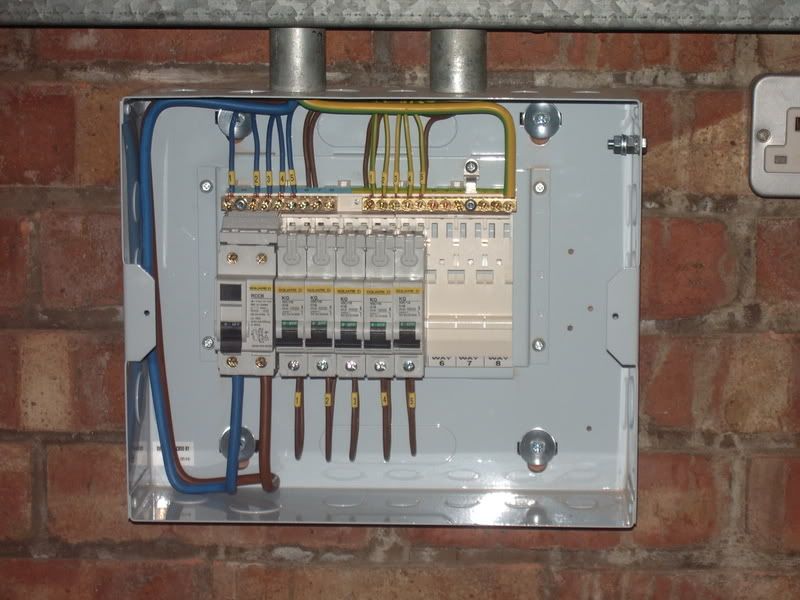
Someone recently (I think it was RF Lighting) posted a picture of a very neatly done CU where the cables clearly exited the CU at the rear, behind the breakers.

And I can see how that makes it easier to do a neat job - sheath stripped back to out of sight, phase conductors looped up and back down into the MCBs etc.

Any suggestions on how to keep things neat and tidy when the cables have to exit through the top of the enclosure? There are two rows of breakers BTW, and it's over 300mm from the top of the lower row to the top of the enclosure, and somewhere they'll have to negotiate earth and neutral bars - although I've not decided where I'm going to put those yet... :roll: :roll: . Did think of putting them at the very bottom, as then I wouldn't have to route conductors over/past them, but then I would have to deal with N & E cores 500mm long.... :?
 
Can you not mount the CU on small 'stand-off' pillars and then take them out the back?
Failing that is there room to slot them down the back of the mcb busbars?

Can you post a pick of the open CU for us?
 
When I did my CU at home to 16th I took out 50mm behind the CU from the plaster 5mm, render 10mm and brick 35mm.
Then I rendered the cavity, fitted wood 38 x 38mm to the perimeter of the boundary to allow for easy fixing of the CU.

Overall affect was to sink the CU 12mm inisde the wall and have a 38mm cavity behind the CU for cable placement and feed via the rear body of the CU.

Took about 3 hours to do neatly, but made the CU very easy to loom neatly.
 
Can you not mount the CU on small 'stand-off' pillars and then take them out the back?
The CU is made of steel - I really don't want to cut a big slot in the back.


Failing that is there room to slot them down the back of the mcb busbars?
Loads - the DIN rails stand about 40mm proud of the back of the CU.


Can you post a pick of the open CU for us?
I'll try and get that done...
 
Overall affect was to sink the CU 12mm inisde the wall and have a 38mm cavity behind the CU for cable placement and feed via the rear body of the CU.

Took about 3 hours to do neatly, but made the CU very easy to loom neatly.
It's not what to do with the cables once they exit that is the problem, it's how to avoid a rats nest inside. The circuit cables can't go through the rear - there's an aperture on top approx 33cm x 6.5cm.
 
This may not apply to what you are considering - but in general if you construct your own distribution board or modify a manufacturers design you should take account of BS EN 60439-1 & BS EN 60439-3.

If you contain cables in trunking (even slotted types) you must at least consider the effects of heat.

BTW if you intend to make use of the UK A Deviation for the short circuit performance of your unit I would be interested to know how you will meet 8.2.3.2 (short-circuit test procedure) :D
 
Well - I'm using a Siemens enclosure, Siemens switches, MCBs, RCDs & RCBOs and Siemens busbars designed for the MCBs etc.

So technically I can't take advantage of the deviation as it's not a packaged "consumer unit", but real-life safety is no different than if I'd bought an off-the-shelf Siemens CU...

And yes, I guess it'll be in breach of 530.3.4, so I'll need to note that as a deviation in the EIC...

As for the trunking - my thought when lazygit mentioned them was to fix it orthogonally to the cables, and just use it as a comb to keep the cables in order, so they won't actually be bunched or enclosed in it.
 
If you are using equipment from one manufacturer designed to be site assembled then I don't see any real problems.

As you say 530.3.4 is an issue but it is a technicality rather than a real safety problem.

The A deviation allows you to use the 16 kA conditional short circuit rating for the unit as a whole. Provided the mcbs, etc. you are selecting have fault current ratings exceeding your assumed fault current - again there is no real safety issue.

Any bunching of cables in trunking or otherwise could potentially cause a problem - many electricians bunch, and sometimes tie wrap, cables within distribution boards because they like the look of it. In industrial boards this may result in problems but in domestic units, whilst it is possible, it is unlikely to cause trouble.

When I come across tie wrapped cables in a DB I get the knipex cutters out :D :twisted:
 
How are you looking to bring all the cables into the unit? Are you looking to use individual holes or one large hole?
 
I do my top entry CU's like this:

IMGP1750.jpg
 
Can you post a pick of the open CU for us?


Yes - it does have a front panel, and a door, and a piece that goes across the top that matches the one at the bottom. And somewhere I've got the gland plates, but right now IHNFI where, nor do I understand why I didn't keep them with the unit...

Ignore the breaker etc arrangement - I just shoved a load in there to get a feel for the space.
 
If you are using equipment from one manufacturer designed to be site assembled then I don't see any real problems.
Well the earth & neutral bars might not be...

And if I can't find the b****y things neither will the top & bottom plates.


Provided the mcbs, etc. you are selecting have fault current ratings exceeding your assumed fault current - again there is no real safety issue.
They're a mix of 6 and 10kA.

Any bunching of cables in trunking or otherwise could potentially cause a problem - many electricians bunch, and sometimes tie wrap, cables within distribution boards because they like the look of it. In industrial boards this may result in problems but in domestic units, whilst it is possible, it is unlikely to cause trouble.
I'd just be running cores across lidless open trunking. Dunno if that's what lazygit had in mind, but right now it looks like a good way to avoid tangles.
 
How are you looking to bring all the cables into the unit? Are you looking to use individual holes or one large hole?
Depends if I can find the gland plates. Without them I've got one very large hole (328mm x 65mm). But that might not achieve a suitable IP rating :lol:
 

If you need to find a tradesperson to get your job done, please try our local search below, or if you are doing it yourself you can find suppliers local to you.

Select the supplier or trade you require, enter your location to begin your search.


Are you a trade or supplier? You can create your listing free at DIYnot Local

 
Back
Top