Aico alarm wiring instructions

No need to oversleeve the interconnect wire on a smoke brown though.
As I wrote in the bits of my post that Simon quoted, that is clearly the case, since the 'interconnect wire' in neither AC nor LV (and not really part of a 'power' circuit'. As such it would seem that BS7671 allows it to be 'identified' with Brown, Black, Red, Orange, Yellow, Violet, Grey, White, Pink or Turquoise - i.e. virtually all of the common colours (plus some others) with the one exception (for whatever reason!) of blue :-)
 
No need to oversleeve the interconnect wire on a smoke brown though.
No, black is a standard colour (along with brown and grey) for line conductors and therefore does not need sleeving brown.
Surely it does though under 514.3 of BS7671:2018? I can't see any other get out clause.

It's also as per the manufacturers instructions
 

Attachments

  • Screenshot_20260102-123407.png
    Screenshot_20260102-123407.png
    330.7 KB · Views: 9
Last edited:
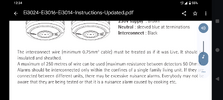
I've justmade the mistake of looking at the instructions for one of my Aico alarms, and found this ....

View attachment 401309

I have no idea what's available in Ireland (so maybe they do have brown/blue/white cables there), but where, I wonder, do they think we are likely to find this hypothesised brown/blue/black cable in the UK? :-)
RD415 cable is used in the south of Ireland for domestic smoke/CO detector installations.

It has a pink sheath.

And, contrary to your beliefs, it is absolutely used for smoke alarm installations despite not being used for other purposes.
 
Surely it does though under 514.3 of BS7671:2018? I can't see any other get out clause.
See what I recently wrote.

The 'interconnect'conductor of an alarm does not carry AC, nor mains voltage (it is 'ELV'), and is not a line conductor of either a single-phase or 30pahse 'power circuit' - so BS7671 does not require it to be identified with brown.

Rather, it presumably qualifies as "Control circuits, ELV and other applications", in which case Table 51 of BS7671 allows it to be identified with black or brown (or Red, Orange, Yellow, Violet, Grey, White, Pink or Turquoise)
It's also as per the manufacturers instructions
The manufacturers are free to say what they wish, provided it is compliant with BS7671 - which, as above, would be the case with brown identification (but also with Black, Red, Orange, Yellow, Violet, Grey, White, Pink or Turquoise).
 
You were the one who asked what was used there though. And by all means look it up.
It appears that RD415 cable has brown, blue, white and G/Y insulated conductors. Is that correct?

If so, I'm therefore a bit of a loss to understand how such a cable could be used in accordance with the manufacturer's instructions, which call for the interconnect conductor to be identified by black.
 
It appears that RD415 cable has brown, blue, white and G/Y insulated conductors. Is that correct?

If so, I'm therefore a bit of a loss to understand how such a cable could be used in accordance with the manufacturer's instructions, which call for the interconnect conductor to be identified by black.
Except if you refer back to the first post it specifies White in Ireland
 
It appears that RD415 cable has brown, blue, white and G/Y insulated conductors. Is that correct?

If so, I'm therefore a bit of a loss to understand how such a cable could be used in accordance with the manufacturer's instructions, which call for the interconnect conductor to be identified by black.
Yes it does, and as per @SimonH2's response.
 
That RD415 looks like a nice cable ...
Maybe, but one (at least, I) have to wonder 'what is the point?' (of the colours of insulation and sheath).

When alarms are installed, they will only work properly (and hence pass initial testing) if wired correctly, regardless of the insulation colours of the cables used - and, once installed, the installation colours of those cores (and distinctive colour of the outer sheath) will almost never be seen by anyone.
 
Why not have a system where N and E are fixed colours, and allow absolutely anything else for everything else?
 
Why not have a system where N and E are fixed colours, and allow absolutely anything else for everything else?
There's obviously any number of ways in which they could have designed the system, and I suppose that could have been one of the possibilities.

I imagine that some people might argue that it is desirable that there should be some consistent way of distinguishing between line phases in 3-phase circuits?
 

If you need to find a tradesperson to get your job done, please try our local search below, or if you are doing it yourself you can find suppliers local to you.

Select the supplier or trade you require, enter your location to begin your search.


Are you a trade or supplier? You can create your listing free at DIYnot Local

 
Back
Top