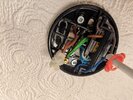
Ceiling Rose Headache

Joined
28 Jan 2026
Messages
3
Reaction score
0
Country
United Kingdom
Hi Team,

I'm really struggling with this Rose!

If I have the two lives in the connector box together, the lights downstream still work. If I disconnect them, they do not.

There appears to be three lives and two neutrals. One of the neutrals is marked ( maybe switched)?

There is actually a third neutral which comes off the live that's not in the connector box but appears to be not in use / terminated.

Any thoughts?
 

Attachments

  • IMG-20260128-WA0001.jpg
    IMG-20260128-WA0001.jpg
    286.5 KB · Views: 53
Everything looks in order there.
You could have the 2 live in the rose loop terminals to make it neater.
Disconnecting them will break the circuit and other lights won't work; that's normal.
What problem are you having?
 
Thats standard rose wiring
If I have the two lives in the connector box together, the lights downstream still work. If I disconnect them, they do not.
Of course . The two lives in the connector are live in and live out. Note that one of the browns appears to be damaged where it enters the rose. . You need to sleeve or repair that !
There appears to be three lives and two neutrals. One of the neutrals is marked ( maybe switched)?
The three browns are (as above) live in and live out to the switch and the switched live. I see no mark on any of the blue neutral wires, expect for a dob of paint.
There is actually a third neutral which comes off the live that's not in the connector box but appears to be not in use / terminated.

Any thoughts?
How do you know its a neutral. A blue wire is just a blue wire. It may not necessarily be a neutral...
Cant comment on anything that I cant see. Cannot surmise without proper testing.
 
Thanks very much chaps.

I think what is throwing me is :

1. on the adjacent rose, I had three lives and a switched live. In this case I only have two lives and a switched live?

2. Do the two neutrals not need to be connected for the downstream lights to work?
 
on the adjacent rose, I had three lives and a switched live. In this case I only have two lives and a switched live?
The one in the photo is probably the last one in the chain. Have a look at this. https://www.diynot.com/wiki/Electrics:Lighting-Circuit-layouts
. Do the two neutrals not need to be connected for the downstream lights to work?
If the neutral is "looped in" at the rose then other lights in the chain will stop working, except for the last rose in the chain. See the wiki diagram!

PS. The two live conductors in your photo should be in the "loop" terminals on the rose. The extra choc block is not needed!
 
Thanks very much! That diagram helps in terms of this being the last light, although I have two neutrals in my rose not one! But that's a huge help, cheers buddy.

These lights are a nightmare, "Double insulated" but the plastic inner box has to be removed for the connections and there's no space to squeeze a wago box into the ceiling. :(
 
These lights are a nightmare, "Double insulated" but the plastic inner box has to be removed for the connections and there's no space to squeeze a wago box into the ceiling. :(
If you remove the plastic box then you lose the double insulated protection.
Its a very common problem. Most lights are designed for international markets. Most of these markets have only a single cable coming to each light point. In the UK we do things differently (better? well differently!)
 
Is it possible that you have 2N and 2Perm L (Lin and Lout) and the Sw L from the switch did not require a L feed to it becaise it got it from another Perm L in the same switchbox? (say a 2 g or 3g switch etc).. the choc block would not be need and the two Perm L could be in the ceiling rose Loop terminations.

other explanations are possible though so it needs some testing.
 
There’s three cables. Two lives, two neutrals, switched live and an unused blue wire. Nothing particularly puzzling. I‘d put the unused blue into the connector and the lives into the loop terminal.
 
If your "Adjacent" rose operates simultaneously with this one it could be that you have one L & one N being all thats needed for it to work and the Perm L is made in the connector block rather than the Loop terminal for some reason and the other Blue is for something else (L or N) or not needed, as some of us have said it needs some testing (someone might have inadvertently used Blue and Brown the wrong way around for N & L, who knows?

We often find strange combinations, especially on lighting, and strange routes (but sometimes this might be more as a result of things being altered piecemeal rather than all at one time.
Given that there are 3 main variants of wiring lighting and different sub variants and sometimes a mixture of them at the outset or at different times it can sometimes be a headscratch to try to work out what someone has intended.
 
1769696726930.png
I have counted three browns, and two blues, so it seems a blue is missing. I would guess the missing blue would be over sleeved with brown. I have on the odd time seen singles used, but in the main we use twin and earth, so same number of browns, blues, and bare wires.
 
It looks like it's got a feed cable in with a brown and blue, then a cable going out to the switch possibly with 2 browns so the permanent live going to the choc block to connect to the feed live, then the switched live going back to the L terminal (then the lamp).
The blue feed goes to the N terminal then out to the lamp.

So what is the extra blue wire?

If the OP has wired this and needs to check it I would:

During daylight hours, turn off the breaker to the lighting circuit, check for any voltage at the lights with a suitable meter.

After checking the wires are dead/have no voltage on them.
Disconnect all wires (perhaps mark them first), using a multimeter on ohms measure across the brown one that was in the L terminal and the other browns that were in the chock block with someone else flicking the switch to see if that is the switch pair.
Once identified, tape and mark them together so you can move them out of the way.

With all wires disconnected from each other, put the wires into choc blocks/wago's and turn on the power and carefully measure (on AC voltage) between earth and the brown wires to see which one has the permanent live feed.
(this assumes the ground wire is actually connected to ground).

Then between the identified brown live feed and a blue see which one gives a +/-240v reading, hopefully they do not both do so.

That would then identify the feed.
put them in seperate wago's and tape off.

The extra wire, can more be pulled down to enable you to see which individual wires go into a t&e cable, that is likely the loop feed to the next lights. check this pair for any voltage on it too, it's likely to have none.

Here is a handy how to wire it from our very own Flameport.


I'm only the DIY'r, the sparkies (ex or not) will say if I'm advising wrong.

 
OP wrote about „a neutral that’s not in use“, I‘d read that as „a spare blue wire“. That would make three T&Es. Maybe the feed goes to the switch, one T&E with permanent live and neutral from the switch to the light and another T&E with switched live and an unused blue core from the switch to the light too. Could have been done using a single 3C+E too if that’s the case but far from impossible.

The third T&E at the light seems to be the feed out.
 

If you need to find a tradesperson to get your job done, please try our local search below, or if you are doing it yourself you can find suppliers local to you.

Select the supplier or trade you require, enter your location to begin your search.


Are you a trade or supplier? You can create your listing free at DIYnot Local

 
Back
Top