Neutral-Earth Voltage 120V

I think that I probably would not. Atually could have written that line to you .
I did suspect that you might well be one of those "a good few others". In fact, although (for obvious reasons) they are not things that we talk about very much here, I suspect that many of 'us' fall into that category ;)
 
1769693171493.png
I note the new breed, but seems it needs batteries 1769693328445.png the hole idea was a tester which could not be turned off, or fail due to depleted batteries. KISS (Keep it simple, silly) has a lot going for it. My non-contact voltage tester, Diffrence line neutral 8 Feb 24 reduced.jpg works well, with many functions in the same device, and the NCV has four levels, but with a simple choc-block connector it can not show which connector is line, the sensing area is too large, but the simple neon screwdriver can.
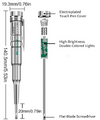
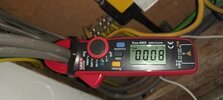
Be it an AVO Mk8 or a neon screwdriver, it is not kept in my tool box. Padded bag, top pocket, so unlikely to get wet, or damaged by other tools.

But I remember going to Island harbour house on the Falkland Islands and trying to cure an earth problem which was giving the lady of the house a shock when using the washing machine. Spend most of my one-day off a week, reconnecting earth wires, only to find there must be a junction box in the loft, which I could not access.

I had in Hong Kong two testers of this 1769694835538.pngstyle, one with a battery and buttons, and one with just LED lights, the latter I opened and filled with re-enterable compound, so no where for water to enter it, and used it below ground, the other was above ground use only. Any tester which needs batteries or has a switch, is likely to get water in, and can fail due to discharged batteries or being switched to the wrong range.
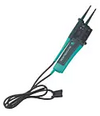
1769695517561.png
These are the curse, used for years, rely on the cable being cleated upto the box as no cable strain relief, but often those clips are missing, and also often find the earths simply not connected, and cable too short to connect it. Should have been banned years ago, we know the problems with bakalite and age. But still for sale. The other is the Wago type connector, often used without any enclosure. And little chance to test, as not access for meter probes, came across them 1980 in Algera, working for a Dutch firm. No way to remove a wire for testing back then, so each time one needed to test, the wires got shorter. Maintance free is only required where you can't access. At least the DIN rail mounted type have a test hole in the middle
1769696278595.png
why anyone thinks it is acceptable to put load of loose connectors in a box I don't know?

 
My non-contact voltage tester, works well, with many functions in the same device, and the NCV has four levels, but with a simple choc-block connector it can not show which connector is line, the sensing area is too large, but the simple neon screwdriver can.

A NCV is always my first go-to, test instrument, and has been so for many years. The sensing area, is quite easily reduced, and restricted, by putting your fingertips, around the tip of the device, maybe combined by pulling out/spacing the wires more.
 
A NCV is always my first go-to, test instrument, and has been so for many years. The sensing area, is quite easily reduced, and restricted, by putting your fingertips, around the tip of the device, maybe combined by pulling out/spacing the wires more.
I did show my NCV tester, it is part of the clamp-on meter, where the two jaws meet, so not really going to help using fingers.
 
Should have been banned years ago, we know the problems with bakalite and age. But still for sale.

Nowt much wrong with Bakelite, I have never heard of it deteriorating under normal conditions. The material can though become conductive, char and burn if over-heated/loaded. My only criticism of them, would be of the terminals/the screws. Too shallow, too easy to get the screw cross-threaded, the terminal depth too shallow.
I did show my NCV tester, it is part of the clamp-on meter, where the two jaws meet, so not really going to help using fingers.

The more compact single function stick, is much better!
 
.... At least the DIN rail mounted type have a test hole in the middle ....
Wagos also have 'test holes' ...
With the new 221 Series Splicing Connectors, you can now test the voltage from both sides – even when installed. The connectors have two test slots right where the WAGO imprint appears: one in the conductor entry direction and one on the opposite side. This accessibility provides extremely convenient testing conditions, even after installation, within a wide range of applications. Every connector variant also provides a secure contact for all standard test probes.
 
Wagos also have 'test holes' ...
With new ones yes, not back in 1980 when I first came across them.
The more compact single function stick, is much better!
I found the cheap stick type does not have a graded response. Both the buzzer rate, and number of bars shown go in four stages with the multi-meter type, well one of mine only three stages, but that is a really cheap multi-meter, it seems there are some
1769699181217.png
*Accurate Readings: The HD digital screen provides clear, precise voltage measurements with non-contact detection capabilities, enhancing safety during electrical testing.
which show a voltage, would you trust the reading? Even a built-in torch, so reading the spec, maybe they are better? Is this what you mean by single function stick? It seems to be a modern version of the neon screwdriver.
 
Why would you need one, when working on normal mains voltage? All I want to know, whilst diagnosing, is - is there volts there or not.
Indeed - and it's a little worrying to hear people talking about a 'graded response' as being a positive feature, since it implies that they are thinking of the device as a very crude 'measuring' instrument.
 
Yep, I've yet to see one which is particularly impressive, but the things on offer can commonly are meant to detect metal, wood and live cables.

I have a multi, and a metal only. The latter, has an adjustment for sensitivity, and is very sensitive - except, it used to be affected, and detect the movement of it's own PP3 case. Jammed in with a bit of card, it works much better. It finds cables, buried deep in plaster.
 

If you need to find a tradesperson to get your job done, please try our local search below, or if you are doing it yourself you can find suppliers local to you.

Select the supplier or trade you require, enter your location to begin your search.


Are you a trade or supplier? You can create your listing free at DIYnot Local

 
Back
Top