I had a new electric shower fitted today. It was a straight swap - Mira Sport 9KW for upgraded model, but basically the same shower. It was done by Mira's own engineer. He left me an advisory note saying that the installation is safe to use and that there is no immediate risk, but that the EFLI is less than 2 OHMS. He says that the cable from the 40A breaker to the shower should be checked. An RCD protects the circuit. Can someone explain this in more detail please? He grades it as a C2 on his report.

You are using an out of date browser. It may not display this or other websites correctly.
You should upgrade or use an alternative browser.
You should upgrade or use an alternative browser.
Advisory after new shower fitted
- Thread starter Vicario
- Start date
The EFLI for a circuit with a B-curve 40A breaker (MCB or RCBO) should be no greater than 1.09 Ohms, but ........ He left me an advisory note saying that the installation is safe to use and that there is no immediate risk, but that the EFLI is less than 2 OHMS. He says that the cable from the 40A breaker to the shower should be checked.
That is what is making the circuit 'safe to use' (if the EFLI is too high for the 40A breaker to make it totally 'safe').An RCD protects the circuit.
Did he say exactly what the EFLI was?
It's here..
Whilst visiting your property our service technician has identified a potential issue with the electrical installation relating to
your electrical product. A more detailed overview is given below. Our technician does not have the necessary technical
expertise to investigate this any further and will be unable to comment on any necessary remedial work. Kohler Mira
recommend consulting a competent electrical engineer who is registered as a member of an approved competent person
scheme. A list of some of these schemes is included below.
ELECTRICAL EFLI CHECK: Less than 2 OHMS
Lower down, it's given a C2 saying potential risk.
Whilst visiting your property our service technician has identified a potential issue with the electrical installation relating to
your electrical product. A more detailed overview is given below. Our technician does not have the necessary technical
expertise to investigate this any further and will be unable to comment on any necessary remedial work. Kohler Mira
recommend consulting a competent electrical engineer who is registered as a member of an approved competent person
scheme. A list of some of these schemes is included below.
ELECTRICAL EFLI CHECK: Less than 2 OHMS
Lower down, it's given a C2 saying potential risk.

This is meaningless. For most installations it would be less than 2 ohms, generally a lot less, such as 0.5ELECTRICAL EFLI CHECK: Less than 2 OHMS
However for some it can be a lot higher.
Your only option is to get someone else to determine what type of earthing is in use, and what the earth fault loop impedance value actually is, and therefore whether it is appropriate or not.
To be fair, he did an excellent job and everything works really well. Bathroom was left clean and tidy and he disposed of all the debris from the old appliance. He clearly knew what he was doing and as it was a swap and not a new installation I was glad to have his comments on the report. At the end of the day it's good to be told if they detect an issue rather than just ignoring potential problems. I'll get an electrician to come and check it over.
His “report” ?

- Joined
- 11 Jan 2004
- Messages
- 47,099
- Reaction score
- 4,093
- Country

My guess would be his tester (whatever it be) is not one that would give an exact reading, but one that has lights for <2Ω, <1Ω, >2Ω ...
But it is pointless saying "less than...", because it could be an OK reading!
Did he mean to say "more than..."?
But it is pointless saying "less than...", because it could be an OK reading!
Did he mean to say "more than..."?
We see this all too bloody often. Statements on test reports that don't make sense and look like they have been copy/pasted from somewhere, either manually or by the software that generated the report.ELECTRICAL EFLI CHECK: Less than 2 OHMS
The most obvious interpretation of that line would be that the EFLI is less than two ohms, but that makes no sense as something to report as a fault. It's normal for the EFLI to be below 2 ohms and unusual for it to be above.
So I think the more plausible interpretation is that the installer was told to ensure that the EFLI was less than two ohms, and that test failed. On a TN system with no RCD this would be something to resolve immediately. On a TN system with a RCD it's not necessarily a problem, but still suspect. On a TT system it would be absolutely normal.
Can you post pictures of your electricty supply equipment (service head, meter, CU etc) and the surrounding wiring.
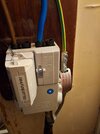
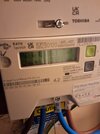
Can you explain why a reading above 2 OHMS might cause a problem please? I'm sure you're correct in that he was referring to the rule rather than the actual reading he got. Many thanks for all the help here - it's much appreciated. I had an EICR done a few years ago when my CU was replaced - would their reading be on there somewhere?

- Joined
- 27 Jan 2008
- Messages
- 29,620
- Reaction score
- 3,658
- Location
- Llanfair Caereinion, Nr Welshpool
- Country
Since clearly the guy did not know what he was doing, it is meaning less. We want an ELI of less than 200 ohms, as above that it can be unstable, with a TT supply that relies on RCD protection. With a TN it depends on fuse size, but with a 100 amp fuse less than 0.8 ohms with TN-S and 0.35 ohms with TN-C-S at the DNO head is considered the highest expected, in real terms more down to the line - neutral reading as over 0.35 ohms likely volt drop would be too high.
However, since you could have a 60 - 100 amp supply, with either TN or TT earthing system any report which does not take into account the supply type is simply useless, and may as well be put in the bin.
I remember my son telling me he was told to always find a fault, it was basic a get out of jail free card, if a fault was reported, did not matter what, then the homeowner would need to have someone else work on the system after him, so then any faults down to guy who followed him, a bit sneaky really.
However, since you could have a 60 - 100 amp supply, with either TN or TT earthing system any report which does not take into account the supply type is simply useless, and may as well be put in the bin.
I remember my son telling me he was told to always find a fault, it was basic a get out of jail free card, if a fault was reported, did not matter what, then the homeowner would need to have someone else work on the system after him, so then any faults down to guy who followed him, a bit sneaky really.
A reading over 2 Ohms on a supply like yours (called TN) would point towards an iffy connection, which could be a fire risk. If there was no RCD it could also pose a risk of electric shock in case of an earth fault.
And yes, the EICR should list EFLI readings for each circuit.
And yes, the EICR should list EFLI readings for each circuit.
Could the connection in the pull-cord isolator in the bathroom be the culprit? Otherwise it's a single 10mm cable from the CU to the shower. Is there any way I can get the reading myself? - I'm guessing that it's not a job for a novice. The reading when the EICR was done in 2021 was 0.9.
As I explained, the EFLI with a B32 brewaker should be no greater than 1.09 Ohms.Can you explain why a reading above 2 OHMS might cause a problem please?
If it is higher than that (and certainly if it is above 2 Ohms), then, in the event of some touchable metal becoming 'live' as a result of some fault (hence presenting a risk of electric shock), the breaker would not necessarily disconnect the supply (to make things safe) as rapidly as required by regulations (which is well under 1 second).

DIYnot Local
Staff member
If you need to find a tradesperson to get your job done, please try our local search below, or if you are doing it yourself you can find suppliers local to you.
Select the supplier or trade you require, enter your location to begin your search.
Please select a service and enter a location to continue...
Are you a trade or supplier? You can create your listing free at DIYnot Local


