Alternative lighting switch systems

Joined
21 Mar 2015
Messages
11
Reaction score
0
Location
London
Country
United Kingdom
Hi,
In italy, and ive seen this in other places as well, they use light switches with a single button (spring loaded) that operate a switch remotely in a wall somewhere, centralised for all wall switches.

Does anyone know what this system is called and why you see it in lots of places but never in uk domestic settings?
 
Do you mean in buildings, like apartment stairs? Press the button on any floor and all the lights come on for a while?
These are used extensively in the UK.
 
I think he's referring to a relay (or electronic equivalent) system with low-voltage wiring to the pushbuttons. It's been promoted a few times in the past in the U.K., but never seems to have taken off, other than for homes which are being wired for extensive automation in other respects.
 
France used to like using retractive switches and latching relays in houses instead of 2 or 3 way switching. I can't think of any advantage, other than saving 1 wire. I have a relay here somewhere designed for that purpose, it buzzes loudly if you keep the button pushed in. o_O
 
I think he's referring to a relay (or electronic equivalent) system with low-voltage wiring to the pushbuttons. It's been promoted a few times in the past in the U.K., but never seems to have taken off, other than for homes which are being wired for extensive automation in other respects.
I agree, but you mean extra-low voltage.
 
Hi, its definitely not a timer thing, could be low voltage and dome kind of relay. In Italy most modern houses have these switches (similar to the press button shown below on taylor's link there), I'm going to continue doing research for it. Very odd to be so common in one country and yet impossible to find in others! Mind you I have also come across it in hotels im various places.
 
The only thing is when pressing the button an MCB looking switch located in a wall cabinet nearby clicks from off to on and vv . All light switches on a floor will each have a switch in that cabinet.
 
Sounds like retractive switches being described to me.

And it's not true to say that they are never used outside the Continent - they were used extensively in a job in Jersey in the Channel Islands that I was on - two-wayed with a dimmer pack for downlighters to match the look of the other switches in an MK Logic Plus grid.
 
That's it I think you've found it.

What would the benefit be for this kind of system? I can only think something to do with phasing of works and saving on cabling? I'm coming to this because I prefer the switches themselves.
 
What would the benefit be for this kind of system? I can only think something to do with phasing of works and saving on cabling?

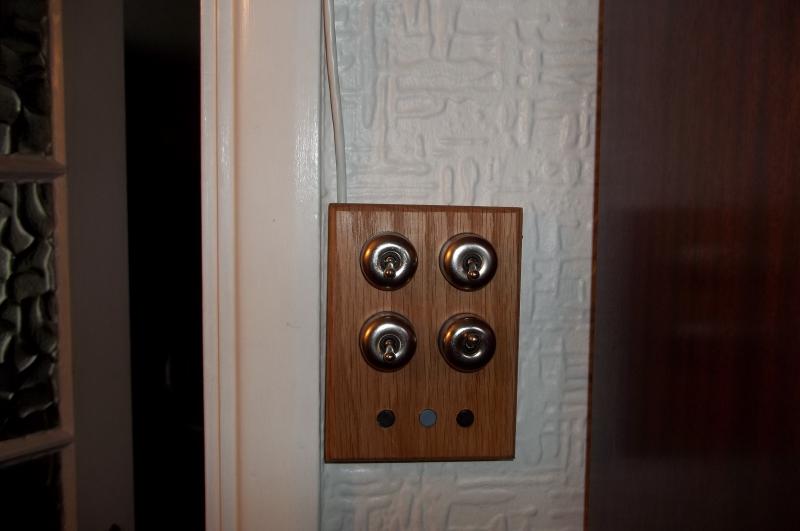
This panel controls 4 lamps and provides a dim function. Ths cable to the panel is 12 core alarm cable which also services a switch on the other side of the wall. Primary reason for this arrangment is the wall is wattle and daub and thus cannot be chased for cables. There a micro-processor based controller which controls the mains supplies to the lamps using relays.

The buttons provide the dim function

This arrangment means switchs can be located almost anywhere and complex switching arrangements can be set up not by wiring but by statements in the program in the microprocessor
 
Any system not used in an area as standard means electricians in that area are not use to it so it takes them longer to repair it or install it. Therefore before using it has to have some really good advantages.

Not only electrics of course, when the thermostatic radiator valve (TRV) came out to be used with intelligent boilers which monitored return water temperature to tell it when to turn off, plumbers were still fitting one radiator without a TRV defeating the system because they had always done it that way. OK I am sure they are doing it correctly now but it took time to adjust to new system.
 

If you need to find a tradesperson to get your job done, please try our local search below, or if you are doing it yourself you can find suppliers local to you.

Select the supplier or trade you require, enter your location to begin your search.


Are you a trade or supplier? You can create your listing free at DIYnot Local

 
Back
Top