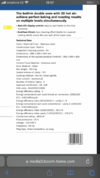
Amp rating of this oven

Joined
30 Mar 2015
Messages
4,383
Reaction score
80
Country
United Kingdom
This oven states 32amp rating but further down, states 4.8kw as total load. Doesn’t 4.8kw equate to 20amp?


Trying to determine the breaker size for this.
I’ve got a massively oversized 10mm cable!
 
The breaker is to protect the 10mm cable. The oven on the end of it is irreverent.
 
The breaker is to protect the 10mm cable. The oven on the end of it is irreverent.
But the cable is oversized in this case. Future proofing. I can understand if the breaker was higher than the rating of the breaker.
 
The breaker is to protect the 10mm cable. The oven on the end of it is irreverent.
That is true for items which are portable, and plug in, the MCB/Fuse/RCBO is to protect the cable. But for equipment which is installed, the manufacturer can, and often does stipulate the protective device to be used, I have had machines with solid state relays stipulate must be protected with a semi-conductor fuse, a MCB is no good.

And the oven is installed, not simply plugged in, so you should follow manufacturers instructions, or at least take them into consideration, however the link is an advert not manufacturers instructions.

But with a freezer for example the run load is likely around the half amp, but the start load more like 8 amp, so to have a 3 amp fuse could be too small, so very likely to have a 5 amp fuse even when the freezer uses a lot less.

Can't see there being much of an inrush with an oven, but elements can draw more when cold then when hot, so I would follow the manufacturers instructions unless you can see it is one of those times when manufacturers have issued blanket instructions for all products which clearly don't apply in this case. I have seen instructions on fitting a plug with battery powered equipment, so need to use some common sense.
 
Can I clarify this please:
- The Protective Device (MCB in my case) needs to be sized based on the design current (oven in my case)
- The cable should be at least the rating of the Protective Device. Additionally, we need the cable to carry some overcurrent.
Higher rated cables don’t present any issues.

Is that correct?
 
Can I clarify this please:
- The Protective Device (MCB in my case) needs to be sized based on the design current (oven in my case)
If you were starting from scratch for the minimum requirements, yes - load/design current, equal or next higher rating MCB then equal or next higher rating cable.
20A oven, 20A MCB, 1.5mm² T&E.

However, you already have 10mm² cable in place so (if method C) you could have a 63A MCB.

The cable should be at least the rating of the Protective Device.
Yes.

Additionally, we need the cable to carry some overcurrent.
What do you mean? You do not have to design for overcurrent.

Higher rated cables don’t present any issues.
Of course not. You could have a single lamp on your 10mm² 63A circuit.
 
However, you already have 10mm² cable in place so (if method C) you could have a 63A MCB.
If I had a 63A MCB in the current situation, won’t that be wrong for the oven I have in place? If my oven develops a fault and starts to draw more current (than the suggested 32amp), the breaker won’t trip until it reaches 63A.

What do you mean? You do not have to design for overcurrent
I thought there was something in the code book suggesting that the cable needs to be very slightly higher rated than the load as it will need to carry the overcurrent in fault condition to the breaker, before it trips.
 
If I had a 63A MCB in the current situation, won’t that be wrong for the oven I have in place? If my oven develops a fault and starts to draw more current (than the suggested 32amp), the breaker won’t trip until it reaches 63A.
It won’t trip at 63 amp either.

I have already told you that the breaker is to protect the cable not the oven on the end of it.

The oven should be internally protected if required.
 
If I had a 63A MCB in the current situation, won’t that be wrong for the oven I have in place? If my oven develops a fault and starts to draw more current (than the suggested 32amp), the breaker won’t trip until it reaches 63A.
Ovens cannot draw more than their design current.

I thought there was something in the code book suggesting that the cable needs to be very slightly higher rated than the load
No.

as it will need to carry the overcurrent in fault condition to the breaker, before it trips.
No, that is allowed for in the current tables for cables.
 
It won’t trip at 63 amp either.

I have already told you that the breaker is to protect the cable not the oven on the end of it.

The oven should be internally protected if required.
So if I had a light on a 10mm cable, I should have a 63amp MCB?
 
Sorry, think I am getting confused in the could and should of this situation.

I conclude that I could have anything higher than 32amp (minimum based on oven) and lower than 63amp (max supported by the 10mm cable).
I think @winston1 initial response left me with the impression that just because the cable is 10mm, I should have an equivalent breaker. This may not have been his intention.

Assuming the summary above is correct and I have the choice, are there any pros and cons for a 32a v 63a breaker in this situation?
 

Attachments

  • E1AF81EB-68BD-445C-84CD-593DF771E370.png
    E1AF81EB-68BD-445C-84CD-593DF771E370.png
    452.4 KB · Views: 67
I thought there was something in the code book suggesting that the cable needs to be very slightly higher rated than the load as it will need to carry the overcurrent in fault condition to the breaker, before it trips.

No, but there might be a need for a larger cable depending on installation method or if it is a particularly long cable, to allow for volts drop,
 

If you need to find a tradesperson to get your job done, please try our local search below, or if you are doing it yourself you can find suppliers local to you.

Select the supplier or trade you require, enter your location to begin your search.


Are you a trade or supplier? You can create your listing free at DIYnot Local

 
Back
Top