
You are using an out of date browser. It may not display this or other websites correctly.
You should upgrade or use an alternative browser.
You should upgrade or use an alternative browser.
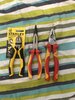
Are any of these insulated for the purposes of electrical work?
- Thread starter Jupiter01
- Start date


They would be safe if the circuit you are working on is not powered up.
If the power is ON then accidentally touching the metal part of the tools could give a fatal electric shock.
Cutting a cable that is carrying current has risks of arcing.
VDE stands for Verband der Elektrotechnik,
The VDE Testing and Certification Institute is a nationally and internationally accredited institution in the field of testing and certification of electrical engineering devices, components, and systems.
If the power is ON then accidentally touching the metal part of the tools could give a fatal electric shock.
Cutting a cable that is carrying current has risks of arcing.
VDE stands for Verband der Elektrotechnik,
The VDE Testing and Certification Institute is a nationally and internationally accredited institution in the field of testing and certification of electrical engineering devices, components, and systems.
Excuse my ignorance but wouldn’t any pliers be safe to work on a circuit that isn’t powered?They would be safe if the circuit you are working on is not powered up.
Are there cutters that are designed to work on a live circuit and if yes, which ones are they?

There are tools designed for this sort of work, and if you are authorised to be performing live line work then your employer will issue you with all the required tools and PPE.
VDE is a German approvals body who approve many different things to many different standards. They seem to have become the go-to certification body for insulated tools, perhaps because many of the quality tool brands are German. There is no reason other certification bodies could not also certify stuff to the appropriate standards though, nor any reason a trusted manufacturer cannot self-certify.
Looking at your picture, the item on the left is certainly not an approved insulated tool. The two on the right look like they probably are, but one can't be certain from a picture alone.
A good rule of thumb (not just in electrics) is to where ever possible keep yourself at least two faults or screwups away from danger. This is why most electricians use insulated tools as a matter of course, even though most of the time they are not intentionally working live. You can and should take all reasonable steps to ensure a cable is dead before cutting it, but sometimes mistakes happen.
Deliberately working on live cables is a specialist skill and absolutely not something a DIYer should be doing.
Looking at your picture, the item on the left is certainly not an approved insulated tool. The two on the right look like they probably are, but one can't be certain from a picture alone.
A good rule of thumb (not just in electrics) is to where ever possible keep yourself at least two faults or screwups away from danger. This is why most electricians use insulated tools as a matter of course, even though most of the time they are not intentionally working live. You can and should take all reasonable steps to ensure a cable is dead before cutting it, but sometimes mistakes happen.
Deliberately working on live cables is a specialist skill and absolutely not something a DIYer should be doing.
Last edited:
Excuse my ignorance but wouldn’t any pliers be safe to work on a circuit that isn’t powered?
Yes they would be electrically safe, but other accidents can happen. The "skill" is ensuring the circuit has been de-powered and remains de-powered
The purpose of my post was not to equip myself to knowingly start working on Live circuits but as you put it above, to ensure I have some added protection. I always use my Fluke two pole tester for checking that circuits are dead before making any changes but would still want the comfort of knowing I am using a tool which provides protection in the event of any unanticipated current. I think this is where I need to have a VDE pliers (I appreciate that there are other bodies too). I have discounted the Stanley cutter. The other two pliers in my picture state "VDE 1000W" I have just spotted.A good rule of thumb (not just in electrics) is to where ever possible keep yourself at least two faults or screwups away from danger. This is why most electricians use insulated tools as a matter of course, even though most of the time they are not intentionally working live. You can and should take all reasonable steps to ensure a cable is dead before cutting it, but sometimes mistakes happen.
To be pragmatic, virtually all plastics and rubbers are such good electrical insulators that (provided they are intact) even the thinnest layers of them (e.g. shrink-wrap tubing), let alone anything 'thicker', would be enough to provide protection against any voltage that would be encountered in a domestic installation, and that would remain true even if one were (extremely unwisely) 'working live'.The purpose of my post was not to equip myself to knowingly start working on Live circuits but as you put it above, to ensure I have some added protection. I always use my Fluke two pole tester for checking that circuits are dead before making any changes but would still want the comfort of knowing I am using a tool which provides protection in the event of any unanticipated current.
Hence, if you are only wanting 'belt and braces' protection, on top of taking all the necessary precautions to ensure, and confirm, that you are never working on anything live, then I think that any tools which had any sort of plastic or rubber insulation on the handles would be more than adequate.
For those who (are trained to) 'work live', the greatest hazard is probably that (perhaps because of poor 'ergonomic' design of the tool) they directly touch something live (despite the tool), rather than that the insulation 'fails' (or is in some way 'inadequate') - but they probably should be wearing appropriate gloves, anyway, so even that shouldn't happen.
I admire the degree of caution, and respect for electricity, that you want to exercise but, as above, I think you are probably worrying unnecessarily, given that you intend to always work in such a manner that even 'bare metal' tools would presumably be OK.
Kind regards, John
You could get a pair of plastic pliers if you’re really worried

I've had a few like that over the years, and maybe they've improved since then, but most of them I'm had have lasted until I've first tried to use them, at which point something has 'snapped off'You could get a pair of plastic pliers if you’re really worried

"Children's tool kits" are a good source
Kind Regards, John
Unfortunately there may come a time where there is an error of judgement on your or someone's else part where the electricity may be or become live.Excuse my ignorance but wouldn’t any pliers be safe to work on a circuit that isn’t powered?
Are there cutters that are designed to work on a live circuit and if yes, which ones are they?
Or even some strange fault or an unexpected bodge can make wires live which you really thought were dead.

DIYnot Local
Staff member
If you need to find a tradesperson to get your job done, please try our local search below, or if you are doing it yourself you can find suppliers local to you.
Select the supplier or trade you require, enter your location to begin your search.
Please select a service and enter a location to continue...
Are you a trade or supplier? You can create your listing free at DIYnot Local

