Bathroom "Vanity Unit"

Joined
29 May 2005
Messages
24
Reaction score
0
Location
Derbyshire
Country
United Kingdom
Hi,
I wonder if any of you kind people can help a lady in distress? I moved to the UK from Spain a few years ago and I’ve finally bought a house ;-) I’ve just bought a vanity unit (or that’s what the company called it) for my bathroom, it has lights in it and I’d very much like to have it working. I plan to call an electrician to do the work but I’ve had a few “cowboys” come and do jobs since I bought the home ;-( So I’d like to get some advice from people I get quotes from at least three electricians. I will then know if they are telling me the truth.

The problem of course is I don’t have any power connector in the bathroom. I thought I’d just get it connected into the ceiling, but the cable provided from the back of the unit is very short, so I don’t think this possible. How should an electrician connect this? I have no idea; I’m guessing the cable can not be extended as it connects to a sealed transformer.

Thanks for any help and advice.

Kind regards

Maria.
 
If the lights are mains operated 220/240V then they would normally be fed from the bathroom light fitting or a nearby junction box, depending exactly what is in the floor/ceiling void above.
Expect a new, longer cable to be fitted to the unit, and a short piece of mini trunking to take the cable up the wall above it and into the ceiling. However, depending on the age of the house you may find the pre-existing bathroom lighting earth bond arrangements don't meet the new-ish requirements of the current regs, and if so a good spark will want to add some green and yellow earth wire between the lighting circuit earths and your plumbing.
Of course if the lamps are low voltage than there will be a transformer somewhere too, but for a vanity unit this is unlikely.

If the unit has a schucko socket (2 pin plus side earth) built into it (Halibert Units are like this), the electrician may not wish to connect it to a UK circuit at all (though he can, there is a reluctance to do so because of the no UK sockets in bathrooms rule, and the installation then has to be done and then tested to another EU country's regs , which while allowed in principle, I can't imagine many sparks being confident or competent to do so.) A work-around is to isolate the socket, but leave the lights working.
 
mapj1 said:
If the lights are mains operated 220/240V then they would normally be fed from the bathroom light fitting or a nearby junction box, depending exactly what is in the floor/ceiling void above.
Expect a new, longer cable to be fitted to the unit, and a short piece of mini trunking to take the cable up the wall above it and into the ceiling. However, depending on the age of the house you may find the pre-existing bathroom lighting earth bond arrangements don't meet the new-ish requirements of the current regs, and if so a good spark will want to add some green and yellow earth wire between the lighting circuit earths and your plumbing.
Of course if the lamps are low voltage than there will be a transformer somewhere too, but for a vanity unit this is unlikely.

If the unit has a schucko socket (2 pin plus side earth) built into it (Halibert Units are like this), the electrician may not wish to connect it to a UK circuit at all (though he can, there is a reluctance to do so because of the no UK sockets in bathrooms rule, and the installation then has to be done and then tested to another EU country's regs , which while allowed in principle, I can't imagine many sparks being confident or competent to do so.) A work-around is to isolate the socket, but leave the lights working.

Wow, one reply, but what a reply ;-) Thank you very much. That is very much appreciated. This gives me plenty of things to go at, when I'm getting the electrician in. It's nice to know a little bit of the "spin" they will try and give me.

Thanks once again,

Regards

Maria.
 
mapj1 said:
If the unit has a schucko socket (2 pin plus side earth) built into it (Halibert Units are like this)

Err....

Maribel said:
I moved to the UK from Spain a few years ago .. I’ve just bought a vanity unit ...

Why on earth would a vanity unit bought in this country have a Schucko socket on it?

Maribel said:
I’m guessing the cable can not be extended as it connects to a sealed transformer

mapj1 said:
Of course if the lamps are low voltage than there will be a transformer somewhere too, but for a vanity unit this is unlikely.

Oh dear oh dear.... :wink:
 
ban-all-sheds said:
mapj1 said:
If the unit has a schucko socket (2 pin plus side earth) built into it (Halibert Units are like this)

Err....

Maribel said:
I moved to the UK from Spain a few years ago .. I’ve just bought a vanity unit ...

Why on earth would a vanity unit bought in this country have a Schucko socket on it?

Maribel said:
I’m guessing the cable can not be extended as it connects to a sealed transformer

mapj1 said:
If the lights are mains operated 220/240V

What else would you connect a transformer to?


Dear oh dear.... :wink:

ban-all-sheds, while your comments make sense, mpaj1 was at least kind enough to answer my question. He tried to cover all possabilites. Do you not think some more.....constructive comments from yourself would help possibly? :) You have nothing to say about the matter? How should the electrician connect this to the mains? Would you know?

Regards

Maria.
 
Oh Mike won't mind.

(At least I hope not :oops: - 'twas meant in fun... :? )

As for your unit, there's a lot of "it depends".

Does it have an integral switch, or does it need an external one to control the lights?

Does it sit flush against the wall, or would there be room behind it for a flush mount flex outlet?

Is the cable long enough to reach past the edge or top of the unit, or would a connection have to be made behind it?

You say that the transformer is "sealed", does that mean that you can't get at the terminals to replace the cable if necessary?

Are you re-decorating? Could a channel be chased into the wall to run cables?
 
Sorry, ban all sheds, I must be missing this British humour once again :oops:

1) Yes it has an integral switch. See comment 3

2) It almost sits flush against the wall, it is recessed by 18mm into the unit so you can hang it. So yes it would allow for a "flush mount flex outlet" (I'm guessing what that is, like a switch but with just a hole for flex?)

3) The cable is less than a foot, it comes from a unit that is totally sealed apart from a shaver adaptor (Not useful for me BTW) that also has the switch. I presume the transformer for the lights is also in this and it's labeled as IP65.

4) Not just re-decorating, re-plastering the whole works. I assumed a length of cable could be put in but I was told that I couldn't make the 230v connection between the vanity unit because it was in a bathroom.

I'm guessing from your answer that I can have some kind of box flush in the wall, which the electrician can connect inside?

Thanks for the answer, sorry I missed the joke :?

Regards

Maria
 
Maribel said:
It almost sits flush against the wall, it is recessed by 18mm into the unit so you can hang it. So yes it would allow for a "flush mount flex outlet" (I'm guessing what that is, like a switch but with just a hole for flex?)
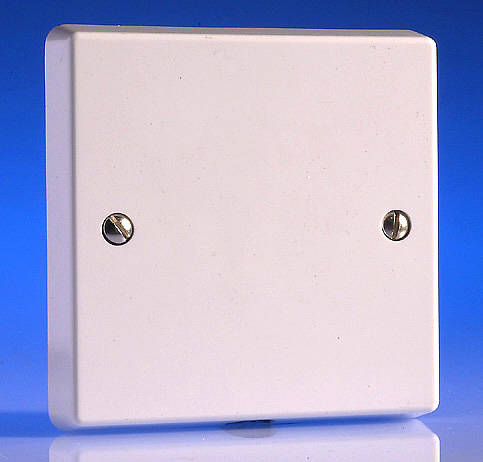
Yup. 18mm is ample. This is an example of one - if you look closely at the reflection at the bottom you'll make out the hole where a flex can go through:

CM2137.JPG


The cable is less than a foot,
Not a lot to work with - would be a 2-person job, one to support it whilst the other person made the connection, unless it could be securely propped up on something..

Not just re-decorating, re-plastering the whole works. I assumed a length of cable could be put in but I was told that I couldn't make the 230v connection between the vanity unit because it was in a bathroom.
Don't know why you were told that.

I'm guessing from your answer that I can have some kind of box flush in the wall, which the electrician can connect inside?
Yup - from the lighting circuit in the ceiling, a cable chased down the wall to a box sunk into the wall behind the unit, flex goes in there through the flex outlet plate, sealed with silicone if condensation might run down the wall.

I'm pondering whether I'd put a switched FCU above the unit for local isolation - it feels like the right thing to do, but I'm not sure why I'd ever want to isolate it.
 
ban-all-sheds said:
Maribel said:
It almost sits flush against the wall, it is recessed by 18mm into the unit so you can hang it. So yes it would allow for a "flush mount flex outlet" (I'm guessing what that is, like a switch but with just a hole for flex?)
Yup. 18mm is ample. This is an example of one - if you look closely at the reflection at the bottom you'll make out the hole where a flex can go through:

CM2137.JPG


The cable is less than a foot,
Not a lot to work with - would be a 2-person job, one to support it whilst the other person made the connection, unless it could be securely propped up on something..

Not just re-decorating, re-plastering the whole works. I assumed a length of cable could be put in but I was told that I couldn't make the 230v connection between the vanity unit because it was in a bathroom.
Don't know why you were told that.

I'm guessing from your answer that I can have some kind of box flush in the wall, which the electrician can connect inside?
Yup - from the lighting circuit in the ceiling, a cable chased down the wall to a box sunk into the wall behind the unit, flex goes in there through the flex outlet plate, sealed with silicone if condensation might run down the wall.

I'm pondering whether I'd put a switched FCU above the unit for local isolation - it feels like the right thing to do, but I'm not sure why I'd ever want to isolate it.

:D Excellent stuff, thank you very much sir. Very much appreciated. Just the information I've been looking for. Am I correct assuming a FCU means a fused connection unit? My tiler is going to love me for this one :lol:

If you would be so kind as to answer one other question, it would be much appreciated. Mapj1 mentioned something about mini trunking, I looked this up (Means nothing to this Spanish lady), is this required or can the cable just be plastered into the wall? (At the moment the wall is bare brick!)

My thanks once more, you have been more than helpful.

Regards

Maria.
 
Maribel said:
If you would be so kind as to answer one other question, it would be much appreciated. Mapj1 mentioned something about mini trunking, I looked this up (Means nothing to this Spanish lady), is this required or can the cable just be plastered into the wall? (At the moment the wall is bare brick!)
Maria,

Mini-trunking is white (usually) plastic and looks like this:
MTMIN0.JPG

It's fixed to the surface of the wall when you can't (or don't want to) run the cable below the surface. It works, but it doesn't look very good! You're lucky, in that you have the opportunity to bury the cable.
The best way to do that is to fix a piece of oval conduit:
MTOV16.JPG

to the brickwork so that the cable can be run inside it, and the plaster will cover it up. If you plaster the cable directly into the wall there's no way to replace it later without ruining the plaster - by putting oval conduit in, you can do any work on the cable without disturbing things. The same applies to mini trunking, but as I said the difference is that mini trunking runs on the surface, oval conduit is buried in the plaster (with the ends open inside the backbox and above the ceiling, obviously!).

Oh, and as for being Spanish, your command of English seems to be better than some of the english electricians on here! :lol:

Cheers,

Howard
 
HDRW,
thank you, this clears things up. You would not belive some of the advice I have had with regard to this vanity unit (mostly from people I work with) you would imagine I bought a power station not a mirror with a shelf. :lol:

As for the Spanish, thank you for the complement :lol: My work is as a software engineer. English speakers don't think about it much, but you NEED to understand English to do this job, as almost all the techincal documents are in English (American usually). To pay my way through University I also taught English to school children, so this helps. Although I will admit when I first came to the UK I was surprised at how.....differently...it is spoken here :lol: I prefer it to French though :wink:

Thank you once more.

Regards

Maria.
 
Hi gents,
I've just bought some of the oval pipe to put up the wall, can you tell me how to stick it? The local DIY shop didn't have anything with which to do this. I presume I can buy some clips or something.

Thanks once more.

Maria.
 
ban-all-sheds said:
Not just re-decorating, re-plastering the whole works. I assumed a length of cable could be put in but I was told that I couldn't make the 230v connection between the vanity unit because it was in a bathroom.
Don't know why you were told that.

Maybe someone told her that she could not do that kind of work in a bathroom because of Part P........
 
Hi,
The guy who told me I could not do it, said something about part P. But as I'm not planning to do this myself :shock: (I would toast myself several times over I'm sure) I was not too worried. I guess the electrician would say yes or no, However I DO want to know what they will do for me and plan to have all the bits I need at the price I want to pay, not the one imposed on me by the electrician. The quotes I've had for all the other jobs in the house try to charge more for the materials I need than I would pay at B&Q! So when I get my quotes for the work I'll be getting a quote just for the labour and maybe one or two random bits I might need. Not for the "lost ark" or whatever else they put in the bill :)

Regards

Maria.
 
I must wait now to jump on one of B-A-S's postings when he's next tired or in a hurry.. no I don't mind a bit.
I think most people may have noticed that in certain conditions B-A-S= Unruhestifter :lol: (I think I might have found a way how to fool the auto censor BTW)
See how the humour is different here..
(and my comments were because I know from experience, as actually we have a Halibert unit, but it came from good old DE, and is wired as per VDE100 - but I'm awaiting the acid comments if ever I need a a PIR from a UK sparks)

Agree totally with other posters - if the tiles are off, conduit is so much better. You may need to chisel a bit of a groove for it to lie in so it is below the surface properly.
There are many ways to hold it in place while the plaster sets - and before fitting it make sure it follows a line of least surprise. ("approved cable route" - see for reference) probably straight up from fitting back box up into the ceiling is best, but make sure there is a clear cable route to the light fitting that can be reached from that point onwards .
Personally I tend to use saren clips, but then I have a box of a hundred (ar rather more accurately about 80 now ! )of the little blighters -minimum order quantity and all that. I have seen screws and bag ties, masonry nails at funny angles, blobs of mastic, double sided tape and all sorts of tricks used , and even with the tacky ones, once the plaster has set, you would never know; but personally I like something that looks (over) engineered. Only one more rule, do not make any holes in the conduit - it must stay smooth bore to be threaded safely, and both ends must remain accessible !!
Organic material (wood/ string) in modern hard plasters cause cause spalling, so are really best avoided. If the plasterer is tame, chat to him as to what he likes. If you are not fitting the cable, have the decency to leave some string in the pipe for Mr Sparks to pull it through with later - it is much harder to thread in once in-situ. (and make sure it can't be blocked with snots of plaster or tile cement , or even vermiculite loft insulation going astray- bits of tissue to pull out later might be good if there is any risk of this.)
Good luck
 

If you need to find a tradesperson to get your job done, please try our local search below, or if you are doing it yourself you can find suppliers local to you.

Select the supplier or trade you require, enter your location to begin your search.


Are you a trade or supplier? You can create your listing free at DIYnot Local

 
Back
Top