• Looking for a smarter way to manage your heating this winter? We’ve been testing the new Aqara Radiator Thermostat W600 to see how quiet, accurate and easy it is to use around the home. Click here read our review.

Bay window damp/condensation

Would that be a PIV?
I'm not a fan of PIV, as a concept; "let's encourage people to install a fan that brings air in, slightly pressurising the house so that moist stale air is pushed into the gaps/cracks in the building fabric"

I'm referring to MVHR; two fans in a box, cleverly arranged so they push air through a heat exchanger; the warm stale air from the house is used to heat up the cool fresh air from outside, resulting in a supply of warm fresh air to the house and cool stale air expelled. The air flows never mix, but they pass by each other, separated by a very thin wall so the heat passes across.

If it manages to recover 90% of the heat in the stale air, then you only need to run your heating at a low level to replenish the 10% of heat lost to outside.
PIV on the other hand, as well as pushing moisture into the building fabric doesn't naturally recover any of the heat so all of the heat energy you paid for, in the air that escapes the envelope of the house, must be paid for again

MVHR are amazing, and I will never again live in a house without one, but they are a bit trickier to fit as a retro compared to doing it when a house is being constructed. They're also relatively expensive, but it is hands down one of the best things I fitted to my house and so to me they represent great value for money. The house is seldom stuffy or smelly; "no more farty bedrooms" is usually an easy way to win over the lady decision maker
 
Last edited:
Having zoomed in on my laptop... it looks like the silicone may have failed on the underside of the uPVC. Try to see if you can push in a thin filling knife at any point.

That said, I don't know if that is the root cause.
Thanks. Will take look. Appreciate your advice.
 
I'm not a fan of PIV, as a concept; "let's encourage people to install a fan that brings air in, slightly pressurising the house so that moist stale air is pushed into the gaps/cracks in the building fabric"

I'm referring to MVHR; two fans in a box, cleverly arranged so they push air through a heat exchanger; the warm stale air from the house is used to heat up the cool fresh air from outside, resulting in a supply of warm fresh air to the house and cool stale air expelled. The air flows never mix, but they pass by each other, separated by a very thin wall so the heat passes across.

If it manages to recover 90% of the heat in the stale air, then you only need to run your heating at a low level to replenish the 10% of heat lost to outside. PIV on the other hand, as well as pushing moisture into the building fabric doesn't naturally recover any of the heat so all of the heat energy you paid for, in the air that escapes the envelope of the house, must be paid for again
Thanks for the comprehensive reply. Will take a look at this
 
The condensation tends to appear in the winter months during the evening. Especially when we have a busy house - for example Christmas Day. I originally thought it was the rain but tbh, I’ve noticed it when it hasn’t rained. I’ll keep a diary this winter to be sure.

You probably have rising damp in the bay window wall, and this makes the inside surface of the wall cold. Then you also are likely to have inadequate ventilation in your front room. So, moisture laden air is condensing against the cold surface.

Your damp proof course in the bay window is probably inadequate.
 
Thanks. Will take look. Appreciate your advice.

Also open the windows and make sure that the weep holes in the bottom channels are not blocked.

I have personal experience of blocked drainage vents leading to hefty stains on ceilings.
 
Also open the windows and make sure that the weep holes in the bottom channels are not blocked.

I have personal experience of blocked drainage vents leading to hefty stains on ceilings.
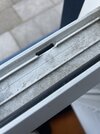
Are these the weep holes? Should they also be on the outside? There doesn’t appear to be anything on the outside of the window
 

Attachments

  • image.jpg
    image.jpg
    270.9 KB · Views: 25
You probably have rising damp in the bay window wall, and this makes the inside surface of the wall cold. Then you also are likely to have inadequate ventilation in your front room. So, moisture laden air is condensing against the cold surface.

Your damp proof course in the bay window is probably inadequate.

You may be correct, but I don't see how you can conclude that the DPM is inadequate based on those two photos.

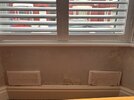
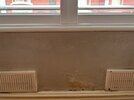
It might be helpful if the OP could take a wider angle of the whole bay from the inside.
 
You may be correct, but I don't see how you can conclude that the DPM is inadequate based on those two photos.

It might be helpful if the OP could take a wider angle of the whole bay from the inside.
Will do this later. Currently have a toddler and the whole Thomas the Tank Island of Sodor set up in the way.
 
OP,
1. The drilled & plugged DPC line seems to be working - however, headers only have been drilled, suggesting that the wall might be solid? Is it a solid wall? Why not measure the wall?
2. No airbricks can be seen - why not stand back & photo the whole of the bay and the walls on either side of the bay. ie the front elevation at low level.
3. Lower the pebbles below any air bricks.
4. Do you have a suspended floor? Ventilation from front to rear of the house is necessary under suspended floors.

5. The interior pics of damp defects show what appears to be mostly penetrating damp.
6. However, there are indications that previous work was done at low level which could imply rising damp?
7. A metal corner bead is rusting, & there could be rot under the window board. The skirting is a badly done re-fix - what condition is the floor in?
8. Why not pic the interior of the bay, and the rest of the wall?

9. The pics in post #9 show very poor attempts at using silicone. All the silicone needs re-doing, maybe the stuck-on trim also needs re-doing or replacing?
10. Opening & locking testing the frame - & cleaning out the tracks & weep holes is needed.
11. Close up inspection by a window guy, and sprinkled water testing would help.
 
Last edited:
Poster #25,
Why do you think the DPC line was installed in the first place?
 
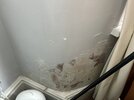
Those images are indicative of penetrating damp, not condensation damp (although that might be resultant) and it's concentration is too high for rising damp.

The stone cills would imply that the cause is penetration from around the frame, not the wall itself.

Check the frame perimeter and sealant - even at the top and the wall above, and drainage holes at the bottom.
Lack of a cill makes the bottom seal or detail suspect too.
 
Good grief! Whoever gunned that sealant in must have suffered with the shakes. Most of that needs removing, thoroughly cleaning up, and then re-gunning with a decent sealant. I don't like the way they have finished the outside off without a sill fitted. I'd like to know what was behind that piece of trim that has been used instead of a sill.
 
Those images are indicative of penetrating damp, not condensation damp (although that might be resultant) and it's concentration is too high for rising damp.

The stone cills would imply that the cause is penetration from around the frame, not the wall itself.

Check the frame perimeter and sealant - even at the top and the wall above, and drainage holes at the bottom.
Lack of a cill makes the bottom seal or detail suspect too.

Good grief! Whoever gunned that sealant in must have suffered with the shakes. Most of that needs removing, thoroughly cleaning up, and then re-gunning with a decent sealant. I don't like the way they have finished the outside off without a sill fitted. I'd like to know what was behind that piece of trim that has been used instead of a sill.
Thanks for this. I’m going to try and get some pics during the week when I’ve got an empty house.

You’re taking to a complete novice here. So when you talk about checking the frame and also the trim being used instead of a sill is that exterior?

Is resealing the windows a job I could practically take on myself? I’ve used sealant before internally.

Thanks
 
Managed to quickly a grab a few more
 

Attachments

  • IMG_3964.jpeg
    IMG_3964.jpeg
    213.3 KB · Views: 31
  • IMG_3963.jpeg
    IMG_3963.jpeg
    244.3 KB · Views: 31
  • IMG_3962.jpeg
    IMG_3962.jpeg
    220.7 KB · Views: 32
  • IMG_3961.jpeg
    IMG_3961.jpeg
    217.9 KB · Views: 28

If you need to find a tradesperson to get your job done, please try our local search below, or if you are doing it yourself you can find suppliers local to you.

Select the supplier or trade you require, enter your location to begin your search.


Are you a trade or supplier? You can create your listing free at DIYnot Local

 
Back
Top