• Looking for a smarter way to manage your heating this winter? We’ve been testing the new Aqara Radiator Thermostat W600 to see how quiet, accurate and easy it is to use around the home. Click here read our review.

Bay window damp/condensation

Are these the weep holes? Should they also be on the outside? There doesn’t appear to be anything on the outside of the window

Yes, they are the weep holes. Water in the frame should run into the gap under the frame and then out. They do get blocked from time to time. Swipe a thin bit of cardboard in the gap between the lower part of the frame and the uPVC sill. The opening sash often has weep holes as well. The water that gets past the seals on the glass is supposed to run in to the channel and through the lower weep holes.

You can test the channel by pouring a little bit of water in to the frame channel and watching it run out.

I still think that the silicone work at the bottom of the sill, and possibly higher up is possibly the root cause, but I am only going by previous experience.
 
OP,
Your latest pics show that you have rising damp & penetrating damp - in terms of the interior remedial work that will be needed it makes no difference.
I can take you through what needs to be done but first:
There are a number of unanswered questions from my post #24 - perhaps you would like to answer my questions and suggestions?
 
Having looked again, I have only just noticed that some of the uPVC sills have had extra trims added.

I wonder if they might have been added because the uPVC still didn't extend far enough and/or was too high up.

Ideally, in my lay opinion, the underside of the lowest uPVC sill should have been set with expanding foam to make it watertight. But... I am only guessing.

I think someone like @crank39 will be able to give you better advice than me. He seems to hang out (exclusively?) in the Windows and Doors sub forum. Hopefully he will notice that his name has been dropped and will help you further.

A wider angle photo of the whole bay might help... assuming that Thomas runs out of coal.

Best of luck.

Opps
 
was done at low level which could imply rising damp?
7. A metal corner bead is rusting, & there could be rot under the window board. The skirting is a badly done re-fix - what condition is the floor in?
8. Why not pic the interior of the bay, and the rest of the
11. Close up inspection by a window guy, and sprinkled water testing would help.

OP,
Your latest pics show that you have rising damp & penetrating damp - in terms of the interior remedial work that will be needed it makes no difference.
I can take you through what needs to be done but first:
There are a number of unanswered questions from my post #24 - perhaps you would like to answer my questions and suggestions?
Tried to answer these as best as I can:

1. The drilled & plugged DPC line seems to be working - however, headers only have been drilled, suggesting that the wall might be solid? Is it a solid wall? Why not measure the wall? - it’s a sold brick wall right through to the inside where it’s then plastered? Is that what you mean? Think it’s single brick.

2. No airbricks can be seen - why not stand back & photo the whole of the bay and the walls on either side of the bay. ie the front elevation at low level. - will get another pic but there is a single air brick under the bay window below floor level. There are also two air bricks that have been installed above the floor level - although not sure they’re any good as I can’t feel any draft from them internally.


3. Lower the pebbles below any air bricks. - will do

4. Do you have a suspended floor? Ventilation from front to rear of the house is necessary under suspended floors - it’s suspended floor I think with LVT flooring over it.

5. The interior pics of damp defects show what appears to be mostly penetrating damp.
6. However, there are indications that previous work was done at low level which could imply rising damp?
7. A metal corner bead is rusting, & there could be rot under the window board. The skirting is a badly done re-fix - what condition is the floor in? - rechecked this and can’t see a metal corner bead? Not sure if it’s just the photo giving off that impression?

8. Why not pic the interior of the bay, and the rest of the wall? - will get one

9. The pics in post #9 show very poor attempts at using silicone. All the silicone needs re-doing, maybe the stuck-on trim also needs re-doing or replacing? - will do

10. Opening & locking testing the frame - & cleaning out the tracks & weep holes is needed. - have done and everything seems fine

11. Close up inspection by a window guy, and sprinkled water testing would help.

 
OP,
Thanks for the above. I look forward to seeing the GF exterior & interior elevations full width etc.

1. You have a 9" wall - easier for damp to penetrate & show on the interior decoration.
2. Pics will hopefully show the various air bricks.
4. Have you crawled under the floor yet? Are there DPC level air bricks in the rear elevation?
7. Post #4 pic 2 upper left shows a rusting corner bead. Closely examine all your angle beads, they will all be metal & will all need replacing with plastic a/beads.
Probe the skirting & the floor boards for softness or rot.
10. The w/frame itself is an odd selection & a poor installation - note the window board(s) will have to be removed for rot examination.
 
OP,
Thanks for the above. I look forward to seeing the GF exterior & interior elevations full width etc.

1. You have a 9" wall - easier for damp to penetrate & show on the interior decoration.
2. Pics will hopefully show the various air bricks.
4. Have you crawled under the floor yet? Are there DPC level air bricks in the rear elevation?
7. Post #4 pic 2 upper left shows a rusting corner bead. Closely examine all your angle beads, they will all be metal & will all need replacing with plastic a/beads.
Probe the skirting & the floor boards for softness or rot.
10. The w/frame itself is an odd selection & a poor installation - note the window board(s) will have to be removed for rot examination.
Hi.

I can’t get under the floor and no air bricks on rear elevation.

Floor under the LVT feels fine (as far as I can tell via foot) as do the skirting boards.

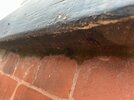
I’ve just had another look at the widows while taking these additional pics. Under the concrete bay, it is really damp and it rained this morning.

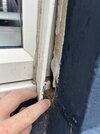
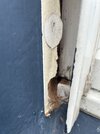
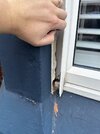
I also noticed these window trims where loose and when move it was just like sand coming out.
 

Attachments

  • IMG_3994.jpeg
    IMG_3994.jpeg
    249.5 KB · Views: 26
  • IMG_3993.jpeg
    IMG_3993.jpeg
    222 KB · Views: 28
  • IMG_3992.jpeg
    IMG_3992.jpeg
    210.8 KB · Views: 27
  • IMG_3991.jpeg
    IMG_3991.jpeg
    232 KB · Views: 25
  • IMG_3990.jpeg
    IMG_3990.jpeg
    617 KB · Views: 31
  • IMG_3989.jpeg
    IMG_3989.jpeg
    558.1 KB · Views: 30
Well done. I think you may have found the source of the water ingress.

It looks like the water may be running off the lowest uPVC sill and into the brickwork at the edges.

Personally, I would remove all of the siliconed on trims, vacuum/brush out the cavities and then seal with expanding foam. Then, if possible, run a bead of silicone where the sill meets the wall. The refit the trims.
 
Well done. I think you may have found the source of the water ingress.

It looks like the water may be running off the lowest uPVC sill and into the brickwork at the edges.

Personally, I would remove all of the siliconed on trims, vacuum/brush out the cavities and then seal with expanding foam. Then, if possible, run a bead of silicone where the sill meets the wall. The refit the trims.
Thanks! I’ve got some days off work coming up so will try and tackle it then.

Really appreciate all the advice.
 
It looks like the water may be running off the lowest uPVC sill and into the brickwork at the edges.
Just a note, that sandy material that came out didn’t feel damp. Could that indicate it’s not not the source?
 
Thanks! I’ve got some days off work coming up so will try and tackle it then.

Really appreciate all the advice.

When working with expanding foam, mist the area first. It helps aid adhesion and curing.

A proper foam gun will give you far more control, but you have the additional cost of the gun.

Spend a fiver(ish) on foam gun cleaner incase you make an error- it is acetone based and will help remove any "errors".

If you are going to use a can with a "straw", look for minimal expanding foam. All foam will potentially expand more than one might expect.

Foam is, by and large, waterproof/resistant because of the closed cell structure. It does become brittle when exposed to sunlight though.

Best of luck
 
Just a note, that sandy material that came out didn’t feel damp. Could that indicate it’s not not the source?

Possibly, but I don't see anything wrong with treating it as a potential source. From the images, you only seem to have removed the trims from one side of the window. It may, or not be the case that water is running in via the opposite edge and then under the sill.

Oh and rather than silicone, if you use a MS polymer such as CT1, it will enable you to paint the blue parts again in the future. Silicone repels waterbased paints.
 
OP,
I've yet to see the full width's pics of the inside & outside of the bay elevation at low level?
I've yet to see an air brick below FFL?
The two air bricks at the front of the bay are useless & need removing.
Lacking through ventilation from front elevation to rear elevation then dry rot will eventually take hold.
The previous repair attempts in the bay floor area, the ongoing damp, & the lack of ventilation would suggest that the joist tails in the bay are at risk of rot.
The concrete window sill lacks a drip channel - its necessary to grind one in.
The mortar bed below the sill needs hacking out as deep as possible & then renewing.
 

If you need to find a tradesperson to get your job done, please try our local search below, or if you are doing it yourself you can find suppliers local to you.

Select the supplier or trade you require, enter your location to begin your search.


Are you a trade or supplier? You can create your listing free at DIYnot Local

 
Back
Top