Blimey, wasn't this a diy job?

Ericmark,

"Of course we have not been given the exact dates and it was just as the new rules BS7671:2008 came into being and because of the changes in 2008 the same situation could not be repeated."

Could you explain this a bit further please?

An interesting (but sad) thread with some very interesting views.

Perhaps if we all used a simpler tester and a pulg in RCD adaptor before using a socket it might reduce risk a bit
If today we got line and earth swapped then touching the live part and true earth would open the RCD so although the person would get a shock it would auto disconnect within 40ms so unlikely to cause death. Today all sockets under 20A must have RCD protection (with some special exceptions) and also buried cables have to in the main be RCD protected. Hence why I say today this could not happen.

Reading the reports it would seem it was the lack of an asbuilt plan which resulted in a human error being missed jurying the inspection and testing procedure.

Although some one clearly connected up a socket incorrectly we have to except that from time to time there will be human error but in this case there were two failures.
1) The mistake
2) Lack of asbuilt plans so tester missed the socket.

In the main accidents are caused by multi actions which means the courts often have to divide the blame between more than one individual. In this case clearly the guy who made the mistake in the wiring must take the majority of the blame but also who ever was responsible for ensuring the asbuilt plans were submitted and passed to the guy doing the inspection and testing must also take some on the blame.

As to the guy doing inspection and testing much would depend on the position of the socket. If it was an extra provided because the house was being used as a show house then one can't really blame him for missing it when hidden behind a filling cabinet. However if it was in a position where one would expect to find a socket i.e. the same location as sockets were found in other houses in the estate then clearly he must also take some of the blame.

Coming from a commercial back ground I was always surprised at the lack of as-built plans for domestic premises. And even where plans were drawn up it seems common for these to be included in the buyer pack but not issued to guys doing inspection and testing.
 
As an aside, GET changed their sockets a couple years ago and this caused problems across the board, although picked up by most during testing (I hope!). They moved the positions of the terminals on the back, and made the usually 'open and exposed' earth terminal on the earth bar part of the moulding on the back of the socket, making it look just like the live and neutral. The earth terminal was also placed close to where the live used to be! .

Exactly the reason why I found out the N/E reverse on a brand new installation the other day. As plug-in checkers don't detect this, it was only because of the RCD operating when something was plugged in that it came to light.
 
So none of the dead tests detect N/E reversal?
Although a dead test will find the fault the point is first one needs to find the socket. And here clearly the tester did not even know the socket existed.

I think the whole idea of having semi-skilled guys doing the wiring then sending a highly skilled guy to test without a very detailed plan is flawed. Yet it is often the case where an inspector and tester visits the houses during and after a re-wire and the guys doing the work are not issued with any test equipment.

To my mind this is wrong. To send a highly skilled guy to test a proportion of the installation to highlight any errors in both the electricians doing the work workmanship and any instrument faults is a good safe guard but to expect a tester to find all faults without a detailed plan to my mind is flawed but is still often done.
 
Although a dead test will find the fault the point is first one needs to find the socket. And here clearly the tester did not even know the socket existed.
My Q was to ricicle about his specific situation, which seemed to be a reversal at a known socket which hadn't shown up because plug-in socket testers don't detect it.
 
IF the job has been notified, the QS is the person responsible for signing the job off.
Indeed, but if it was notified (and the fact that four electricians were involved suggests that it probably was notifiable work), that notification may have facilitated punishing the right person, but it clearly didn't prevent the incident/tragedy occurring, and obviously won't bring the lad back.

Maybe if it had been notified DIY work, inspected by a third party, rather than (one guesses) self-certified by an electrician, the victim would still be alive?

Kind Regards, John

We don't know what happened in this case, just that it was tragic. As this appears to been so unpredictable, I don't see how any assessment regime would necessarily had any impact here.

I'm not surprised to see the only 'IF' that comes to your mind is if it was a diyer and tested by a third pary it may have been okay.
It is your mantra.

We don't know if it was a simple faceplate chnage, or if cabling was run.
The socket may have been fitted by one of the 4 electricians. It could just as easily have been the houseowner. In either case, if nobody mentioned it to the tester, it could easily have been missed.

I have absolutely no objection to being assessed and would happily have a randomising element included. How do you see your random inspections work and who will pay for it? You are talking about people's homes here. Does the inspector turn up at tea-time demanding access to check the installation?

I do wnder how much of your concern stems from the fact that, regardless of the fact you don't have relevant qualifications (but as you said, given time you could probably easily gain these) or professional experience (not quite so easy to get IMO), you have to have your work checked.
 
So none of the dead tests detect N/E reversal?

I'll just make it clear - it wasn't my installation, it was done by contractors on our site. The only dead test that will detect N/E reversal is the polarity confirmation by inspection. This evidently wasn't done.
 
IF the job has been notified, the QS is the person responsible for signing the job off.
Maybe if it had been notified DIY work, inspected by a third party, rather than (one guesses) self-certified by an electrician, the victim would still be alive?
I'm not surprised to see the only 'IF' that comes to your mind is if it was a diyer and tested by a third pary it may have been okay.
It is your mantra.
It was you who introduced the 'IF it had been notified'. I merely pointed out that 'if it had been notified' by a DIYer, then inspection would necessarily have been by a third party (rather than self-certification by the person who did the work, which may have been what happened in this case) - and, as a general principle, inspection by a third party is usually 'better and safer' than self-inspection of one's own work. I accept that self-certification is always going to happen but was really highlighting the irony that (expensive) third-party inspection of DIY work is probably more likely to prevent (incredibly rare) tragedies like this than is self-inspection of work undertaken by the person who undertook the work.

I have absolutely no objection to being assessed and would happily have a randomising element included. How do you see your random inspections work and who will pay for it? You are talking about people's homes here. Does the inspector turn up at tea-time demanding access to check the installation?
The details and practicalities would obviously have to be worked out. However, it's far from a unique situation and has been made to work in many fields. As for cost, that would presumably become part of the payments for scheme registration and thus would presumably ultimately be passed on to customers.

I do wnder how much of your concern stems from the fact that, regardless of the fact you don't have relevant qualifications (but as you said, given time you could probably easily gain these) or professional experience (not quite so easy to get IMO), you have to have your work checked.
Depends what you mean. I have no problem at all with requirements for me to have my work checked (even though some of the 'checking' I've experienced has been a complete joke!) - but I can see an argument that some 'checking' of all work (no matter who undertakes it) would be an 'expected' audit process.

Kind Regards, John
 
The only dead test that will detect N/E reversal is the polarity confirmation by inspection. This evidently wasn't done.
So was it a hidden, unknown socket?

If not, WTF was the circuit energised?


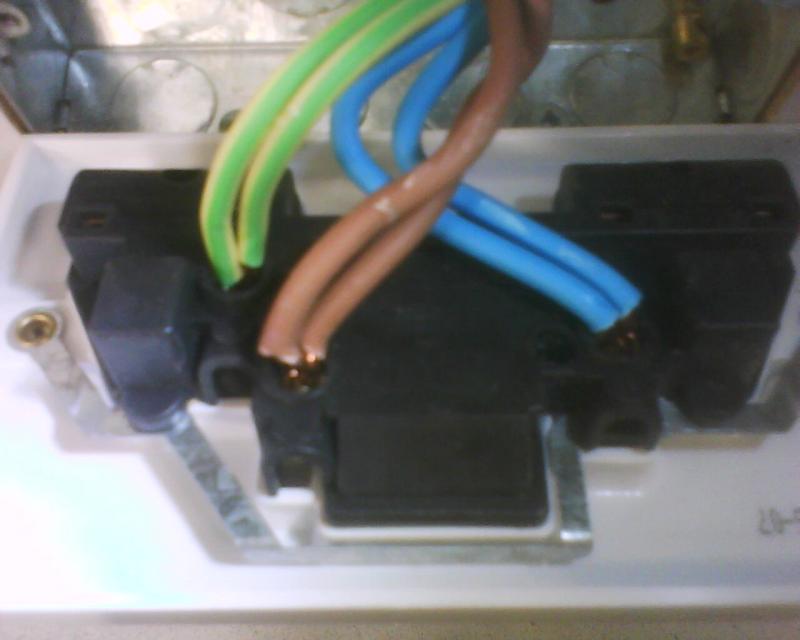
The offending socket:-

<Photo of a socket where even if the installer couldn't read the legends he could clearly see the metal strap connecting the two fixing screw holes running to the terminal into which he put the N conductors.>
 
IF the job has been notified, the QS is the person responsible for signing the job off.
Maybe if it had been notified DIY work, inspected by a third party, rather than (one guesses) self-certified by an electrician, the victim would still be alive?
I'm not surprised to see the only 'IF' that comes to your mind is if it was a diyer and tested by a third pary it may have been okay.
It is your mantra.
It was you who introduced the 'IF it had been notified'. I merely pointed out that 'if it had been notified' by a DIYer, then inspection would necessarily have been by a third party (rather than self-certification by the person who did the work, which may have been what happened in this case) - and, as a general principle, inspection by a third party is usually 'better and safer' than self-inspection of one's own work. I accept that self-certification is always going to happen but was really highlighting the irony that (expensive) third-party inspection of DIY work is probably more likely to prevent (incredibly rare) tragedies like this than is self-inspection of work undertaken by the person who undertook the work.


Kind Regards, John
In this case I must disagree. It was more likely because testing was done by a different person to the one who installed everything that the socket was missed.

To have random parts of ones work re-tested must be good. However I firmly believe everyone should be able to inspect and test their own work. Had this been the case the socket in question would not have been missed.

I believe the idea of saving a few pounds on test equipment by employing one guy to inspect and test many electricians work is flawed as for it to work very detailed plans need to be passed on to the inspector.

My method was always to take photos of an installation as stages so I could refer back to remind myself of what had been done.

Even in my own house where I have lived since it was built I have found wires which I can't remember fitting and have not a clue why they were installed and what they do. The same applies to my dad's house which he designed and has lived there for last 55 years. So if I can't remember what has gone into those houses what chance is there to remember what I installed in a house 6 months ago?

In the main one only remembers items which are not the norm. And a socket for a washing machine is not what one would consider as unusual.
 
So was it a hidden, unknown socket?

If not, WTF was the circuit energised?

The socket was quite clearly on show. In fact the whole situation came about because these sockets were part of a servery counter circuit which has a SFCU on the wall to isolate. The staff want to isolate the hot cupboard at the end of a shift but was plugged into a socket at the back of the counter. They could isolate at the wall SFCU but this turned off all sockets which included a fridge. I suggested plugging the hot cupboard into one of the accessible sockets, but the Chef thought that the load was too great because the "circuit kept blowing".
My initial thought was that the hot cupboard had a fault on it until I realised that it had been working perfectly ok on the other hidden socket. As to why it was energised it was possibly subject to 'wire and fire' or omitted from testing. (There are a full compliment of certs. for the installation and I did witness some testing although it wasn't my job to)
I am not sure whether this counter wiring was carried out by the main electrical contractor or the servery fitting company. Either way an investigation is under way through the snagging process with the main contractor. (this was part of a £10M project)
I have also found emergency lighting wired incorrectly (L and SL reversed), heating control wiring crossed over, lights missing from the specification. It does make you wonder sometimes !!
 
Just my 2d worth ...

It sounds like this could have been part of a larger development. So 4 guys doing electrical installation, in multiple properties - all of which will look the same after a while. So 4 of you have been fitting sockets, in numerous properties - and 6 months later someone asks you who fitted a specific socket in a specific property.
Put me in that situation and I'd not know.

As ot socket markings - not only are the locations non-standard, but some times I wonder if they tried to save 0.001p/unit in plastic by not making the letters very prominent. Some units have virtually illegible markings - especially if you're working in a dark corner somewhere.
 
The only dead test that will detect N/E reversal is the polarity confirmation by inspection.

You may want to re-think this statement - 'Continuity of Ring Final Circuit conductors', (Figure of 8 ). if done correctly, confirms polarity of all conductors.

If you had N/E reversal at a socket outlet, you wouldn't get a reading at that 'outlet' during either of the cross-tests...........telling you that N and E are reversed. :)
 

If you need to find a tradesperson to get your job done, please try our local search below, or if you are doing it yourself you can find suppliers local to you.

Select the supplier or trade you require, enter your location to begin your search.


Are you a trade or supplier? You can create your listing free at DIYnot Local

 
Back
Top