
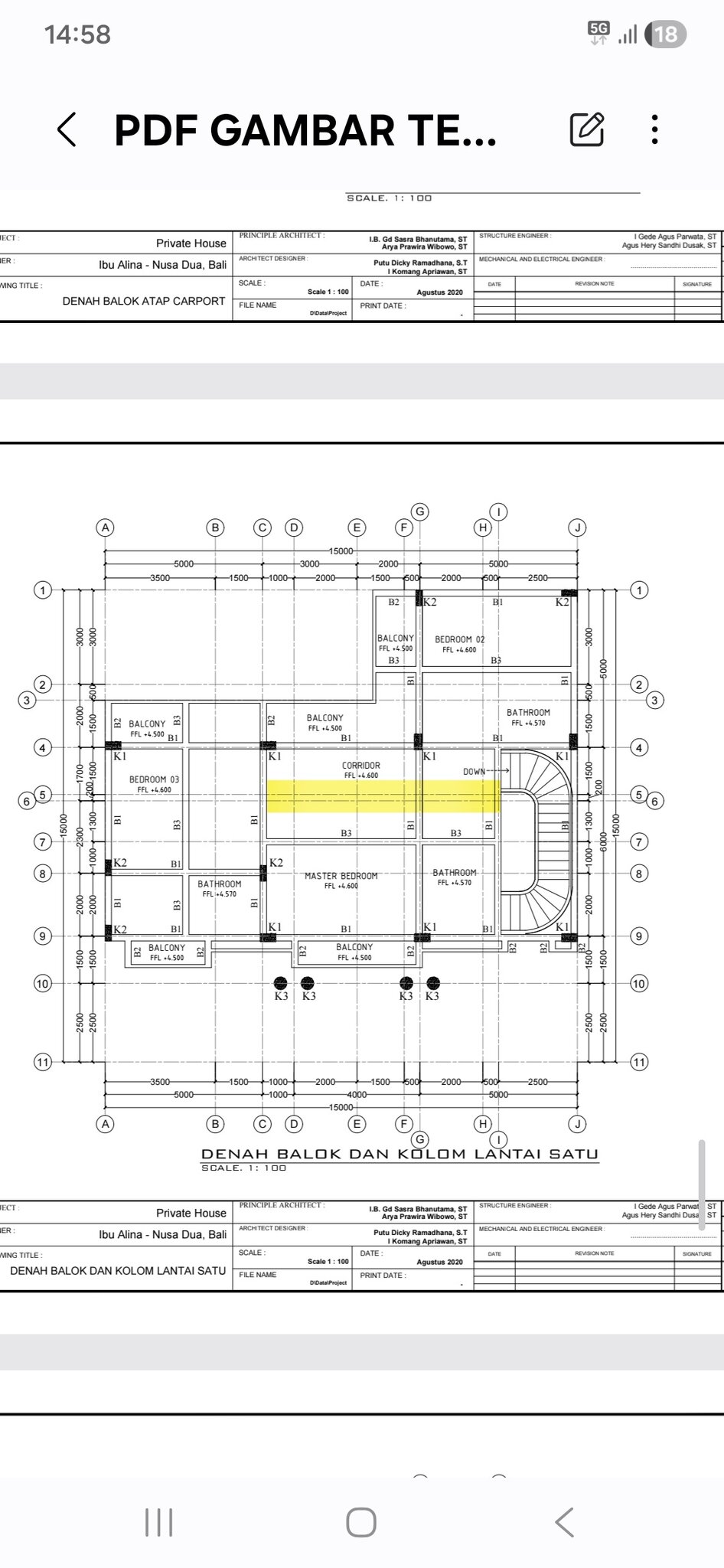
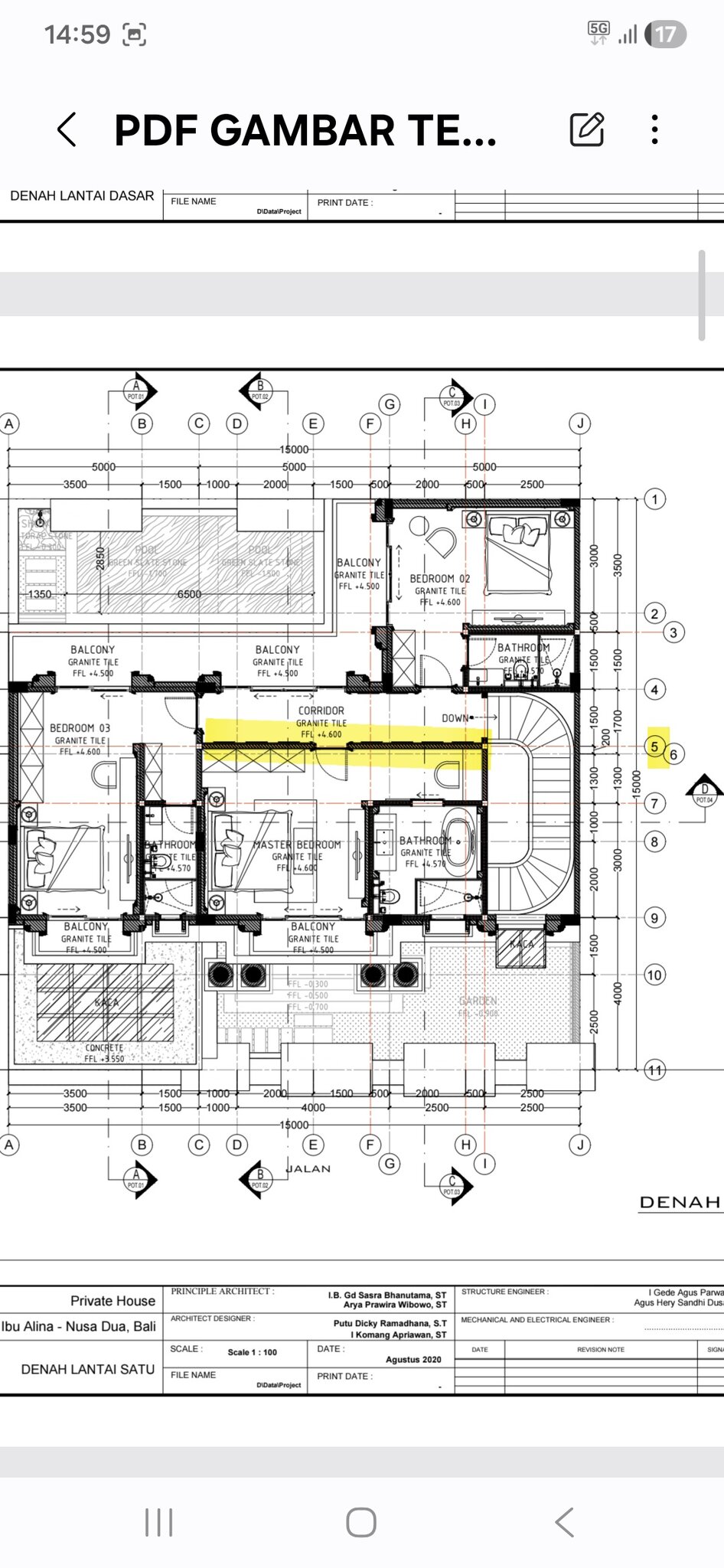
Hi guys. Just questioning a couple of things on our house designs. We have a brick wall on the upstairs floor that forms a corridor to the bedrooms. It's 4.5m high so quite substantial weight and is largely just being supported by the floor slab which is 12cm thick 2 layer x 10mm wire reinforcement at 15cm spacings. The wall starts and ends on perpendicular beams and there is 1 other perpendicular beam that passes under it 2.5m in on one end. Is this OK? Designs are attached so you can see the corridor highlighted and the beams. Thanks

You are using an out of date browser. It may not display this or other websites correctly.
You should upgrade or use an alternative browser.
You should upgrade or use an alternative browser.
Building a brick wall on suspended slab
- Thread starter mattrams
- Start date
I have asked already but they're all on religious holiday in Bali right now so waiting for reply. Also im pretty sure they'll say its fine as they designed it but I'd like a second opinion from a developed country. The way it is here is there is little responsibility or recourse. If something fails its just us on the hook for it. Dont get my wrong, they are a respected architectural firm and answer our questions and that, no issue with them, just a couple of things seem to be pushing engineering limits imo. For example 6m 20cm x 40cm beams. Our builder even commented 5m span would be the max normally. They have qualified structural engineers in the firm, nether the less on a quick Google/ Ai search all sources seem to agree with the builder that we are a bit underspeced.
Not everyone on the Internet is a self proclaimed expert. There is some valuable advice around too. You just have to sort the wheat from the chaff. You helped us out last time with your welding advice thanks. We ran with what you said. We heated the rebar up first. Unfortunately we couldn't use the low hydrogen rods as none of the welders round here had decent enough welding machines. They thought the low hydrogen sticks were just for boats lol. We did try but the sticks weren't having it so just had to run with 6013. At least he could get a decent weld on it. Our rebar is higher grade 420 so hopefully wont get brittle.
Not everyone on the Internet is a self proclaimed expert. There is some valuable advice around too. You just have to sort the wheat from the chaff. You helped us out last time with your welding advice thanks. We ran with what you said. We heated the rebar up first. Unfortunately we couldn't use the low hydrogen rods as none of the welders round here had decent enough welding machines. They thought the low hydrogen sticks were just for boats lol. We did try but the sticks weren't having it so just had to run with 6013. At least he could get a decent weld on it. Our rebar is higher grade 420 so hopefully wont get brittle.
Fair point, but sometimes the wheat and chaff look an awful lot alike!
I'm glad the welding advice worked, but surprised they couldn't make lowH rods work: maybe something as simple as too big a rod for the machine they had. I don't recall us having any issues with the rods.
I can maybe set your mind a bit at rest re the concrete beams. It all depends on what they're doing. If they're free spanning with no lateral support then slenderness becomes a factor just as it does for timber or structural steel. If however they are supporting an integral slab or linked with cross beams then I wouldn't worry because lateral torsional buckling will be prevented.
So far as your current question it's a bit of a dice toss. 2 layers of 10mm bars at 150 crs is a reasonable amount of steel but at ony 150 thick the cover used will have a big effect on the overall strength. I'm seeing a span <3m with the wall at midspan? then the slab is supported on the other 2 sides? that will give you some membrane effect, especially if the slab is structurally continuous over adjoing spans.
What if anything you can do depends on where you're at in the build and how helpful your builder is. You could drop the soffit locally to give you 200 thickness with an extra layer of steel in the bottom or you could simply add some extra steel to what you have. Less disruptive but less effective.
You could put Bricktor into the wall to stiffen it. Not suppoed to be ujsed structurally but it adds a lot of stiffness which would tend to take laod away from the middle portion of the wall as the slab deflects and back to ends where you have support. Should have some small but hopefully positive effect.
Do let us know what your SE has to say, though I suspect your prediction is on the money!
I'm glad the welding advice worked, but surprised they couldn't make lowH rods work: maybe something as simple as too big a rod for the machine they had. I don't recall us having any issues with the rods.
I can maybe set your mind a bit at rest re the concrete beams. It all depends on what they're doing. If they're free spanning with no lateral support then slenderness becomes a factor just as it does for timber or structural steel. If however they are supporting an integral slab or linked with cross beams then I wouldn't worry because lateral torsional buckling will be prevented.
So far as your current question it's a bit of a dice toss. 2 layers of 10mm bars at 150 crs is a reasonable amount of steel but at ony 150 thick the cover used will have a big effect on the overall strength. I'm seeing a span <3m with the wall at midspan? then the slab is supported on the other 2 sides? that will give you some membrane effect, especially if the slab is structurally continuous over adjoing spans.
What if anything you can do depends on where you're at in the build and how helpful your builder is. You could drop the soffit locally to give you 200 thickness with an extra layer of steel in the bottom or you could simply add some extra steel to what you have. Less disruptive but less effective.
You could put Bricktor into the wall to stiffen it. Not suppoed to be ujsed structurally but it adds a lot of stiffness which would tend to take laod away from the middle portion of the wall as the slab deflects and back to ends where you have support. Should have some small but hopefully positive effect.
Do let us know what your SE has to say, though I suspect your prediction is on the money!
Yes the hydrogen rod was indeed too big for the welder. Couldn't get them in the smaller size, no demand for them I guess. Maybe they are only used on big structures like ships over here. Literally nobody around here had a decent wattage welder, tried all the welding shops and self hire. Didn't fancy buying an expensive welder for a one off 20 minute job.
Current problem...the slab is already poured. Yes the span there is 3m and the wall sits bang in the middle of that. It is well supported by beams on the other sides (5m span) where the wall starts and finishes plus one more running under it. I think that helps the membrane effect as you say. The steel is all continuous across beams. Also the slab is 12cm not 15cm. That's another thing the builder pointed out was that residential slabs here are normally 15cm. Not sure why our architect skimpt on that when this is a luxury house. Would've helped if the builder said that before not after because not difficult to have just done 15cm!
The 6m 40cm beams are for the roof. Roofs here are like flat concrete roofs for about 1m around the house perimeter and then there's a small ring wall about 1m high (that has beams under it) that the pitched roof sits on. These beams all cross link with each other and the main ring beams that link the columns if that makes sense. So in this case each 6m beam has 2 other beams linking either through or into them. Agreed that helps with torsional forces but also adds 2 heavy point loads which surely would add to deflectional forces? My understanding is 6m beams of only 40cm are at risk of deflection so having to carry the load of 2 more beams only adds to this. The 6m beams are the main load bearing ones too as they sit on the columns.
Current problem...the slab is already poured. Yes the span there is 3m and the wall sits bang in the middle of that. It is well supported by beams on the other sides (5m span) where the wall starts and finishes plus one more running under it. I think that helps the membrane effect as you say. The steel is all continuous across beams. Also the slab is 12cm not 15cm. That's another thing the builder pointed out was that residential slabs here are normally 15cm. Not sure why our architect skimpt on that when this is a luxury house. Would've helped if the builder said that before not after because not difficult to have just done 15cm!
The 6m 40cm beams are for the roof. Roofs here are like flat concrete roofs for about 1m around the house perimeter and then there's a small ring wall about 1m high (that has beams under it) that the pitched roof sits on. These beams all cross link with each other and the main ring beams that link the columns if that makes sense. So in this case each 6m beam has 2 other beams linking either through or into them. Agreed that helps with torsional forces but also adds 2 heavy point loads which surely would add to deflectional forces? My understanding is 6m beams of only 40cm are at risk of deflection so having to carry the load of 2 more beams only adds to this. The 6m beams are the main load bearing ones too as they sit on the columns.
Yikes a thin slab got 30mm thinner.
I think I'd be starting to get a bit concerned if t'was mine now. Does anything bear on the wall? How about building it from timber to reduce the load? Difficult to see what else might help at this point in the build.
The beams I'm still not fussed about (always assuming they're designes right). LTB is when the top of a beam kicks sideways due to the compressive forces building up (easiest to picture in a steel UB). The taller and/or narrower the beam is the more likely this is to happen before the compressive and tensile stresses from the bending reach their limits so you don't get the full capacity of the beam. Stop the sideways movement and the beams can catrry their load quite happily. Think blocking in timber floor costruction
I think I'd be starting to get a bit concerned if t'was mine now. Does anything bear on the wall? How about building it from timber to reduce the load? Difficult to see what else might help at this point in the build.
The beams I'm still not fussed about (always assuming they're designes right). LTB is when the top of a beam kicks sideways due to the compressive forces building up (easiest to picture in a steel UB). The taller and/or narrower the beam is the more likely this is to happen before the compressive and tensile stresses from the bending reach their limits so you don't get the full capacity of the beam. Stop the sideways movement and the beams can catrry their load quite happily. Think blocking in timber floor costruction
The upstairs corridor wall wasn't something I really thought about until it's nearly time to do it. Then I thought thats a lot of wall for a slab to hold. I know weight transfers down at 45 degrees, so I suppose a lot will get transfered to beams but still. There's a baby beam only 1.5 m away that breaks up the 6m span to 2 x 3m and supports the slab. Could've done with another baby beam under this wall really. I guess we could use aac blocks to save weight. I'll try to get a comprehensive answer from our architect as to why they think this is acceptable.
I'm not that worried about the beams. I think the design might be better but I've seen some questionable builds here in Indonesia and they haven't fallen down
I'm not that worried about the beams. I think the design might be better but I've seen some questionable builds here in Indonesia and they haven't fallen down

DIYnot Local
Staff member
If you need to find a tradesperson to get your job done, please try our local search below, or if you are doing it yourself you can find suppliers local to you.
Select the supplier or trade you require, enter your location to begin your search.
Please select a service and enter a location to continue...
Are you a trade or supplier? You can create your listing free at DIYnot Local
Similar threads
- Replies
- 8
- Views
- 19K
- Replies
- 0
- Views
- 3K
- Replies
- 0
- Views
- 531