• Looking for a smarter way to manage your heating this winter? We’ve been testing the new Aqara Radiator Thermostat W600 to see how quiet, accurate and easy it is to use around the home. Click here read our review.

Changing light fitting - no colour cables.

Joined
12 Jan 2024
Messages
35
Reaction score
1
Country
United Kingdom
Hi guys.
I have looked on the forum but couldn't see anybody saying about this.
I'm trying to change a light fitting (which I've done twice before over the years) but sadly this one's throwing up a new problem.

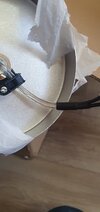
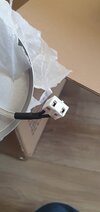
The wires from the light fitting are not colour coded (see photo) and don't show any difference between the two.
I was just wondering will I need a multimeter to find which is live and neutral? Some ppl on this forum have said if they are both completely blank then it doesnt matter as it'll work both ways.

Also it says on the instructions that IF there is an earth wire to add it to a separate terminal block. As there is so I just buy another terminal block and put it in that?
Any one knows? Thanks :)

Additional. The light fitting is a screw in and plastic
 

Attachments
  • 20240529_154620.jpg
    20240529_154620.jpg
    89.5 KB · Views: 151
  • 20240529_154618.jpg
    20240529_154618.jpg
    180.8 KB · Views: 152
  • 20240529_155301.jpg
    20240529_155301.jpg
    94.7 KB · Views: 160
  • 20240529_161210.jpg
    20240529_161210.jpg
    102.6 KB · Views: 169
Last edited:
Some ppl on this forum have said if they are both completely blank then it doesnt matter as it'll work both ways. Any one knows? Thanks :)

Screw in lamps, have to be connected so the live/brown/red, goes to the centre terminal, neutral/blue/black, to the threaded part of the base.

An additional point is - is the unit marked as 'double insulated', a square box, inside a square box symbol? Lacking that, any conductive parts, need to be earthed.
 
Screw in lamps, have to be connected so the live/brown/red, goes to the centre terminal, neutral/blue/black, to the threaded part of the base.

An additional point is - is the unit marked as 'double insulated', a square box, inside a square box symbol? Lacking that, any conductive parts, need to be earthed.
Hi thanks for your reply.
The fitting IS double insulated yes.

Ah so it's a case of picking up a multimeter then? I do have one but it's sadly 90 miles away (I'm staying at a friend's doing some odd jobs for them).
 
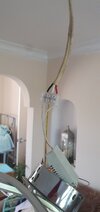
What is the last picture showing? the luminaire in that pic obviously has an earth connection, but youve said the fitting in question is double insulated???.
 
Those wires are transparent so can likely trace which is most probably connected to the centre (ideally Live, by convention) and which the outer screw thread contact (ideally neutral, by convention).

But it really matters not which is which: both are potentially 'live' conductors.

Being SES its also difficult to get (adult) fingers in when no lamp is fitted, cf a ES. Also the modern style has most insulating material so it matters far less than with older style lampholders...

https://engx.theiet.org/f/wiring-and-regulations/20952/reg-559-5-1-206-e-s-lampholders is probably relevant.
 
What is the last picture showing? the luminaire in that pic obviously has an earth connection, but youve said the fitting in question is double insulated???.
That last photo is of the wire coming out of the ceiling with the old fitting attachedm tbh I attached the pic by mistake
 
Modern European Edison sockets no longer have a permanently connected screw shell, the thread part that holds the lamp in place is insulated, either plastic or ceramic. That means as soon as you unscrew the lamp a little, the thread no longer touches the spring connecting it to the supply. However, in many countries the regs still require the centre to be connected to the live.

I wonder if your light actually has the required approvals for sale and use in the UK, having an ES lamp holder supplied by a flex with no discernible core colours seems fishy.
 
However, in many countries the regs still require the centre to be connected to the live.
As discussed in the IET thread BS7671 requires the centre to be connected to the live *unless* the lampholder complies with BS EN 60238. I suspect said standard describes the "modern" lampholders you reffer to

The thing is in practice what is an installer supposed to do?

Look at the documentation? given the abysmal quality of the documentation that most light fitting manufactuers supply I doubt this will be fruitful.
Read the standard and carefully apply it to judge whether the lampholder complies? fat chance, would take too long and most electricans don't have a subscription to a standards library.
Look for markings on the lampholder? might work but likely difficult to read.
Take a guess? risks guessing wrong
Just assume it might not be and make sure the live is connected to the centre contact? safest option fo the installer, though it may require use of a test meter.
 
Modern European Edison sockets no longer have a permanently connected screw shell, the thread part that holds the lamp in place is insulated, either plastic or ceramic. That means as soon as you unscrew the lamp a little, the thread no longer touches the spring connecting it to the supply. However, in many countries the regs still require the centre to be connected to the live.
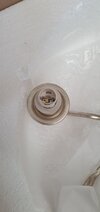
Photo #3 in Post #1 clearly shows this.
Both the "Centre" and "Outer Shell" contacts are equally "touchable" - as in a "Bayonet" socket.
 
Photo #3 in Post #1 clearly shows this.
Both the "Centre" and "Outer Shell" contacts are equally "touchable" - as in a "Bayonet" socket.

Which makes this a modern socket as I described above. Properly old (and US ones) had the entire screw thread connected to one of the terminals.

That means even if the lamp is just touching the socket, the whole exposed screw thread is live in case of reverse polarity.
 

If you need to find a tradesperson to get your job done, please try our local search below, or if you are doing it yourself you can find suppliers local to you.

Select the supplier or trade you require, enter your location to begin your search.


Are you a trade or supplier? You can create your listing free at DIYnot Local

 
Back
Top