Is there a tool that can easily detect overloaded or overheating cables? I want to add 2 or 3 extra sockets in a property, but the existing installation is a nightmare. I just want something I can plug into each socket to give me a reading for peace of mind (or not). Is there, for example, a tool that draws the rated current and checks for an acceptable voltage drop over time? For example by drawing the maximum rated current and checking for an acceptable voltage drop over a certain time?

You are using an out of date browser. It may not display this or other websites correctly.
You should upgrade or use an alternative browser.
You should upgrade or use an alternative browser.
Check for overloaded cables?
- Thread starter tgd241
- Start date
Your property or for a customer?
Its almost impossible to do without taking a long time and having kit as above and the competence to use it.
Do you know which sockets are on which circuits ? and on each circuit do you know what is plugged in / attached?
Do you know what the average usage per day is?
Its almost impossible to do without taking a long time and having kit as above and the competence to use it.
Do you know which sockets are on which circuits ? and on each circuit do you know what is plugged in / attached?
Do you know what the average usage per day is?
Property owned by me.
What do you mean by 'a long time'? Do you mean physically tracing and inspecting each cable? Because the entire point of the question is not to do that.
I've figured out which circuit each socket is on, unless ive inadvertently missed a socket somewhere. Most of them are on a single circuit. I can guess what will be attached where, although the property isnt yet inhabited. Not clue what the average usage will be.
What do you mean by 'a long time'? Do you mean physically tracing and inspecting each cable? Because the entire point of the question is not to do that.
I've figured out which circuit each socket is on, unless ive inadvertently missed a socket somewhere. Most of them are on a single circuit. I can guess what will be attached where, although the property isnt yet inhabited. Not clue what the average usage will be.
The voltage at the CU should be known, let's say 230V. A diagnostic tool plugged into a socket should be capable of drawing a known, fixed current and measuring the voltage at the socket, giving a voltage drop and resistance of the cables. If you also give it an estimate of the cable length, this should tell you whether the resistance is within acceptable limits, no? Furthermore, the tool should be able to detect if the resistance is constant over time , or increases in a manner consistent with and overheating cable somewhere.
So let's say you plug this tool in an every socket, and have it draw as close as possible to the rated current of the circuit at every socket. If you're not getting a rising resistance or as long as the resistance plateaus at some acceptable value, all is well in theory?
So let's say you plug this tool in an every socket, and have it draw as close as possible to the rated current of the circuit at every socket. If you're not getting a rising resistance or as long as the resistance plateaus at some acceptable value, all is well in theory?

- Joined
- 27 Jan 2008
- Messages
- 29,588
- Reaction score
- 3,646
- Location
- Llanfair Caereinion, Nr Welshpool
- Country

I can monitor what a socket uses
 and I can also see what I am using for the whole house,
 with my solar software, one could use as said a clamp meter
 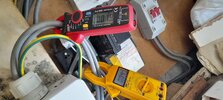 here shows looking at earth leakage, and the old yellow one was giving a poor reading and the jaws were not seating well, but it is rather old, bought it in Hong Kong when it was still British.
A radial can't be overloaded, the MCB/Fuse/RCBO is smaller that the cable capacity, only the ring final can be overloaded if the load is near the origin. If near the origin the load on the two cables will not be even, So we have a 32 amp overload and 20 amp cables, so the instructions
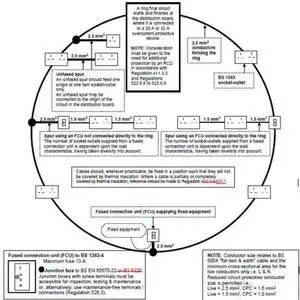 advise on their use, and how they should be arranged, with
However, it is tradition, from the days of the twin tub washer, we have used the kitchen for one day of the week as a laundry room, and since no cooking done on that day, it was not a problem, could not really cook with a twin tub in middle of the floor, but as we moved to front loading machines, and then added a drier, this is now the biggest single load on a ring final.
It was the electric fire, but as we have improved the insulation in the home, we have moved away from 3 kW electric fires, now 2 kW seems to be the limit, with oil filled radiators down to around 850 watts, and most are thermostatically controlled, I remember my parents with a 4 bar fire, but these have long gone.
Only time I have seen a ring final at its limit, is a new build where the builder was trying to dry out the house, for me the smart meter does not help, due to having solar and battery, but normally they do show how little electric we use, my highest draw is likely mid-summer with the AC running.
Why are you worried?
and I can also see what I am using for the whole house, here shows looking at earth leakage, and the old yellow one was giving a poor reading and the jaws were not seating well, but it is rather old, bought it in Hong Kong when it was still British.A radial can't be overloaded, the MCB/Fuse/RCBO is smaller that the cable capacity, only the ring final can be overloaded if the load is near the origin. If near the origin the load on the two cables will not be even, So we have a 32 amp overload and 20 amp cables, so the instructions
The "rated power exceeding 2 kW on their own dedicated radial circuit" for equipment likely to use high current for an extended time, has been done for years with the immersion heater, but next down the list must be a resistive clothes drier, these can run for an hour at 2.5 kW so we really should put them on a dedicated circuit.The load current in any part of the circuit should be unlikely to exceed for long periods the current-carrying capacity of the cable (Regulation 433.1.5 refers). This can generally be achieved by:
(i) locating socket-outlets to provide reasonable sharing of the load around the ring
(ii) not supplying immersion heaters, comprehensive electric space heating or loads of a similar profile from the ring circuit
(iii) connecting cookers, ovens and hobs with a rated power exceeding 2 kW on their own dedicated radial circuit
(iv) taking account of the total floor area being served. (Historically, limit of 100 m² has been adopted.)
However, it is tradition, from the days of the twin tub washer, we have used the kitchen for one day of the week as a laundry room, and since no cooking done on that day, it was not a problem, could not really cook with a twin tub in middle of the floor, but as we moved to front loading machines, and then added a drier, this is now the biggest single load on a ring final.
It was the electric fire, but as we have improved the insulation in the home, we have moved away from 3 kW electric fires, now 2 kW seems to be the limit, with oil filled radiators down to around 850 watts, and most are thermostatically controlled, I remember my parents with a 4 bar fire, but these have long gone.
Only time I have seen a ring final at its limit, is a new build where the builder was trying to dry out the house, for me the smart meter does not help, due to having solar and battery, but normally they do show how little electric we use, my highest draw is likely mid-summer with the AC running.
Why are you worried?
Property owned by me.
OK
What do you mean by 'a long time'? Do you mean physically tracing and inspecting each cable? Because the entire point of the question is not to do that.
Ideally you need to determine which circuit breaker serves which sockets - the cables are irrelevant
I've figured out which circuit each socket is on, unless ive inadvertently missed a socket somewhere. Most of them are on a single circuit. I can guess what will be attached where, although the property isnt yet inhabited. Not clue what the average usage will be.
How many sockets / circuits do you have? How big is the property?
Could you post a photo of the fuseboard / consumer unit?
Do you understand the basics of circuit design?
It's really just the circuit with all the sockets on that I'm worried about. This will not include an oven, induction hob, immersion or space heaters, or power shower. It will include (off the top of my head) TVs, PCs, other electronics, washing machine, dishwasher, fridge/freezer, vacuum cleaner, handheld power tools, lawnmower, toaster, coffee machine, boiling water tap or kettle, kitchen extractor fan, anything else that can be plugged in. Dryer? Unlikely but possible.
- This circuit has a 32A MCB and is run in 2.5T&E, but I havnt confirmed its a ring. There are junction boxes everywhere going to different places that are almost impossible to trace. At least, parts of it are radial branches with at least 5 sockets connected in a line but not a double ended ring. Maybe all of this circuit is radial which would make either the cables too small or the MCB overrated. I dont want to downgrade it from 32A, would rather test to see if it can safely handle 32A.
- This property is a bungalow and cables forming this circuit are run underneath and through the middle of thick loft insulation, potentially compounding the above issue.
- There's rat **** everywhere, although it doesnt look fresh and I guess the RCDs would pick up the fault if a cable was damaged.
The existing sockets are mainly single gang and I want to upgrade some of them to double gang. Along with adding a few new sockets, this increases thr opportunities to inadvertently overload the circuit one day.
Things I'm worried about are:Why are you worried?
- This circuit has a 32A MCB and is run in 2.5T&E, but I havnt confirmed its a ring. There are junction boxes everywhere going to different places that are almost impossible to trace. At least, parts of it are radial branches with at least 5 sockets connected in a line but not a double ended ring. Maybe all of this circuit is radial which would make either the cables too small or the MCB overrated. I dont want to downgrade it from 32A, would rather test to see if it can safely handle 32A.
- This property is a bungalow and cables forming this circuit are run underneath and through the middle of thick loft insulation, potentially compounding the above issue.
- There's rat **** everywhere, although it doesnt look fresh and I guess the RCDs would pick up the fault if a cable was damaged.
The existing sockets are mainly single gang and I want to upgrade some of them to double gang. Along with adding a few new sockets, this increases thr opportunities to inadvertently overload the circuit one day.
Ideally you need to determine which circuit breaker serves which sockets - the cables are irrelevant
How many sockets / circuits do you have? How big is the property?
Its a single 32A MCB serving most of them, which should correspond to a single circuit (?) This is the circuit I'm most concerned about for the reasons given in the post above, since it could conceivably need to handle all the plugged in loads in the house (also listed above). It has about 10 single gang and 10 double gang sockets now, I want to add 3 more DG and upgrade 3 of the SG. Property is around 100m2 bungalow.
I'll postba photo when I get there later, but its a 32A MCB in question.Could you post a photo of the fuseboard / consumer unit?
Do you understand the basics of circuit design?
If you mean the difference between ring and radial and the other stuff ericmark posted above then yeah. But ive tried to trace some of this circuit through the loft and its extremely difficult. As well as a mishmash of cables (in old and new colours , snaking in and out of thick insulation there's several junction boxes, most of them lying around loose not fixed to anything solid. One of these feeds a burglar alarm, others go to different extensions that I can't trace because the ceiling voids aren't accessible. One of the extensions has 3 cables (attached to this circuit) going to it instead of the 2 you'd expect if it was a ring. Ive physically traced sections of this circuit with 5 sockets wired radially. No fused connection anywhere that I can see (not in any of the JBs).

Is there a tool that can easily detect overloaded or overheating cables?
There is no such obvious tool for that. An electrical installation relies heavily, on who ever does the installation, to understand the regulations, and to apply them using common sense. You can only check the loading on a circuit, when the loads are applied to it. Joint boxes, on socket ring circuits, are rare, and not usually necessary anyway. Joint boxes were more common on lighting circuits - the cable sizes entering the JB, should help identify which it is.
A good starting point, is to turn all the circuits off, except one - then go around testing, to see exactly what stays on, and what goes off. You can buy a cheap socket tester, which plugs in to easily check for live or not.
Is it your intention to rent out this property? If so, then it will need an EICR to be done on it anyway.
Surprising, is the only alternative a physical tracing and inspection of cables? Surely that's impossible in a lot of cases and leaves hail mary as the only option.There is no such obvious tool for that.
In this case I can see a lot of JBs with cables going to/from sockets (see previous posts)Joint boxes, on socket ring circuits, are rare, and not usually necessary anyway. Joint boxes were more common on lighting circuits - the cable sizes entering the JB, should help identify which it is.
Already did that part at least.A good starting point, is to turn all the circuits off, except one - then go around testing, to see exactly what stays on, and what goes off. You can buy a cheap socket tester, which plugs in to easily check for live or not.
It was rented out by the previous owner and I have a somewhat recent EICR which predictably has a disclaimer about not checking the loft space etc. However your reply prompted me to have another look at it, and I now not that a ring impedance test was completed on the circuit with the sockets so this presumably means some of it at least is a ring?Is it your intention to rent out this property? If so, then it will need an EICR to be done on it anyway.
The biggest issue with 50 ish year old homes (2.5 / 1.0) dates to 1976 to 1980 ish) is DIY improvements with no testing
If this is going to be a long term home with lots of decorating / improving then full rewire is something I think you should seriously consider
If this is going to be a long term home with lots of decorating / improving then full rewire is something I think you should seriously consider
In this case I can see a lot of JBs with cables going to/from sockets (see previous posts)
That sets alarm bells ringing!
However your reply prompted me to have another look at it, and I now not that a ring impedance test was completed on the circuit with the sockets so this presumably means some of it at least is a ring?
Yes, but you need to investigate what has been added to that ring, how, and why all the JB's....
There was a method, more common in bungalows, where a ring would be installed in the loft, then a JB added where a socket was required, with a single 2.5mm dropped to each socket. Is this a bungalow?
A full rewire isnt gonna happen . I will be getting someone to put a new circuit for the cooker and hob, and I will do some lighting improvements myself. The loft space is hellish but its only really this sprawling sockets network which is keeping me awake at night. I believe most of the previous 'improvements' have been done by various tradies although not necessarily electricians.The biggest issue with 50 ish year old homes (2.5 / 1.0) dates to 1976 to 1980 ish) is DIY improvements with no testing
If this is going to be a long term home with lots of decorating / improving then full rewire is something I think you should seriously consider

DIYnot Local
Staff member
If you need to find a tradesperson to get your job done, please try our local search below, or if you are doing it yourself you can find suppliers local to you.
Select the supplier or trade you require, enter your location to begin your search.
Please select a service and enter a location to continue...
Are you a trade or supplier? You can create your listing free at DIYnot Local
Similar threads
- Replies
- 190
- Views
- 29K


