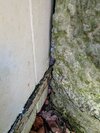
Crack diagnosis - subsidence?

It's an obvious weak point, it's obviously a very old building.

It's possible that the hinges have contributed, squirty grease may help. But it's much more likely that the section of wall beyond the door has moved away from the rest of the building.
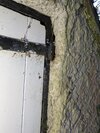
Let me clarify the point regarding the hinges because there might have been a misunderstanding. The hinges are attached to the door by a raised metal bar. When I open the door fully, there is no doorstop. The only way the door stops is when the raised metal bar from the hinges hits the pebbledash. My thoughts are because this contact point happens at a point close to the fulcrum, then it is high leverage and so therefore high force. Perhaps this is a possible cause for the crack?

If you look at picture number 3 in my first post you can see this contact.
 
When you sell a property you have to disclose cracks in walls and any repairs to those cracks. If it is subsidence, then there will be a problem when it comes to the sale as mortgage lenders are reluctant to loan money on a property with subsidence.
Hmmm thats not strictly true, if you use form TA6 then you can leave it blank and its up to the seller to decided if they want to get a survey on the solicitors advice, TA6 is not legally binding.. There is absolutely no compunction to disclose anything, you can sell a house as sold as seen and in a lot of older properties that will be the case. Have a quick look at zoopla and clock the number of grade 2 buildings being sold under the local price per sqm, why because the new owner inherits the problems and the price is adjusted appropriately.

In insurance cases the state of a building will be factor in a bit of the cost based on the condition report you give but mostly its contained in the excess, as I live in a grade 2 my excess for subsidence is 10k my sons new build is 1k.
 
I do get your point about the hinges. But there's no crack between the hinge and the ground. It hasn't detached a small lump of the building.

I'd put it another way... if the right-hand side of the building had a solid foundation, then do you think you could have pushed half of the building down into the ground just by opening the door and pushing it back really hard? The answer's no by the way!

Building movement almost always comes from below ground, not above.

The crack appears to be wider at the top than the bottom, because the chunk of building to the right of the door has sunk into the ground at its right corner, so it has tipped away from it. The door lintel and a bit of mortar obviously didn't hold back several tons of bricks obeying gravity so it cracked at its weakest point.

Have a dig, see what's holding it up. Also look at the other side of the same lean-to, see if that entire end is sinking or if there are fractures along that outer wall indicating that just its corner is sinking.

Definitely remove that conifer and anything similar within a few metres.
 
I do get your point about the hinges. But there's no crack between the hinge and the ground. It hasn't detached a small lump of the building.
Ok, let's explore this a little bit more. Firstly, the interior wall has a hairline crack, as opposed to a 5mm crack on the outside. My assumption is that the internal wall and external wall are likely to be connected. If so, why is there also not a similarly sized crack on the internal wall?

Secondly, I have enclosed the lower hinge image, where you can see the pebbledash has come away. Also, another image showing the crack going below the upper hinge.

I want to stress that I knew nothing about this stuff until I did lots of Q&A with AI.
 

Attachments

  • PXL_20250107_150947196-min.jpg
    PXL_20250107_150947196-min.jpg
    342.1 KB · Views: 53
  • PXL_20250107_150910403-min.jpg
    PXL_20250107_150910403-min.jpg
    474.1 KB · Views: 55
Perhaps just the render is falling away then. You'll be able to tell better than someone at the other end of the internet!

Try prising it off, see what happens. If it's loose it needs to come off, you can't glue it back on so you won't be doing any harm.
 
Surely the question is....is it still moving/cracking further? Glue some picture glass across the crack and monitor for 12 months
 
That just looks like water penetration and frost heave or mechanical expansion - ie rusty fixings expanding... see the black being washed out the block work... I would check the roof first.
 
I wouldnt worry about that crack one bit....just fill and forget...
 
Should the internal wall also have a similar sized crack if the building has moved?
You seem to be clutching at straws. The wall has definitely sunk, there's a blooming great crack in that tells you this!

Whether it's worth worrying about is another thing. But start by accepting it's moved.

As already stated, have a dig and see what's holding it up. If it has a decent footing then fill the crack and forget it. If not then it will need some work under it.

Remove the conifer!!!
 
You seem to be clutching at straws. The wall has definitely sunk, there's a blooming great crack in that tells you this!

Whether it's worth worrying about is another thing. But start by accepting it's moved.

As already stated, have a dig and see what's holding it up. If it has a decent footing then fill the crack and forget it. If not then it will need some work under it.

Remove the conifer!!!
I agree with removing the conifer and I understand you are convinced that the wall has definitely sunk. You may be right. However, I disagree with the clutching at straws statement.

What I am asking here is that if the external wall has sunk and cracked, why has the internal wall not done the same? My understanding is that this is probably a solid wall construction, and therefore acting as one-unit. If so, would not the internal wall have also cracked to the same degree?
 
There's a gap in the wall. Either that bit of the extension has gone to the right, or your entire house has moved to the left.

The internal wall is probably more flexible, perhaps the wood lintel hasn't gripped the mortar so has slid instead of cracking.
 
The internal wall is solid brick, so I am not sure how much flex there is in it. And because they are only hairline cracks on the internal wall, I cannot see any sliding.

One possibility I see is that when the door is opened, the raised metal bars hit the pebbledash. This, over time, has led to cracking. And instead of the cracking stopping at a certain point, it has spread upwards. And then the freeze thaw cycle due to water ingress has led to a widening of the crack.

On the other hard, because the crack is wider at the top, that suggests possible movement. And so does thd 5mm width of the crack at the top, and the close location of the trees, with possible root issues causing a foundation problem.

And they are not mutually exclusive. It could be that the door hinge mechanical force has created a crack, and there is also some downward pressure due to root issues from the trees. The existing crack then means less force is required for movement to occur.

This is all wild speculation on my part, and because of the ambiguity of the cause I may be forced to get a Chartered Structural Engineer in to do a specific defect survey in. The cheapest quote I got was about £550 + VAT. I hate to pay that sort of money but if I get issues when selling the house, it could prevent a sale and I am up against a deadline.
 
It sounds like you're only willing to believe what you want to believe.

If the render is attached to the building to the right of the door then that part of the building has moved relative to the rest, the evidence is the blooming great crack right through it.
 

If you need to find a tradesperson to get your job done, please try our local search below, or if you are doing it yourself you can find suppliers local to you.

Select the supplier or trade you require, enter your location to begin your search.


Are you a trade or supplier? You can create your listing free at DIYnot Local

 
Back
Top