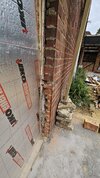
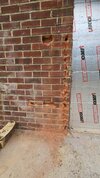
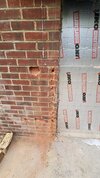
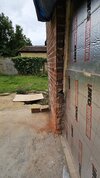
Damaged brickwork next to opening underneath a structural steel.

Joined
4 Feb 2023
Messages
247
Reaction score
8
Country
United Kingdom
I need to understand whether I should be repairing (if so how?) or taking out bricks that are damaged for replacement that are positioned close to the ground on the edge of the wall that meets the 2.4m wide opening below the 2.7m steel to make it ready for sliding patio doors (photos attached). The steel was installed 2 months ago but the plan back then was to build an extension so the external wall was planned to be patched and covered. The situation now is we will be installing just the patio doors therefore we need to repair the brickwork.

I need to repair/replace the bricks as they were drilled through for electrics in the past (demolished conservatory) and covered with a board. The bricks will now be on show.

I am a fairly skilled DIYer and wondering whether I can tackle this myself?
 

Attachments
  • WhatsApp Image 2024-07-24 at 22.12.54.jpeg
    WhatsApp Image 2024-07-24 at 22.12.54.jpeg
    389.9 KB · Views: 148
  • WhatsApp Image 2024-07-24 at 22.12.53 (2).jpeg
    WhatsApp Image 2024-07-24 at 22.12.53 (2).jpeg
    418.3 KB · Views: 146
  • WhatsApp Image 2024-07-24 at 22.12.53 (1).jpeg
    WhatsApp Image 2024-07-24 at 22.12.53 (1).jpeg
    422.7 KB · Views: 150
  • WhatsApp Image 2024-07-24 at 22.12.53.jpeg
    WhatsApp Image 2024-07-24 at 22.12.53.jpeg
    358.5 KB · Views: 162
Last edited:
Tricky one - I will let the experts answer but wont one big problem be that you will not find the same bricks to match the old ? Also to go removing bricks from a wall supporting an rsj :unsure: - is there anything above the opening - like the rest of your house or is it a single story.
The return face could be covered with upvc or an aluminium plate to match the doors and I wonder if it would look ok if you used a complete L shape profile peice of colour matched to the doors that also covered the front face on the left hand side (do the same on the right to match.which would only leave you 2 or 3 bricks to repair with something like Milliput Modelling Epoxy Putty, something I have used to repair brick work but only 22mm copper pipe holes..

 
Thank for a quick reply.

I have plenty of recovered bricks from the conservatory dwarf wall which were pretty closely matched.

There is a 2nd floor bedroom directly above so yes rest of the house unfortunately.

Just to add if it changes anything there is internal concrete lintel for the internal skin and external steel I beam for the external brick skin.

Thanks for the aluminium plate and milliput epoxy suggestions! I will take a look at that.
 
I am a fairly skilled DIYer and wondering whether I can tackle this myself?

Simplest/quickest - The L shape, above. You can easily stitch drill around the mortar, to remove and replace, that other damaged brick - no support needed to do that single damaged brick.

More involved - fit a length of timber under that RSJ, and support with acros, whilst you drill out the mortar, and remove all of those damaged bricks up the corner.
 
Instead of completely replacing the damaged bricks what about cutting some slips so you are basically making brick tiles and cement them in place. But I would only do this for the 3 on the left and would probably fill the bad ones with some sort of concrete repair and then cover with an aluminium L plate.
The next problem to over come is to try and match the colour of the mortar for your "slips" I have done a similar repair and did experiments with different mixes and let it dry to test and try and match the old mortar, I thought I had it right but its not perfect and drives me mad so at some stage I will scrape out and have a another go.
If you go with the L ideal at least you can get the doors in and secure and then take your time on sorting out the bricks and fitting the L.
 
Prop the beam, 300mm in, cut the bricks out with a disk saw or if the mortar is soft a tungsten tipped hand saw, and tooth the new bricks in.
 
On the matching brick front, I have particular bricks that you cannot find so when someone locally has some building work involving removing bricks I check the skip for bricks the same as my house and rescue them for future use. :LOL: ( after asking )
 
On the matching brick front, I have particular bricks that you cannot find so when someone locally has some building work involving removing bricks I check the skip for bricks the same as my house and rescue them for future use. :LOL: ( after asking )

That's what I do/did, including roof tiles. I have a stack of each, at the back, that have come in handy over the years - most recently, earlier this year, when I had 100+ roof tiles replaced. Saves a lot of time, if the materials are ready and on site, rather than a roofer chasing around reclaim yards to find a match.
 
Thank you all for your replies.

What would be a rough estimate for someone doing it as I am considering all options. I am based in Surrey.
 
Easy DIY job. You seem to have an adequate prop on hand - little load on the outer skin and it will triangulate out (obviously replace outer ones first). Make sure you fully fill the joints when replacing the bricks, a thin "finger trowel" will be useful - it can be a slow task when not used to it, and clear out any excess mortar that falls into the cavity. Make sure you reinstate whatever cavity closer is there.

Screenshot_20240726-152332~2.png
 
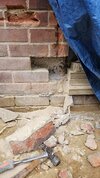
I've started taking bricks one by one from the bottom up. I have propped the steel with two 6 x 2 on left side and one 6 x 2 on the right side.

Do you think I can take the whole lot of the damaged bricks which is until half the height of the bearing? I am not touching the damaged bricks further away from the opening.
 

Attachments

  • WhatsApp Image 2024-10-06 at 16.18.32.jpeg
    WhatsApp Image 2024-10-06 at 16.18.32.jpeg
    454.9 KB · Views: 58
Ok I got all of the damaged bricks removed.

Is Blue Circle Natural Hydraulic Lime 3.5 25kg a right product to use knowing it is a load bearing wall?

If so how do you mix it with sharp sand - what ratio?

How do you approach laying the bricks? Apologies if this is a silly question - it will be my first try.
 
Use this:

Screenshot_20241012-095017.png


If you haven't got them you'll need a pointing trowel, finger trowel and jointer.

Mix small amounts of mortar. For the ones you are inserting, lay a bed, try to smear some mortar on the end and top of the brick but don't worry too much about it - the bed needs to be thick enough for you to push/gently tap the brick down so it's level along it's length, at the correct height and the face is plumb. Use your finger trowel (get one thin enough) to push mortar in to the joints to fully fill them, leave it to firm up a bit then joint it - rub mortar into the joints with your jointer - try to match the existing as best you can. Leave it a bit and brush off as much of the mess as you can with a soft brush - again don't worry - you can clean it later with brick acid if needed. If you feel mortar is being pushed into the cavity slide a temporary piece of cardboard in to contain it.
 
For the ones you are inserting, lay a bed, try to smear some mortar on the end and top of the brick but don't worry too much about it - the bed needs to be thick enough for you to push/gently tap the brick down so it's level along it's length, at the correct height and the face is plumb.

I find it useful, to use dowels/rods or whatever I can find, which is a similar diameter to the mortar gap. Place those, then slide the brick on top, pushing mortar in around the brick, once filled, pull the dowels out, and fill the gap they leave.
 

If you need to find a tradesperson to get your job done, please try our local search below, or if you are doing it yourself you can find suppliers local to you.

Select the supplier or trade you require, enter your location to begin your search.


Are you a trade or supplier? You can create your listing free at DIYnot Local

 
Back
Top