
Dodgy TT

Joined
11 Jan 2004
Messages
46,011
Reaction score
3,568
Country
United Kingdom
I cannot remember ever sharing these pix...They have been buried in a memory card lost for a while.

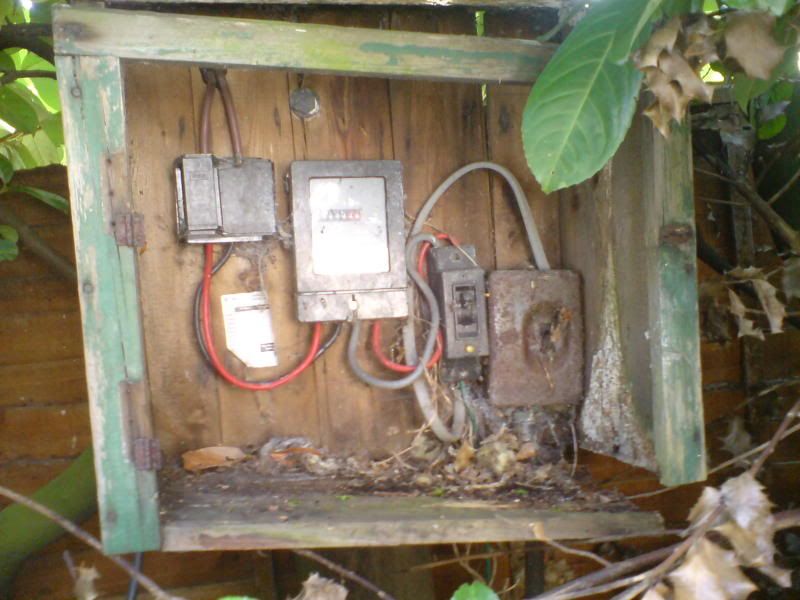
The picture is of a TT supply feeding a bit of armoured to a static 'van.
600.jpg


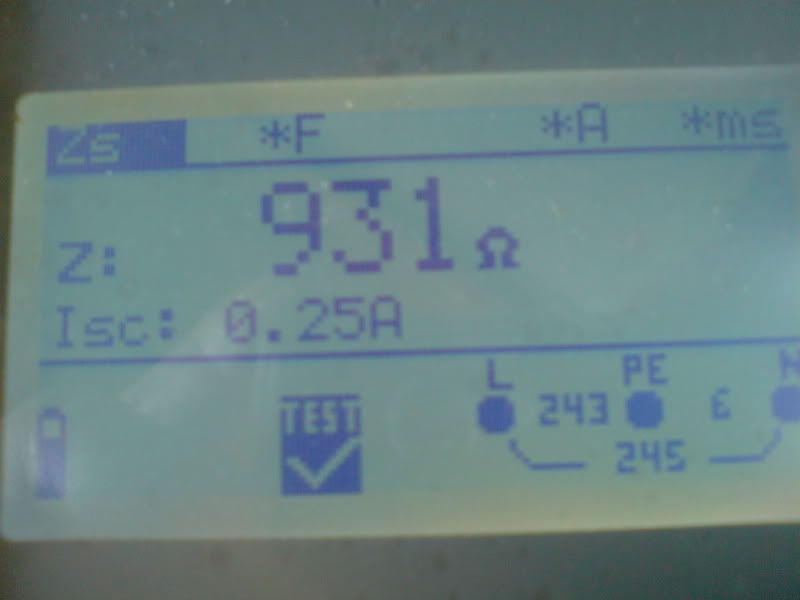
And this is the lowest Zs I could find, at a socket outlet.
601.jpg


It was reported to Manweb at the time, but unfortunately we could not obtain an update on what happened.
 
And this is the lowest Zs I could find, at a socket outlet.
Did you follow that earthing conductor to see where it goes (if anywhere?) - a 3 inch nail 'earth electrode', perhaps?

Mind you, if that is a VO ELCB and if it's actually properly connected to the SWA/circuits (can't really see), if you measured with the setup 'as is', your Zs reading would include the ELCB coil (which ISTR could be around 300Ω), wouldn't it? - although still nothing like enough to explain your reading.

Kind Regards, John.
 
Why was it reported to manweb and nothing else done?

An earth rod and RCD would be a start! Would would manweb do?
 
I'm trying to figure out why you would report it to the supplier at all, unless you discovered that the high loop impedance was caused by a fault on the live supply conductor? (Which I assume was not the case as that would have caused equipment to stop working properly.)

If that's the case, then it still leaves best part of 400 missing ohms to explain.

The E50 breakers were specified for use with an earth electrode resistance of up to 500 ohms anyway, so in fact that reading is within the design parameters of the ELCB, even though I'd agree that it might be a good idea to investigate further to see if it's a badly deteriorating earth connection/electrode which is only going to get worse.
 
I'm trying to figure out why you would report it to the supplier at all, unless you discovered that the high loop impedance was caused by a fault on the live supply conductor? (Which I assume was not the case as that would have caused equipment to stop working properly.)
I wonder if it was, perhaps, the exposed-to-the-elements supply head and meter that was being reported, rather than the earthing?

If that's the case, then it still leaves best part of 400 missing ohms to explain.
The E50 breakers were specified for use with an earth electrode resistance of up to 500 ohms anyway, so in fact that reading is within the design parameters of the ELCB, even though I'd agree that it might be a good idea to investigate further to see if it's a badly deteriorating earth connection/electrode which is only going to get worse.
Fair enough - but earth electrodes are meant to be under 200Ω and, in practice, should really be (and usually are) under 100Ω, so I would be very concerned (as you say, particularly with the future in mind) if it were 400Ω+.

Kind Regards, John.
 
I wonder if it was, perhaps, the exposed-to-the-elements supply head and meter that was being reported, rather than the earthing?

Ah, could be. I was taking the comment as referring to reporting the high loop impedance.

Fair enough - but earth electrodes are meant to be under 200Ω and, in practice, should really be (and usually are) under 100Ω, so I would be very concerned (as you say, particularly with the future in mind) if it were 400Ω+.

No disagreement there, especially given the overall poor state of the equipment. In fact given that the ELCB had, presumably, been fairly exposed to elements by the time this picture was taken, it could even be something like corrosion on the contacts inside. Remember that the coil connects to the "F" terminal (and thus the installation earth) via the test button, so any bad contact there could have an effect. Or, of course, it could be a high-resistance connection somewhere else in that well-weathered apparatus.
 
I left my paperwork with the owner of the static on the day.

I also rang Manweb and asked them to check their equipment for safety.

What I would like to do is go back and take a picture after their visit, but I'm not sure if I can get back.
Did you ever get to go back?
 
If that's the case, then it still leaves best part of 400 missing ohms to explain.
The E50 breakers were specified for use with an earth electrode resistance of up to 500 ohms anyway, so in fact that reading is within the design parameters of the ELCB, even though I'd agree that it might be a good idea to investigate further to see if it's a badly deteriorating earth connection/electrode which is only going to get worse.
Fair enough - but earth electrodes are meant to be under 200Ω and, in practice, should really be (and usually are) under 100Ω, so I would be very concerned (as you say, particularly with the future in mind) if it were 400Ω+.


True but then why do we put (for a30mA rcd) max permitted zs 1667 ohms. I know it's to do with the max 50v touch voltage bug seems odd technically it can be much higher than 200 ohms...
Kind Regards, John.[/quote]
 
True but then why do we put (for a30mA rcd) max permitted zs 1667 ohms. I know it's to do with the max 50v touch voltage bug seems odd technically it can be much higher than 200 ohms...
Yes, it can still be as high as 1667&#937; and still allow a 30mA RCD to operate at a touch voltage of 50V. However, I think the point is that as it is so relatively easy to get <100&#937; with a simple TT electrode, that if the Zs is much higher than that, it suggests there is something very iffy about the earth electrode/connection, with the consequent liklihood that it may well deteriorate to unacceptable levels in the future. Furthermore with lower Zs, the RCD will operate at much lower touch voltages than 50V, which is no bad thing!

Kind Regards, John.
 
It can in theory be as high as 1666.666&#937; and upto this impedence the RCD wil disconnect before the touch voltage exceeds 50V.

The only reason for the 200&#937; / 100&#937; maximum values is to ensure reliability of connection of the rod(s) as ground conditions change etc.
 
And, as I seem to recall being discussed briefly some weeks ago, the specified 500-ohm maximum electrode resistance figure for the old Crabtree E50 already incorporated a fair margin to allow for deterioration.

But I agree that in any other than exceptional locations a much lower figure should be easily attainable.
 

If you need to find a tradesperson to get your job done, please try our local search below, or if you are doing it yourself you can find suppliers local to you.

Select the supplier or trade you require, enter your location to begin your search.


Are you a trade or supplier? You can create your listing free at DIYnot Local

 
Back
Top