I am a former electrician, though not certificated any more. Nevertheless, I still do my own electrical work at home. I am considering air-conditioning and would like to install the power supply to the outside wall, for a single Mitsubishi MXZ-2F53VF condenser unit with 2 internal (cooling) units. But the air-con companies I've spoken to cannot seem to distinguish between cooling capacity (5.3kW) and electrical input, which is fractional compared to the cooling capacity. They say it will need a separate 20 Amp supply, whereas I cannot see why I cannot feed it from my ring main, via a suitable isolating switch. And they talk about a rotary isolator, which seems a bit antiquated and unnecessary to me. Does anyone here have experience of this, particularly whether the unit can be spurred of the ring main?

You are using an out of date browser. It may not display this or other websites correctly.
You should upgrade or use an alternative browser.
You should upgrade or use an alternative browser.
Domestic Aircon power supply
- Thread starter DIYjobber
- Start date

They say it will need a separate 20 Amp supply, whereas I cannot see why I cannot feed it from my ring main, via a suitable isolating switch. And they talk about a rotary isolator, which seems a bit antiquated and unnecessary to me. Does anyone here have experience of this, particularly whether the unit can be spurred of the ring main?
It seems sensible, that it should be on its own 20amp supply, to cover the startup current. The rotary isolator is normally fitted, and adjacent to the outdoor unit to allow it to be isolated to work on.

- Joined
- 27 Jan 2008
- Messages
- 29,557
- Reaction score
- 3,638
- Location
- Llanfair Caereinion, Nr Welshpool
- Country

Inverter drives have reduced the start load, but until you know the start load, there is no answer.
It's all a bit woolly, but the manual says the max current is 12.2 Amps.Inverter drives have reduced the start load, but until you know the start load, there is no answer.
I understand the need for an isolator, just cannot understand why it needs to be a rotary isolator.It seems sensible, that it should be on its own 20amp supply, to cover the startup current. The rotary isolator is normally fitted, and adjacent to the outdoor unit to allow it to be isolated to work on.
It's all a bit woolly, but the manual says the max current is 12.2 Amps.
I understand the need for an isolator, just cannot understand why it needs to be a rotary isolator.
You wouldn't want that sort of load, constantly loading your ring.
The rotary isolator, is a grey, plastic cased unit, with a bright red knob, and a clear yellow on/off markings, beloved of AC engineers.
It's max, not constant. Running current will be considerably lower. The ring can carry 30A. I don't see the problem, but that's why I'm asking.You wouldn't want that sort of load, constantly loading your ring.
- Joined
- 27 Jan 2008
- Messages
- 29,557
- Reaction score
- 3,638
- Location
- Llanfair Caereinion, Nr Welshpool
- Country
The ring can carry 30A. I don't see the problem, but that's why I'm asking.
Any static item i.e. over 18 kg and not on wheels, using 2 kW or over, should be on a dedicated circuit.The load current in any part of the circuit should be unlikely to exceed for long periods the current-carrying capacity of the cable (Regulation 433.1.5 refers). This can generally be achieved by:
(iii) connecting cookers, ovens and hobs with a rated power exceeding 2 kW on their own dedicated radial circuit
It is rare the manufacturers will state the inrush, but they will normally tell you the size of supply required, which is a good indexation of the inrush.
134.1.1 Good workmanship by competent persons or persons under their supervision and proper materials shall be used in the erection of the electrical installation. Electrical equipment shall be installed in accordance with the instructions provided by the manufacturer of the equipment.
Yes, in some cases we can see they have used cut and paste from some other product. For example, instructions for a 20 volt battery angle grinder says "If operating a power tool in a damp location is unavoidable, use a residual current device (RCD) protected supply.
Use of an RCD reduces the risk of electric shock." clearly nothing to do with the angle grinder, they are not supplied with battery or battery charger, these are bought separately.
Isolators should switch off by moving the lever down, if lever type. Many switched FCU down is on, so you need a isolator in a box of some type, and also needs provision to lock it off, so when we compare
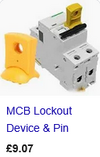
Also the £13.99 isolator is wrong colour, needs to be red and yellow.
I accept that, but once again there is confusion between cooling/heating capacity and electrical capacity. The dual unit I am looking at is a Mitsubishi MXZ-2F53VF (or similar) which is rated for cooling/heating at 5.3kW, but the electrical loading is just 1.4kW, or 1.56kW if used for heating. I could have 2 x 3kW appliances on a twin socket on a ring main if I wanted to. The manufacturers specify a 16A breaker. I am trying to figure out whether I can install a spur from the ring with a dedicated waterproof 16A MCB for the A/C unit. Not ideal, I grant you, but it will cope with the starting current, it will provide good discrimination with the 32A MCB protecting the ring circuit, the running current will only be around 6A, and it has the "off" position facing downwards. The alternative is no A/C, as access for a new circuit to the consumer unit is just not practicable.Any static item i.e. over 18 kg and not on wheels, using 2 kW or over, should be on a dedicated circuit.
The alternative is no A/C, as access for a new circuit to the consumer unit is just not practicable.
The choice, is of course your own, but the general advice is that fixed appliances generally, and certainly nothing larger than around a 2Kw fixed appliance load, should be not be run on a ring main circuit. A ring main circuit is basically designed to allow portable appliances to be plugged in temporarily.
Last edited:
Do you mean "should NOT be run".the general advice is that fixed appliances generally, and certainly nothing larger than around a 2Kw fixed appliance load, should be run on a ring main circuit.
Knowing me, I'm probably talking Bow Locks but at 1.4kW would this be suitable for a ring final (assuming the startup current ain't too bad).
Do you mean "should NOT be run".
Knowing me, I'm probably talking Bow Locks but at 1.4kW would this be suitable for a ring final (assuming the startup current ain't too bad).
Yes, now corrected, thanks!
- Joined
- 27 Jan 2008
- Messages
- 29,557
- Reaction score
- 3,638
- Location
- Llanfair Caereinion, Nr Welshpool
- Country
Is it? I was led to understand it was to allow electrical heating of homes as WWII, the original used around 2.9 mm² cable, and no wasting on the live pins for extra insulation, and fused to 30 amps not 32 amps, so the original has been downgraded. But since originally designed for heating, although not all rooms at the same time, hard to say it should not be used for heating any more.A ring main circuit is basically designed to allow portable appliances to be plugged in temporarily.
But "Electrical equipment shall be installed in accordance with the instructions provided by the manufacturer of the equipment." and if they get it wrong, we need some very good evidence to show the instructions are in error. As an electrical engineer maybe I can show I have the expertise to counter the manufacturers instructions, as an electrician not so sure, in the main down to insurance, professional indemnity insurance will be required to counter and manufacturers instructions.

Only if it's intended function is an emergency stop - which it certainly won't be for an aircon unit or most of the other applications they are used for.needs to be red and yellow.
Is it? I was led to understand it was to allow electrical heating of homes as WWII, the original used around 2.9 mm² cable, and no wasting on the live pins for extra insulation, and fused to 30 amps not 32 amps, so the original has been downgraded.
That, was before the days of fridges, freezers, microwaves, TV's, entertainment systems, various chargers, and perhaps a heater etc., all plugged into the ring main circuit. Nobody, post WWII, would be able to afford to max out the ring main, using heaters, so that in itself, limited the loading.

DIYnot Local
Staff member
If you need to find a tradesperson to get your job done, please try our local search below, or if you are doing it yourself you can find suppliers local to you.
Select the supplier or trade you require, enter your location to begin your search.
Please select a service and enter a location to continue...
Are you a trade or supplier? You can create your listing free at DIYnot Local
Similar threads

- Replies
- 25
- Views
- 20K


